Castro Photos Brought
Fame, Forced Exile
BY WILFREDO CANCIO ISLA,
El Nuevo Herald
Ignoring official
warnings and counsel
from colleagues, Cuban
news photographer
Cristóbal Herrera
Ulashkevich showed the
world embarrassing
photos of Fidel Castro
out of professional
pride, he says.
As a freelance
photographer for The
Associated Press in
Havana, Herrera captured
two crucial images of
Castro's health slide:
his fainting spell while
making a speech in 2001
and his dramatic fall
after another speech in
October 2004.
The two sets of photos
appeared in media around
the world, boosting
Herrera's professional
standing but also
putting him on the road
to forced exile in Costa
Rica -- because security
forces did not like his
images.
''I am condemned to
forced exile,'' Herrera,
36, told El Nuevo
Herald. ``The Cuban
government barred me
from returning to my
country, without
explanations.''
''We had no other option
left,'' he said. ``This
is the price for doing
photojournalism in
Cuba.''
Herrera, his wife and
2-year-old daughter left
Costa Rica this spring
and crossed the Mexico-U.S.
border. They arrived in
Miami in May, looking
for a better life.
Herrera once worked as a
photographer for Cuba's
Bohemia magazine, and
the AP later hired him
as a freelancer in
Havana. His first
assignment was the Elián
González case, and he
was later designated to
cover Fidel Castro's
public appearances.
That's what he was doing
June 23, 2001, as Castro
delivered a speech in El
Cotorro under a
scorching sun. He
noticed that after three
hours of speaking Castro
was turning red and
sweating profusely, and
he snapped the instant
he fainted.
OTHERS MISSED OUT
Most photographers there
missed the shot. Herrera
says another
photographer there urged
him not to send his
photos abroad ``for the
good of his family.''
State security agents
approached him as he
left the site and also
urged him not to
transmit the photos to
AP headquarters in New
York, Herrera said. But
he refused. ''It was a
very tense moment,'' he
recalled. ``In the
majority of cases the
correspondents bow and
follow the
recommendations of the
security people. But on
this occasion they found
a half-crazy and
romantic youth, with
more professional pride
than common sense.''
Luckily, he had
transferred five of the
fainting photos from his
digital camera to his
laptop, he says. When he
got to the AP office in
Havana, he
''mysteriously'' lost
about 600 other photos
he had snapped that day.
''When I transmitted the
photo I told the AP
people in New York that
if something happened
they should find me a
job in Serbia or
Afghanistan,'' he said.
From that moment on, the
international media
began following the aged
Castro's steps more
closely. And the Cuban
leader's personal
security detail began
tightening controls on
foreign correspondents.
Live TV broadcasts of
Castro's events were put
on a 10-second delay, to
be able to edit out
embarrassing moments.
INJURED IN FALL
Then came Castro's fall
just after a speech in
2004, which left him
with a shattered kneecap
and broken arm.
''Most of the
photographers had left
to transmit their images
as soon as the speech
ended,'' Herrera said.
But he had stayed and
caught Castro's fall,
along with two other
photographers. One was a
veteran photographer in
the official news media.
The second, a
photographer with a
foreign news agency,
consulted with the
security agents at the
event and opted not to
publish them, he added.
''The security agents
jumped on me, but I told
them what I had was out
of focus, nothing
good,'' Herrera
recalled. ``I didn't
move from there to avoid
raising suspicions, then
on the way out I managed
to transmit from the
laptop in some bushes .
. . [another
photographer] protected
me by pretending that he
was urinating.''
Government officials who
handle the foreign media
banned him from covering
further high-profile
events, Herrera said.
And his criticism of the
Cuban system grew. ``I
couldn't stand Fidel
Castro or [Venezuelan
President] Hugo Chávez;
their speeches sounded
to me like mocking the
intelligence of the
people. And watching
[Foreign Minister
Felipe] Pérez Roque was
like attending the
performance of a lying
clown.''
PAPERWORK DONE
One morning in December
2004, two men approached
him on the street and
suggested he should take
a vacation abroad,
Herrera said.
''It was clear that [the
government] didn't want
me there and that I had
no alternative but to
leave,'' he said. ``The
paperwork and the red
tape were processed at
once, which clearly told
me where the order came
from.''
Herrera and his wife
went to Costa Rica on
Dec. 23, 2004, and he
began working as an AP
photographer for Central
America and the
Caribbean until March
2005, when he tried to
return to Havana to fill
an AP job slot that had
opened.
But the Cuban government
refused to issue him the
permit he needed to
return to Havana, he
said. His daughter was
born in Costa Rica.
Herrera now has a photo
project in hand that
could again anger the
Cuban government, a
collection of about 600
photos from daily life
in Cuba, titled Hard
Cuba, that underline
conditions on the
island.
''It is an attempt to
demonstrate the
surrealistic nature of
communism in Cuba,''
Herrera said. ``It is
not only a professional
ambition but also a
personal effort to
understand my roots and
the attitude of my
parents, a Cuban father
and a Russian mother who
live in Cuba and
continue to defend
communist ideas,
although to different
degrees.'' |
|
|
|
|
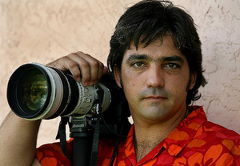
Cuban photographer
Cristobal Herrera arrived in the United States this year
by way of Costa Rica via the Mexican border. He is the
AP photographer stationed in Cuba who photographed Fidel
Castro's fall during a speech in 2001 and his subsequent
fall in Santa Clara in 2004. |
|
|
| |
|


