Panama Weighs Debt and
Threat of Noriega
By Marc Lacey, New York
Times
If Manuel Noriega, the
deposed dictator, ever
returns to Panama,
Winston Spadafora, a
justice on the country’s
Supreme Court, has a
question for him.
“I’d like to ask him,”
Justice Spadafora said
in a recent interview in
his chambers, “what he
did with my brother’s
head.”
Panama has unfinished
business with Mr.
Noriega, who was taken
from here in January
1990 after the American
military invaded. There
are criminal convictions
against him, including
one for the beheading of
Justice Spadafora’s
brother, Hugo, a leading
opposition figure, in
1985. And there is a
sense among the
population that despite
his years in prison in
the United States, he
has not fully paid for
all the rough years he
put everyone here
through.
Still, as his long
prison sentence in Miami
nears an end (he is
scheduled to be released
Sept. 9), there are
mixed feelings in Panama
about his possible
return, and some relief
that the United States
is trying to send him to
France, where he has
been convicted of using
illegal drug profits to
buy property worth more
than $3 million.
The diminutive Mr.
Noriega appeared in
federal court in Miami
on July 26, his hair
dyed black, his military
uniform neatly pressed
under a bulky black coat
and his bearing still
ramrod straight, at
least for a
septuagenarian former
general. “Manuel Antonio
Noriega,” he said in a
deep voice when the
magistrate handling the
United States
government’s extradition
request, William C.
Turnoff, asked his name.
Mr. Noriega’s lawyers
are fighting for him to
go to Panama, not
France, insisting that
the Geneva Conventions
mandate that as a
prisoner of war he be
sent back to his
country.
The issue remains
unresolved. But many say
that Mr. Noriega,
despite 17 years away
and his country’s best
efforts to forget him,
continues to cast a
shadow over Panama.
Some Norieguistas, as
his former cronies are
called, hold positions
in the government, which
is controlled by the
same Democratic
Revolutionary Party that
Mr. Noriega used to run.
One of them, Benjamin
Colamarco, who used to
run the Dignity
Battalions, the
paramilitary outfit that
cracked down on
dissenters, is now the
minister of public
works.
Mr. Noriega’s numerous
homes and other
properties, seized years
ago by the government
but never sold, lie in
ruins. In one ramshackle
home in the capital,
looted and overrun by
rodents, a small sign on
the gate says “Noriega.”
Unlike Chileans, who
have fought hard to have
their former dictator,
Augusto Pinochet, return
from overseas to face
justice, Panamanians
appear more ambivalent
about whether Mr.
Noriega ought to spend
time in local detention.
“If he comes back,
plenty of people are
going to use his return
for their own interest,”
said Miguel Antonio
Bernal, a constitutional
law professor and
opposition leader who
clashed with Mr.
Noriega’s government.
“Those who believe in
him will go to the
airport to meet him.
Those who hate him will
protest. And some people
will fear that he will
open his mouth and tell
all that he knows.”
Samuel Lewis Navarro,
Panama’s foreign
minister and the son of
one of Mr. Noriega’s
biggest foes, regards
the jailed former
general as a historical
figure even though he
still lives. “The
Panamanian people today
recognize that period of
our history as a very
sad, very unfortunate
period,” he said. “But
they have overcome it
with a forward-looking
vision.”
As for Mr. Noriega
somehow returning to
Panamanian politics,
something his lawyers
say he is not
contemplating, Mr.
Lewis, who also serves
as vice president, said
flatly, “The political
relevance of Noriega in
Panama is none.”
In many ways, Panama is
not the same place it
was when Mr. Noriega
walked out of the
Vatican Embassy and into
the hands of the
American soldiers who
took him to Miami to be
tried on drug
trafficking charges.
Skyscrapers and
construction cranes now
dot the skyline of the
capital. The economic
sanctions that the
United States imposed in
the 1980s to protest Mr.
Noriega’s rule were long
ago lifted, and Panama’s
economy is now bursting
at the seams, second in
this part of the world
only to Brazil’s.
The military that Mr.
Noriega used to lead has
been disbanded, deemed
nonessential for the new
Panama. When Mr. Noriega
dons his uniform, as he
did in court this week,
he is the general of an
army of one.
Various Panamanian
governments have
requested the
extradition of Mr.
Noriega since as far
back as 1991. The first
extradition request, in
fact, was signed by
Julio E. Berríos, who
worked at the Foreign
Ministry at the time but
is now one of Mr.
Noriega’s local defense
counsels. Still, despite
the long-standing
extradition effort,
there has been no
full-court press by
President Martin
Torrijos to get Mr.
Noriega home.
“We’re following it very
closely,” said Mr.
Lewis, describing the
extradition as an
American legal matter.
“That’s as much as we
can do.”
Frank Rubino, one of Mr.
Noriega’s lawyers, put
it differently. “They’re
hiding in the
background, letting
France have their
citizen,” he said of
Panamanian officials.
Besides the killing of
Mr. Spadafora, Mr.
Noriega has been
convicted of the 1989
killings of a group of
army officers who tried
to overthrow him,
including Maj. Moisés
Giroldi. Mr. Noriega
also has been convicted
of corruption and
kidnapping.
“As military regimes go,
Noriega’s was a
relatively benign one,”
acknowledged an official
in the current Bush
administration who was
involved in American
policy in Panama before
the invasion ordered by
the first President Bush
in December 1989. “They
didn’t kill that many
people. They didn’t
torture that many
people. But that’s
comparing them with the
very worst.”
American officials say
that in most cases
deposed leaders should
pay for their crimes in
the country where they
committed their wrongs.
But in the case of Mr.
Noriega, officials
acknowledge that his
presence in Panama would
probably disrupt the
country’s progress.
Washington’s current
plan is for Mr. Noriega
to go to France, where
he could spend a decade
in prison, and then go
to Panama, if he is
still alive.
The problem is that for
all the changes in
Panama, Mr. Noriega
would return to a
country with some of the
same dysfunctions as the
one he left. The
judiciary, for instance,
is considered corrupt
from the Supreme Court
on down, and recent
changes in the penal
code make it possible
that Mr. Noriega would
not spend much, if any,
time behind bars.
In a few years, Mr.
Noriega, who said in
court recently that he
was 72, could take
advantage of a new
provision mandating
house arrest for those
older than 75. He could
demand a new trial
because he was not in
the country to defend
himself. He could claim
illness, as Rafael
Arosemena, a bank
president in Mr.
Noriega’s time, did
recently. That action
enabled Mr. Arosemenato
to return from exile in
Mexico and serve his
corruption sentence at
home.
“He should not serve a
day in jail,” said Mr.
Berríos, one of Mr.
Noriega’s Panamanian
lawyers, referring to
the convictions in
absentia as patently
unfair.
In discussing Mr.
Noriega, some
Panamanians
instinctively seem to
slip back in habits of
the past, when
criticizing him openly
was dangerous. A waiter
at a trendy restaurant
in the old section of
the capital, his voice
falling to a whisper,
said he had an ashtray
in his home that was
looted from one of the
former general’s
residences. “Noriega
smoked cigars and I
always think about all
the awful things he was
planning as he and his
friends put out their
cigars in that ashtray,”
he said, insisting that
his name not be printed
just in case Mr. Noriega
returned home.
A former neighbor
recalled all the noise
that Mr. Noriega’s
peacocks used to make in
the neighborhood and how
she and others would
grumble about how, if
they ever caught one of
the birds, they would
make peacock sancocho,
which is a popular
Panamanian stew.
“There was a lot less
crime when he lived
here,” the neighbor
acknowledged, also
insisting on anonymity
in case Mr. Noriega
became a neighbor again.
“That was because of all
the soldiers around.
There was less crime but
everybody still lived in
fear of the soldiers.”
Not everybody. Mr.
Noriega had many
backers, and a few are
rearing their heads.
Sipping a rum drink
recently as the sun went
down on the Caribbean
coast of Panama, Elvia
Gayle recalled her dear
friend Manuel, a tough
man, she admits, but one
who had cared about poor
Panamanians like her.
“I’m not saying he was
good,” said Ms. Gayle,
who was a member of a
pro-Noriega security
battalion. “But I was
his friend and I saw he
was a man who could
cry.”
She also has something
to say to Mr. Noriega
upon his return. “I will
hug him and tell him how
much I missed him,” she
said. “I will be at the
airport when he comes
back even if I’m the
only one. I know I won’t
be alone, though.”
Probably not. But also
there would probably be
his many detractors.
“I don’t think we
Panamanians would try to
kill him,” Mr. Bernal
said. “But he wouldn’t
have a nice time here.
There would be plenty of
people yelling at him,
telling him what they
think of him. He would
wish he were back in
Miami.” |
|
|
|
|
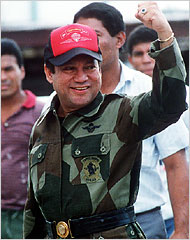
In October 1989, Gen.
Manuel Noriega was in charge in Panama, but within
months he was ousted, and then tried and imprisoned.
|
|
|
| |
|


