Why Mexico struggles to confront its dark past
By Monica Campbell | Contributor to The Christian Science
Monitor
MEXICO CITY – When President Vicente Fox took office in 2000, he ousted
the authoritarian Institutional Revolutionary Party (PRI) and pledged to
go after the politicians and military brass responsible for the killings
of hundreds of dissidents during the party's 71-year rule.
In 2002 Mr. Fox was applauded for opening secret security files that
would give prosecutors the legal firepower to implicate historically
untouchable leaders of Mexico's "dirty war" era of the 1970s and 1980s,
when the government practiced systematic abuses against dissident
groups. Human rights workers say the documents make clear the abuses
committed under previous governments.
But when a judge threw out an arrest order Saturday against former
President Luis Echeverría, known for his notorious role in the dirty
war, it underscored the difficulty Mexico has had in coming to terms
with its dark past - unlike some other Latin American countries.
|
|
|
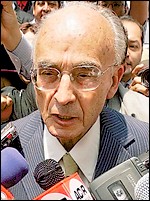
OFF THE HOOK?
Former President
Luis Echeverría.
DANIEL AGUILAR
/REUTERS/FILE
|
Just days earlier, human rights advocates had been praising
Ignacio Carrillo Prieto, the government's dirty-war prosecutor, for
bringing murder charges against Mr. Echeverría, the first president
in Mexico's modern history to face criminal indictments. Mr.
Carrillo's indictment alleges that Echeverría ordered
military-trained thugs, known as the Falcons, to attack student
marchers in Mexico City while he was president in 1971. At least 25
protesters were killed in the crackdown.
But the judge, Julio César Flores, threw out the charges, arguing
that the 82-year-old Echeverría cannot be bound to a massacre that
occurred 33 years ago given Mexico's 30-year statute of limitations.
Trusting Mexico's antiquated and corrupt judicial system with
high-level cases like Echeverría's was a miscalculation, say
analysts. In a February statement, New York-based Human Rights Watch
warned Fox that if the special prosecutor's office did not receive
more money and administrative support, its efforts could buckle
under the weight of the dirty-war caseload.
Meanwhile, the Fox administration has decided against
recommendations from local and international human rights groups to
create a truth commission to examine past abuses. Other Latin
American countries, like Argentina, Chile, Peru, and Guatemala, all
hit with heavy doses of violent state-sponsored political repression
during the cold war, established truth commissions that Human Rights
Watch claims "have played a crucial role in improving the
judiciary's capacity to handle human rights cases."
Government officials close to the special prosecutor's office say
Fox backed away from the truth commission idea, seeing it as too
controversial for the PRI to support. This has left much up to
Carrillo, who says he will appeal Saturday's decision this week.
His legal tactic for going after the ex-president, along with 11
other high-ranking officials, was to charge them with genocide in
the 1971 massacre. Some legal experts say that the genocide count,
defined by Mexican law as "systematic crimes against the lives of
members of any national group," is an attempt to catapult the
special prosecutor's cases to Mexico's Supreme Court or the
Inter-American Court of Human Rights, based in Costa Rica.
But the tactic could backfire if the evidence against Echeverría and
others falls short of genocide. "This case is about a group of
demonstrators and protesters and members of a left-wing group," says
George Grayson, a Mexico scholar at William & Mary College in
Williamsburg, Va. "What happened in 1971 in Mexico is not comparable
with the Holocaust."
Kate Doyle, a senior Mexico analyst for the National Security
Archive, a private research institute based in Washington, questions
the prosecutor's approach. "The decision to base this case on
genocide seems to be a very dangerous legal style," she says. "It
can be called wildly ambitious or downright irresponsible."
However, Ulises Beltrán, a political scientist at the Center for
Economic Research and Teaching, a Mexico City think tank, sees the
legal wrangling as a sign of the country's democratic transition.
"We have to respect the rule of law, even if we're not happy with
the outcome," he says. "The legal system must run its course."
Joel Ortega, a Mexican human rights activist who witnessed the 1971
massacre, says: "Mexico has made a big deal about ratifying every
international human rights accord out there. Why don't we follow the
same codes at home?"
With barely two years left in Fox's term, it is doubtful that his
legacy will include a meaningful correction of Mexico's faulty human
rights record as long as PRI politicians control Congress. The
president needs the PRI if he is to advance any of his reforms, and
PRI politicians threaten to block Fox's every legislative move if
the special prosecutor continues his work.
Polls show that Mexicans support punishing those responsible for the
abuses of human rights during the dirty war. But some wonder whether
Fox is slaying the wrong dragon. "Is it better to go after a tired,
sick 82-year-old ex-president or should the energy be focused on
solving the murders of women in Juarez, or the drug cartels, or
crime that is taking place today?" asks Mr. Grayson.
|


