
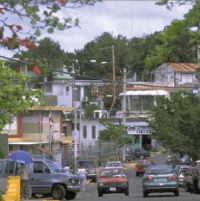
Downtown Isabel Segunda, capital of
the Puerto Rican island municipality
of Vieques.
|
 |
PUERTO RICO
From bombs to
eco-tourism
By Larry Luxner
A year after US Navy’s exit, Vieques tourism is booming.
Since the early days of World War II, the U.S. Navy had used Puerto Rico’s
offshore island municipality of Vieques as target practice, turning two-thirds
of its territory into a vast artillery and bombing range.
But few people here were happy about it, and after years of protests, the
island’s 9,300 people were successful in getting the Navy to pack its bags and
sail into the sunset. On May 1, 2003, an enormous fiesta erupted when, for the
first time in 60 years, local viequenses could visit once-forbidden beaches and
reclaim the 135-square-kilometer (52-square-mile) island for themselves.
One year later, things have quieted down a lot. Deprived of its favorite bombing
range, the Navy has even shut its enormous Roosevelt Roads Air Station on the
main island of Puerto Rico. Cable News Network (CNN) has left, the Rev. Jesse
Jackson has stopped making speeches here and Vieques no longer gets mentioned on
the nightly news — or anywhere in the media, for that matter.
In fact, it is pretty much left alone, and that’s fine with most locals.
"The Navy oppressed us. Now we can finally enjoy our own beaches," said Nazario
Cruz Viera, who at 94 is the island’s oldest inhabitant.
Cruz, taking his daily stroll on Red Beach along the island’s south coast, says
he would like tourists to come, but not too many. After all, few people want to
see Vieques turned into another St. Thomas or San Juan, with their accompanying
hotels, cruise ships, advertising clutter and traffic congestion.
"We are pushing eco-tourism, low-key bed-and-breakfasts and centers for marine
biology," said local activist Myrna Pagán. "Certainly there should be some good
hotels, but they should not be on the beach and should not exclude locals. We do
not want to see our coastline taken over by exclusive hotels."
That’s also the viewpoint expressed by José Suárez, executive director of the
Puerto Rico Tourism Company (PRTC).
"Vieques represents a tremendous opportunity for Puerto Rico now that the
bombing has stopped," he said. "The type of tourism we’re proposing for Vieques
is different from what we want on the big island: more sustainable tourism that
respects the environment. Not that we don’t do that on the main island, but we
have an opportunity to preserve the beauty of Vieques — even the areas where the
Navy was."
Local activist Roberto Rabín, whom the Navy used to equate with Fidel Castro and
Che Guevara, insists the people of Vieques should be the ones who decide the
fate of Vieques, not bureaucrats in Washington or even San Juan.
"We know better than they do how to develop this island," he said. "There are
intensely wonderful possibilities and worrisome ones, too. We’re at a
crossroads. If we want, we can make Vieques a model of non-violent civil
disobedience and a model of sustainable development."
In fact, the Navy’s presence on Vieques was one of the few issues that have ever
united all three of Puerto Rico’s major political parties, from independentistas
on the left to statehooders on the right. Some protesters event went to jail for
their occasionally violent protests.
But their cause went nowhere until April 19, 1999, when a Navy bomb killed a
local security guard named David Sanes. That sparked an enormous uproar,
eventually leading to a municipal referendum on what to do about the Navy.
The results of the referendum: only 29 percent wanted the Navy to stay, while
another 3 percent supported an option backed by the Clinton administration and
Puerto Rico’s governor at the time, Dr. Pedro Rosselló. But the overwhelming
majority — 68 percent of viequenses — elected to kick the Navy out immediately.
As a result, at the stroke of midnight on April 30, 2003, the Navy vacated its
last 14,000-acre parcel of land. But the property wasn’t turned over to the
government of Puerto Rico, nor the municipality of Vieques. Instead, its
deserted white-sand beaches and rolling, forested hills are being managed by the
US Interior Department’s Fish and Wildlife Service.
For several years now, the PRTC has promoted Vieques and the nearby municipality
of Culebra as the "Spanish Virgin Islands" — a marketing gimmick similar to the
somewhat artificial designation of western Puerto Rico as "Porta del Sol".
"We’re promoting smaller, eco-friendly hotels, and we’re in constant contact
with developers," said PRTC’s Suárez, a former manager for Wyndham Hotels &
Resorts. He added that a recent Puerto Rican law offers 100 percent exemption
from municipal and commonwealth taxes, as well as tax credits based on specific
investments.
"Any development there is on Vieques will be small-scale. We don’t want any
major developments there," Suárez said.
One example is the 16-room Hacienda Tamarindo on the south coast of Vieques, not
far from the little fishing village of Esperanza.
Tamarindo’s owner Burr Vail came here 7 years ago after also considering
Grenada, Tobago and Roatan, Honduras — and says all the controversy over Vieques
only helped promote the island to tourists who would otherwise have never heard
of the place.
Yet Vail worries for the island’s future.
"The mayor wants to bring cruise ships to dock along Mosquito Pier [a long pier
just west of the airport that extends nearly a mile toward the main island].
These people spend an average of US$3 per visit and buy only T-shirts."
The US Navy dominated two-thirds of this island for decades and "saved us from
all that crap," said Vail. "What remains now is for us to take advantage of that
uniqueness. You can put high-rise hotels anywhere, but how many 15,000-acre
wildlife reserves are there in the Caribbean?"
|


