|
There is
a new "phishing*" incident being perpetrated
primarily against Bank One customers. Other banks
are also under attack by this new kind of mail
fraud.
If you’ve recently received bogus e-mails attempting
to trick you into divulging personal or financial
information, you’re not alone. An estimated 60
million such e-mails were sent during the last two
weeks of 2003. That’s a 400% increase over previous
weeks and the “phishing,” as the practice is called,
shows no signs of stopping.
According to Anti-Phishing.org, an Internet
clearinghouse that tracks fraudulent e-mail schemes,
these e-mails are designed to masquerade as
legitimate messages from banks, retail stores and
even credit card companies. The senders use dozens
of covert methods to convince you to give them
private information such as User IDs, passwords,
Social Security Numbers and account information.
An average of five percent of all users who
receive bogus e-mails actually believe they are
legitimate and respond, according to Anti-Phishing.org.
Doing so can have devastating consequences,
including financial loss or identity theft.
It is important for bank customers to be aware of
these bogus e-mail scams and to guard their own
financial accounts.
Identity theft is the fastest-growing white collar
crime in the United States, according to the U.S.
Attorney General. In identity theft, a thief assumes
your identity by using personal information, such as
your name, Social Security number, and date of birth
to commit fraud. The imposter could buy cars, open
credit accounts, rent apartments or buy homes in
your name and then disappear, leaving you with the
bills and the damage to your credit.
The latest scam undertaken by computer criminals is
“phishing.” Here’s how it works:
Phishing is a practice where identity thieves send
bogus e-mails to trick customers into divulging
personal or financial information. Many of the
e-mails feature company logos and language. In
addition, some show exact copies of company website
pages.
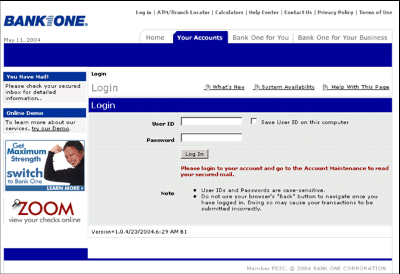
You receive an e-mail that appears to be from a
legitimate company, say Bank One. It has the Bank
One logo, and might even be designed to look like
the BankOne.com site. The e-mail directs you to
enter personal information such as your account
number, PIN number or password on what appears to be
the authentic bankone.com log-in page. But when you
enter your information, it is actually routed to the
criminals.
What can you do to make sure you’re not a victim of
this scam or others?
You shouldn’t reply to unsolicited e-mails from
companies/people that you do not recognize
requesting personal information. If you have
questions about your account, you should call the
company, or start with a clean Web browser and type
in a known company address.
This is an example of
what the latest fraudulent e-mail looks like.
For more fraudulent email
examples click here
|