The Rise and Fall of Angel
Miguel Ángel Rodríguez Echeverría decided early in life that
he wanted the reach the top, and not only scaling the Chirripó, high
point in Costa Rica as he did in July of 2001, but to the presidency and
beyond..
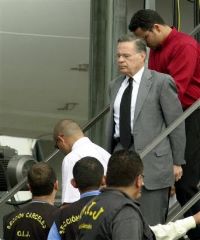 |
The road to the presidential seat was long and hard. The fall from
disgrace, fast.
Rodríguez lost his first bid for the presideny to Rafael Angel Calderón
in 1990 and then again in 1994 to José María Figueres Olsen.
Four years later, he got the job and if the accusations turn to be true,
it was well worth it, as Rodríguez allegedly received more than
us$4.400.000 in payoffs and kickbacks, in addition to his salary and
other perks that come with the job.
Until last year, a Costa Rican president could not be re-elected to
office, so he set his sights higher to a new post, one that could give
him more than national fame and recognition, but be on the world stage.
Rodríguez decided to seek out the top post at the Organization of
American States (OAS) and after a costly and hardous campaign, and with
the support of President Abel Pacheo and Costa Rica, he was the first
Costa Rican to be elected to the post in June of this year.
It would not be until September that he would take office as the new
Secretary General of the OAS and it would be less than one month later
that he left office.
To Rodríguez can be attibuted many positive changes in Costa Rica:
- the fight against infant mortality
- added coverage of secondary education
- the passage of a law of parental responsibility
- and laws to protect workers
However, critics says that because of Rodríguez, the lines for medical
appointments at the Caja Costarricense de Seguro Social (CCSS) got
longer, a lowering on the teaching of English to public school students
and that he did not work hard enough to lower the poverty rate which
affects more than 20% of the population.
Rodríguez is also faulted for not lowering the unemployment rate and was
heavily criticized for promoting privatization of public institutions -
the Instituto Costarricense de Electricidad (ICE), the Instituto
Nacional de Seguros (INS) and the CCSS, among a few.
It was also during the Rodríguez administration that Ticos (Costa
Ricans) took to the streets for the first time to protest government
actions. In May of 2000, a wave of yellow filled the streets, as ICE
workers protested the "Combo del ICE".
Notwistanding, Costa Rica saw a 45% growth in traditional telephone
service and a 650% jump in cellular telephone service during the
Rodríguez administration. When he took office in 1998, a person had to
wait up to a yeat to get a cellular telephone line, however, by the end
of his term in 2002, and with the installation of 400.000 GSM cellular
telephones lines instally by Alcatel shortly after his leaving office,
changed all of that.
Rodríguez made it to the top. But, it is said, that everything that
rises must fall. And now the Angel has begun his fall.
|


