
"I Don't Want To Leave" Natgeo Leader
Says Of Isla Del Coco
The leader of the National Geographic team
that is filming a report on Costa Rica's
Isla del Coco, Enric Sala, told the Spanish
language newspaper, Al Día, "I don't want to
leave this place".
Sala explained, during a telephone
interview, that this is the first time he
has visited the island and overwhelmed by
the beauty it possesses and the great amount
of marine life in its waters.
sala, who heads National Geographic's "Ocean
Now" team has a Ph.D. in ecology from the
University of Aix-Marseille in France,
moving to the United States, where he was
the youngest professor at the Scripps
Institution of Oceanography.
National Geographic's Ocean Now is an
exploration, research, and conservation
project that aims to find, survey, and help
protect the last healthy, undisturbed places
in the ocean.
During September 2009, National Geographic
Fellow Enric Sala, National Geographic
Explorer-in-Residence Sylvia Earle, and a
team of leading marine scientists from
Central America and across the globe are
gathering together in Costa Rica.
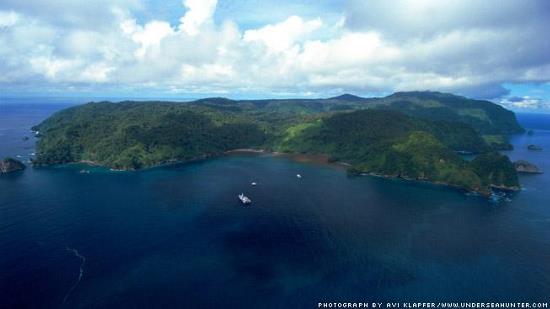
Destination: Cocos Island - Isla del Coco,
ringed by some of the most shark-rich waters
anywhere - and the submerged and
all-but-unexplored summits of the Gemelas
(“Twin Sisters”) Seamounts
If you dive, you’ve probably heard of Cocos.
Renowned ocean explorer Jacques-Yves
Cousteau called it “the most beautiful
island on Earth.”
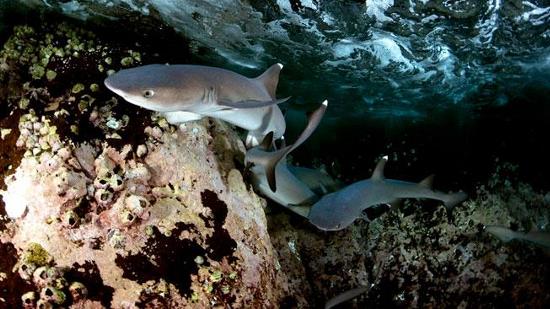
Cocos is legendary for its schools of
hammerheads, plus its white tip reef sharks,
whale sharks, dolphins, tuna, marlin,
turtles, and manta rays.
Rising seawater, cold and nutrient-rich,
helps creatures flourish off Cocos’ shores.
Rife with large marine predators, many
“pelagic” or migratory, Cocos is a Serengeti
of the sea.
Above water, Cocos is shrouded in rain
forest and cloud forest, bedecked with
waterfalls, alive with endemic creatures.
Even if you’ve never pulled on a pair of
fins, you already know this lush volcanic
island. Scholars have argued that Cocos
helped inspire both Robert Louis Stevenson’s
Treasure Island and Daniel Defoe’s Robinson
Crusoe. Real pirates hid real treasure here.
While Cocos has helped define the world’s
image of an untouched island paradise for
centuries, the Gemelas Seamounts have
lurked, mostly unseen and unknown, beneath
hundreds of feet of seawater. But marine
creatures know them as fertile and important
waypoints on their wanderings. These rich
feeding grounds may be critical to the
survival of many of the migratory predators
that pass through them.
Expedition partners include Google, the
Waitt Family Foundation, the Walton Family
Foundation, the Oracle Education Foundation,
Cocos Island National Park, the Nature
Conservancy, Conservation International,
MarViva, Forever Costa Rica, and the
University of Costa Rica.
Track the Ocean Now Expedition:
http://ocean.nationalgeographic.com/
|
|
|
|
|
| |
|
|
|
|
|


