Costa Rica Celebrates Tuesday 188 Years Of
Independence
This week the Costa Rican flags on display
everywhere - private homes, public
buildings, store windows, etc - are not to
support the Costa Rican national soccer
team, "the sele", but, rather to celebrate
the country's 188th day of independence
which is on Tuesday, September 15.
Beating drums have been a fixture at all
public schools this week, as teachers have
been stressing the importance of the
independence and instill patriotism.
To mark the celebration is the arrival of
the independence torch, arriving tomorrow at
the north border from Nicaragua and be in
San José Monday night.
Tuesday, traditional parades will be on hand
in all the provinces, children beating their
drums, to remind the public of liberty and
independence that is a privilege in Costa
Rica, which has shown does not have to be
defended by arms. (Costa Rican abolished its
army in 1948).
Costa Rica joined other Central American
provinces in 1821 in a joint declaration of
independence from Spain.
After a brief time in the Mexican Empire of
Agustín de Iturbide Costa Rica became a
state in the Federal Republic of Central
America from 1823 to 1839. In 1824 the
capital was moved to San José, but violence
briefly ensued through an intense rivalry
with Cartago. Although the newly independent
provinces formed a Federation, border
disputes broke out among them, adding to the
region's turbulent history and conditions.
Costa Rica's membership in the newly formed
Federal Republic of Central America, free of
Spanish rule, was short lived; in 1838, long
after the Central American Federation ceased
to function in practice, Costa Rica formally
withdrew and proclaimed itself sovereign.
The distance from Guatemala City to the
Central Valley of Costa Rica, where most of
the population lived and still lives, was
great. The local population had little
allegiance to the government in Guatemala
City, in part because of the history of
isolation during Colonial times. Costa
Rica's disinterest in participating as a
province in a greater Central American
government was one of the deciding factors
in the break-up of the fledgling federation
into independent states, which still exist
today.
However, all of the Central American nations
still celebrate September 15 as their
independence day, which pertains to the
independence of Central America from Spain.
Historically, Costa Rica has generally
enjoyed greater peace and more consistent
political stability compared with many of
its fellow Latin American nations.
|
|
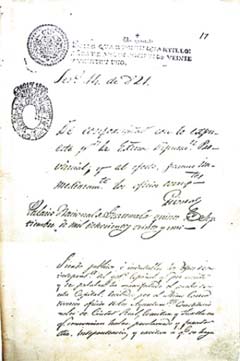
The document declaring Costa Rica's
independence was signed in Guatemala on
September 14, 1821, but it did not arrive in
San José a month later. |
|


