 |
LATIN AMERICA |
| |
Brazilian President
Says Massive Blackout
Isolated Incident
RIO DE JANEIRO - Brazil's
President Luiz Inacio Lula da Silva denied
on Wednesday that there is an energy
shortage in Brazil, stressing that the
blackout which affected several states on
Tuesday night was an isolated incident.
According to the President, the blackout was
caused by a problem in the energy
transmission lines, having nothing to do
with energy generation.
He also denied that the problem was related
to a lack of investments in the energy
sector. According to Lula, his government
invested 30 percent more in energy than the
previous administrations.
President Lula also said that he will not
assign blame before all facts are known.
According to him, the authorities are
working hard to discover the exact causes of
the blackout, which lasted over four hours
and affected 18 out of Brazil's 27
federation units, as well as most of the
Paraguayan territory.
"It is important that no theories are made,
that we wait until we have the facts in
order to better inform society," he said.
Earlier in the day, the Ministry of Mines
and Energy's Executive Secretary, Marcio
Zimmermann, stated that adverse weather
conditions were the cause of the massive
blackout.
According to him, those weather conditions
caused three transmission lines to collapse.
Those lines take the energy from the Itaipu
Power Plant, located in southern Parana
state, to several states in the country.
Two of the collapsed transmission lines
connect the town of Ivapora, in Parana
state, to Itabera, in neighboring Sao Paulo
state. The third one connects Itabera to
Tijuco Preto, also in Sao Paulo state. The
exact point of the lines in which the
problems occurred has yet to be discovered.
According to Zimmermann, the collapse of the
three transmission lines could not be
prevented. He stressed that no system in the
world is prepared to deal with a situation
of triple contingency.
The blackout affected the entire states of
Sao Paulo, Mato Grosso do Sul, Rio de
Janeiro and Espirito Santo. Some areas in
the states of Minas Gerais, Mato Grosso,
Goias, Rio Grande do Sul,Santa Catarina,
Parana, Acre, Rondonia, Bahia, Sergipe,
Paraiba, Alagoas, Pernambuco, and Rio Grande
do Norte were affected as well.
In most states, there were no lingering
effects of the blackout. In Rio de Janeiro ,
Sao Paulo and Espirito Santo, however, the
water distribution has been affected; the
states' local water companies informed that
the water distribution will only be
normalized on Thursday.
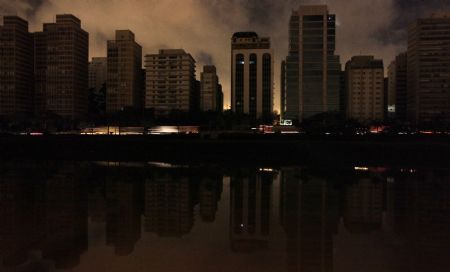
Dark buildings are seen during a blackout in
Sao Paulo November 11, 2009. A major
electricity outage at the Itaipu
hydroelectric dam, the world's largest
operational electricity generator on the
border with Paraguay, left tens of millions
of people in Brazil's two largest cities of
Sao Paulo and Rio De Janeiro without power,
according to the Brazilian director of the
dam. |
|
|
|
|
| |
|
|
|
|
|
|


