 |
LATIN AMERICA |
| |
Venezuela Minimizes Border Bridge Closure,
Calls It Only Temporary
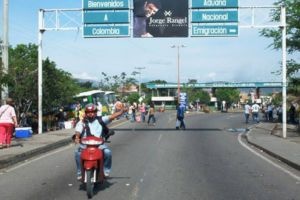
CARACAS – The Venezuelan government
minimized the closure of the international
bridge that connects the Venezuelan city of
San Antonio del Tachira with the town of
Cucuta in Colombia, and said it was made
necessary by a protest of fuel smugglers,
but by the beginning of Saturday afternoon
the situation was “totally normalized.”
“Security measures” established by the
Bolivarian National Guard at the border led
to the closure of the border crossing
because of the reaction of gasoline
smugglers, who “threw rocks at the
Venezuelan military,” Venezuela’s state news
agency ABN said.
“The smugglers, who sneak contraband
gasoline into Colombia, organized
demonstrations against the action taken
against them by the National Guard,” and
were further enraged by having their
gasoline seized “in Colombian territory,”
ABN said.
Colombian press stories said that also
involved in the protest besides the fuel
smugglers were vendors who take trunks of
merchandise across the more than
2,200-kilometer (1,370-mile) border.
The demonstrators protested mistreatment and
the seizure of goods by Venezuela’s National
Guard, which barred their entry into the
country.
In the last two weeks, Venezuela has closed
the crossing several times at this and other
border bridges normally crowded with
hundreds of people transporting merchandise
and fuel between the two countries.
Meanwhile a Venezuelan soldier was detained
in Cucuta on Saturday accused of committing
a number of robberies in the past month, the
commander of the Metropolitan Police in that
city, Col. Jorge Ivan Florez, said.
Found during a search of the detainee’s
quarters were three Venezuelan army uniforms
and a card identifying him as a soldier on
active duty.
Because of rising tension on the border, the
Colombian government asked Spain Friday “to
explore mechanisms of checking and
monitoring” the area, and to investigate the
cases of Colombians slain and arrested in
recent days in the neighboring country.
The most serious incident was the murder of
nine Colombians who had been kidnapped on
Oct. 11 together with a Peruvian and a
Venezuelan in the Venezuelan town of
Fernandez Feo, where they were playing
soccer.
Then last Monday two agents of the
Venezuelan National Guard were also killed
at the border. Disturbances at border
crossings have now heightened even more the
sense of crisis in the area.
The government headed by Hugo Chavez, which
connects the deaths to actions by Colombian
“paramilitaries,” announced Thursday the
deployment of 15,000 soldiers along the
border.
The troubled relations between Colombia and
Venezuela deteriorated further in August
when Chavez ordered them suspended and cut
trade between the two countries.
Chavez was reacting to the military
agreement between Colombia and the United
States announced at the time, and said that
Caracas considered it a threat to regional
security because it allowed U.S. troops to
use up to seven of the Andean nation’s
bases.
Colombian Foreign Minister Jaime Bermudez
said this week that his country is willing
to enter into talks with Venezuela to
resolve the crisis with Venezuela, while
acknowledging the existence of “difficulties
and delicate problems” on the border.
Meanwhile Brazilian President Luiz Inacio
Lula da Silva said he trusts that Chavez
will come to an understanding with his
Colombian counterpart, Alvaro Uribe, and
announced his intention to promote a meeting
between the two on Nov. 26 in the Brazilian
town of Manaus.
|
|
|
 |
|
| |
|
|
|
|
|
|


