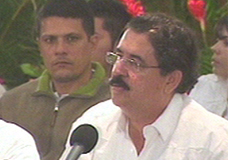
Honduran Military Backs Costa Rica's Arias
Mediation Efforts
The military of Honduras has said it will
support the negotiations to solve the
political crisis in Honduras that began a
month ago, ousting president Manuel Zelaya,
who has camped out on the border briefly
crossing into Honduras and returning to the
Nicaraguan side.
It was the military, on the orders of the de
facto president, Roberto Micheletti, who
whisked Zelaya from his home on the morning
of June 28, putting him on a plane and
sending him to Costa Rica.
And it is now the same military that is
backing the "Acuerdo de San Jose" (San Jose
Accord) proposed by Costa Rican president,
Oscar Arias, following the first round of
dialogue by both sides of the crisis.
And it is the same accord that has been
rejected by both Micheletti and Zelaya
camps, that resulted in a impasse to the
crisis.
While Zelaya camps out at the border,
Micheletti has opened a little crack in the
door open to more talks.
The talks in San Jose fell apart on July 19
when Arias presented his proposal that
included the return Zelaya to power, early
elections and an amnesty for all political
crisis committed due to the coup d'etat.
For Zelaya time is not on his side. A month
into the crisis, Zelaya must keep the world
focused on his cause or will soon be
forgotten as the world media looks moves on
to the next headline.
For Micheletti he has nothing to lose by
standing firm on keeping Zelaya out. The
country is functioning and the elections for
a new president and new legislature are
around the corner, scheduled for November.
"Both sides have shown that they are not
willing to fight and may be willing to
dialogue", said Kevin Casas, former
vice-president of Costa Rica and now with
the Brookings Institute, on CNN Espanol.
“It is still possible for them to resume
negotiations, though there is no way
Micheletti will allow Zelaya’s return to
power,” said Casas. “I think the U.S. must
be exerting a lot of pressure on both sides
now to begin talks again.”
Soldiers sent Zelaya to Costa Rica on June
28 after he ignored court orders to
reinstate the head of the military. The army
chief had refused to help organize a poll
sought by Zelaya, aimed at gauging support
for changing the constitution, which the
country’s Supreme Court had ruled was
illegal.
Micheletti says Zelaya’s goal is to seek
another term in office, which is barred by
the constitution.
Since being ousted, Zelaya has visited
Nicaragua, Costa Rica, El Salvador and the
U.S. to build support for his return. The
United Nations, European Union and the
Organization of America States (OAS) have
backed his bid to return to power.
On July 5, the military and police blocked
the runway at the airport in the Honduran
capital, Tegucigalpa, and prevented Zelaya
from landing. The ousted president spent
less than 30 minutes in Honduras without
being arrested when he crossed by foot on
July 24.
U.S. Secretary of State Hillary Clinton
called Zelaya’s crossing “reckless.”
Zelaya has promised to camp out at the
Nicaraguan border. Several hundred Hondurans
have trickled across the border since Zelaya
called for them to come to Nicaragua.
“We are going to liberate that part of the
country,” Zelaya told supporters yesterday,
as he talked about the curfew on border
towns in Honduras.
At a school at the border, people dried out
their shoes and muddy pants in the sun while
Nicaraguan officials provided them with
medical checkups and a social group handed
out meals.
“We’re going to cross back to Honduras with
the president be it today or tomorrow or
whenever,” said Oscar Cruz, 28, who hiked to
Nicaragua with a group of 200 people. “We’ll
find a way.” Cruz hid in coffee bushes when
a helicopter pursued his group during the
nine-hour hike.
“We are waiting for an order to rise up be
it in a peaceful or bellicose way,” he said.
“We will die for our president.”
|
|
|
|
|
| |
|
|
|
|
|