Deposed
President Zelaya Begins Return To Honduras
By Land From Nicaragua
Managua -
Ousted Honduran President Manuel Zelaya on
Thursday began his trip home amid fears his
return could start a wave of violence in the
already impoverished Central American
country.
Zelaya said that the time for negotiations
is over, the Arias talks have failed and the
de facto government is mocking the
Organization of American States (OAS) and
the international community.
"I have to try", said Zelaya at the
beginning of his return home fro Esteli.

Honduras' ousted President Manuel Zelaya
arrives at the Honduras embassy in Managua
on Thursday began his trip home amid fears
his return could start a wave of violence in
the already impoverished Central American
country. (Reuters Photo)
Zelaya, who was deposed in a military coup
on June 28, announced his plan to return to
Honduras hours after the talks between his
delegation and the post-coup government,
mediated by Costa Rican President Oscar
Arias, failed Wednesday.
He departed from Managua, capital of
Nicaragua, at about 4:15 p.m. local time
(2215 GMT) to Nicaraguan municipalities
bordering Honduras. The ousted president is
expected to enter Honduras at a time between
Friday and Sunday.
A caravan formed by local and international
press accompanied Zelaya, whose supporters
will meet him at the border.
Despite the alleged detention order against
him and the threat of being shot once he
enters Honduran territory, Zelaya said he
was not afraid.
"I know that there are threats of shooting
me. I have been told not to enter Honduras,
because they (coup-leaders) are ready to do
it," he told an Argentine TV channel.
Zelaya said he has "all the right to retake
the charge that the Honduran people gave him
in the elections."
TENSIONS IN HONDURAS
In Honduras, Zelaya's followers began a
nationwide strike that was joined by workers
from the Education Ministry, the National
Company of Energy, the National Agrarian
Institute and the Institute of Social
Security.
His supporters also blocked the northeast,
north, west, Atlantic and east entrance to
the country.
Meanwhile, Honduran entrepreneurs offered
financial aid to the country's de facto
government, led by Roberto Micheletti, to
equip the police and buy weapons due to the
possibility of Zelaya's supporters taking up
weapons.
According to reports from Nicaraguan media,
the Honduran de facto government has
reinforced security at its borders with
Nicaragua by deploying police agents and
soldiers in the area.
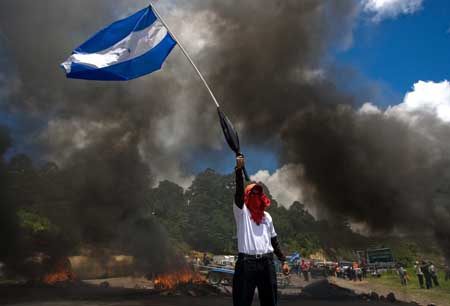
A supporter of ousted Honduran President
Manuel Zelaya wave flag on the road in
Tegucigalpa, Honduras on Thursday. Thousands
of Zelaya's supporters took control of many
major roads leading to the border from
Honduras capital Tegucigalpa, hoping this
action would make the interim government
accept Zelaya's return to the country.
(Reuters Photo)
Nicaraguan media also reported that
Honduran migration offices in the area have
stopped providing service to the public
Thursday.
The government also announced that from
Thursday on, the curfew will be extended in
Honduras' border areas, in response to
claims by Zelaya to return home.
The curfew lasts from 6:00 p.m. (0000 GMT)
to 6:00 a.m. (1200 GMT) in border areas, and
12:00 p.m. (0600 GMT) to 4:30 a.m. (1030
GMT) in the rest of the country, it said.
Nicaraguan Interior Minister Ana Isabel
Morales said there were reported movements
of Honduran soldiers and policemen at the
border.
"We are observing the situation to take the
necessary measures to guarantee the security
of our citizens," Morales said.
APPEALS FROM INTERNATIONAL COMMUNITY
Earlier in the day, the UN Security Council
said it would intervene in Honduras'
political crisis to seek a solution only
when Arias did not have more proposals.
Regional blocs like the Organization of
American States (OAS) should intervene
first, the Council said, adding that if they
failed, it would consider taking measures to
mediate the crisis.
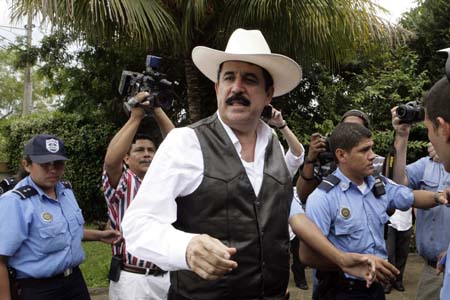
Honduras' ousted President Manuel Zelaya
arrives at the Honduras embassy in Managua
July 23, 2009. (Reuters Photo)
In Washington, U.S. State Department
spokesman Philip Crowley said Zelaya's
return to Honduras was "not prudent."
"Any step that can add a risk of violence in
Honduras or the area is not prudent," he
told reporters.
Crowley said the U.S. government hoped that
both sides would "take the opportunity of
solving the crisis in a pacific way."
Also on Thursday, Chilean President Michelle
Bachelet urged the OAS to take measures to
avoid a bloodbath in Honduras.
"If Arias mediation failed, we think that
now the OAS has to take all the extra
measures needed to achieve the fulfillment
of the resolutions approved by the
Extraordinary General Assembly … for the
Honduran people to restore democracy,"
Bachelet said. |


