 |
COSTA RICA |
| |
Costa Rica
Mourns The Death Of Rodrigo Carazo Odio
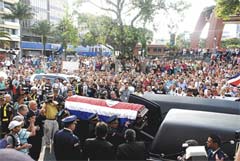
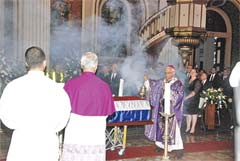
On Thursday Costa Rica bid farewell to its
40th president, Rodrigo Carazo, with a
ceremony at the Asemblea Legislative and a
state funeral at the Catedral Metropolitana
in San José, following by three days of
national mourning.
The 83 year old Carazo died on Wednesday of
heart failure after being admitted to the
Hospital México on November 26.|
Doctors said on Tuesday that Carazo's
condition had improved, though it was still
delicate. At 1:20pm Wednesday, doctors
announced the passing of the former
president.
Carazo will surely be remembered for his
commitment to public service and tough stand
on issues, governing between 1978 and 1982,
a period of economic decline, not only in
Costa Rica, but around the globe.
Rodrigo José Ramón Francisco de Jesús Carazo
Odio was born on 27 December 1926 in
Cartago. Before serving as president, he was
the central bank's Director and General
Manager for RECOPE (Costa Rica's
nationalized oil refinery business).
During his term, Carazo founded the
University for Peace, an institution focused
and dedicated on the study and promotion of
world peace. His government also
concentrated on and promoted the country's
petro-chemical industry and even began
exploration and digging near the Talamanca
Mountain Ridge in search for petroleum. In
the energy sector, his government
inaugurated the hydroelectric plant in Lake
Arenal. The Carazo government also regulated
the excavation of gold in the southern
region of the country.
On the international front, Carazo had to
deal mainly with the radical changes the
neighboring country of Nicaragua was going
through. Nicaragua had been under the
control of the Somoza dictatorship for
decades and Costa Rica had always opposed
his rule.
As the Sandinista movement rose in the
1970s, Nicaragua was faced with civil unrest
and small armed clashes.
Costa Rica's government supported any power
that went against Somoza, thus they gave
their backing to the Sandinista insurgents.
Many of the battles that took place in the
Nicaraguan region bordering Costa Rica
spilled onto Costa Rican soil. Carazo's
government warned Somoza to stay on his side
of the border several times. The government
also began plans on creating a defense force
to fight off any Somoza attempt to attack to
invade Costa Rican territory. The attacks
finally ended in 1979 once the Sandinistas
took control of the country and Somoza was
exiled. The government received a strong
backlash from the public and the opposing
political leaders claiming that Carazo had
failed to protect Costa Rica's sovereignty.
Further, Carazo's government allowed three
U.S. helicopters to touch down on national
soil to facilitate Somoza's escape from
Nicaragua, sending the President's critics
on a political bashing rampage, calling the
matter a disrespect to national sovereignty.
Later, in 1982, the Central American
Democratic Community was formed in San José
with U.S. backing. Its aim was to isolate
Nicaragua from the rest of Central America
as long as they had a Communist regime in
power.
Another big move was in 1981, when Carazo's
government broke off all diplomatic ties
with Castro's Cuba.
Carazo's government was plagued by economic
instability and social unrest.
During his presidency, there was a world
economic recession. Oil prices were at
historic highs and the value of Costa Rica's
main crop, coffee, was falling.
Against the advice of his Minister of
Finance, Hernán Sáenz Jiménez, and the
International Monetary Fund (IMF), Carazo
instructed the Central Bank of Costa Rica to
borrow heavily in order to maintain the
value of the colón, the local currency,
hoping that an economic recovery was close
at hand.
This policy eventually became unsustainable,
leading to a catastrophic sudden devaluation
in September 1980. The heavy load of debt
that the central bank acquired has
contributed to the high rates of inflation
that Costa Rica has endured ever since.
After stepping down as president in 1982,
Carazo became a well-known critic of the IMF
and other global financial institutions. In
his last years he campaigned vigorously
against the Central American Free Trade
Agreement (CAFTA).
|
|
|
 |
|
| |
|
|
|
|
|
|


