|
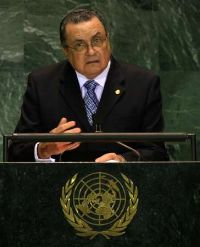
Pacheco
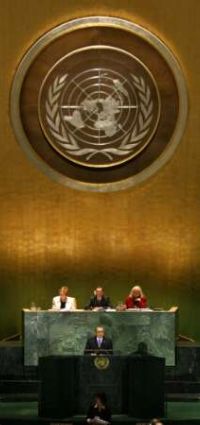
Addresses United Nations
Assembly
As 95 Heads of State
and Government began arriving at
United Nations Headquarters in
New York Tuesday for the start
of the General Assembly's annual
high-level debate, President
Abel Pacheco de la Espriella of
Costa Rica called for a fairer
world economic system.
"This General Assembly, which
represents and expresses the
common will of all mankind, must
play a central role in promoting
a markedly humane
globalization," he said.
Pacheco, said the time had come
to speak of an inclusive global
society. The Assembly, which
represented and expressed the
common will of all mankind, must
play a central role in promoting
a markedly humane globalization.
Economic development must be
directed and guided. The
economy’s positive and powerful
forces must not be left to an
invisible hand, which was
guided, in most cases, by the
obvious inequality among
nations.
Current data on the global
economy, however, showed the
reverse of what was needed for a
truly peaceful, stable and fair
world.
For that reason, and in order to
enable the poorest peoples to
participate in the benefits of
economic development, policies
and programmes must be promoted
that created opportunities for
all.
He urged progress at the
international level in the
following two directions: rules
and policies that provided a
fair normative framework for
globalization must be agreed and
strengthened; and the venues for
effective international
negotiation, management and
implementation of those
agreements should be created or
broadened.
Poverty, the lack of
opportunities, deficient medical
services and limited access to
education, frequently
accompanied by excessive
expenditure in armaments, caused
the suffering of most peoples.
In 2003, a record $956 billion
was devoted to military
expenditure, or 17 times the
amount of resources devoted
worldwide to official
development assistance, and more
than the sum of the foreign debt
of the 64 countries with the
lowest gross domestic product
(GDP). The world did not yet
understand that security did not
result by a multiplication of
weapons, but by “a
multiplication of loaves of
bread”.
Peace and security were built,
in the first place, by combating
injustice, satisfying basic
needs, striving for common and
social goals, and by fair and
honest government, he said.
He fully supported the draft
framework convention on
international arms transfers,
which, by regulating arms
exports, could prevent arms
transfers to terrorists and
rebel groups, and to those
States in breach of
international humanitarian law
or basic human rights
principles.
He urged its adoption by all
Member States, as that would
contribute substantially to the
struggle against illicit weapons
trafficking worldwide.
Also crucial was to confront,
firmly and resolutely, all acts
of terrorism, as well as their
financing sources and safe
havens. Equally essential was to
combat, with the same resolve,
the poverty, inequality and
hunger, of both food and
justice, which afflicted so many
people.
The fight against terrorism must
be assigned to an independent
and permanent organ located at
the centre of the Organization.
He, thus, proposed the creation
of a United Nations high
commissioner for terrorism to
assist the Security Council, the
Assembly and the Economic and
Social Council (ECOSOC).
Speaking at the outset of the
session, Brazilian President
Luis Inácio Lula da Silva
appealed for economic and social
justice in a world where the
disparity in per capita income
between the richest and poorest
nations is now 16 times greater
than it was nearly two decades
ago, while a lack of basic
sanitation has killed more
children in the past decade than
all military conflicts since the
end of World War II.
United States President George
W. Bush called on the world body
to support democracy in
Afghanistan and Iraq as part of
the global war on terrorism.
Mr. Bush proposed establishing a
Democracy Fund within the UN.
"This is a great calling for
this great organization," he
said, pledging an initial US
contribution and urging other
nations to donate to the fund,
which would help countries lay
the foundations of democracy by
instituting the rule of law and
independent courts, a free
press, political parties and
trade unions.
|