|
Union Leaders Ready for Protests Tomorrow
All is set for the march tomorrow march
to protest the signing on the Free Trade Agreement
with the United States in Washington last Friday.
|
|
|
|
|
|
|
|
|
|
|
|
|
|
|
|
|
|
|
|
|
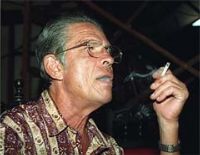
Every day, it is estimated that
seven people die from the
effects of cigarette smoking.
Tomorrow, May 31, will be
World
No Tobacco Day 2004.
There are anti-smoking
activities planned in La Plaza
de la Cultura in downtown San
José. |
|
|
Unions are calling on their membership to unite
and show their commitment to the country, by staging
a one day walkout.
The employees of the Caja Costarricense de Seguro
Social (CCSS) are calling it "a day in defense of
social security".
The march will kick off in front of the ICE building
in the La Sabana Norte around 9am. Marchers will
head unto the Legislative Assembly with a signed
document denouncing the signing of the Free Trade
Agreement.
The march, after leaving La Sabana will head east on
Paseo Colón continuing on Avenida Segunda to the La
Plaza de la Democracia and to the Legislative
Assembly building.
A special committee was set up by the President's
office to ensure public security and order. More
than 100 police officers have been assigned to the
march detail. Unions are predicting that more than
10.000 will be on hand, while police officials
expect around 2.000 marchers.
Randall Quirós, a spokesperson for the President's
office was quoted as saying that "we hope all will
be calm, however, we will be ready to act
immediately in case any violence breaks out."
In past demonstrations, the areas around the
Legislative Assembly building have been cordoned off
with police officers posted every few meters and the
rain has been a major factor in keeping things calm
and ending early. Forecasters are calling for
tomorrow and to continue for the next couple of
days.
Central America Trade Agreement Comes With Worries
WASHINGTON - U.S.
manufacturers and farmers would enjoy increased
access to Central American markets under a free
trade agreement signed yesterday, but U.S. textile
makers and sugar producers are worried about the
increased competition they will face as trade
barriers are lowered.
Ultimately, voters may decide the fate of the
Central American Free Trade Agreement because of the
different views held by President Bush and
presumptive Democratic nominee Sen. John Kerry.
The Bush administration hopes Congress will approve
the agreement during a lame-duck session after the
November elections. Kerry said yesterday that if he
is elected he would demand that the pact be
renegotiated to include better protections of worker
rights and the environment.
The agreement was signed by the chief trade
negotiators of the United States and Costa Rica, El
Salvador, Guatemala, Honduras and Nicaragua.
The Dominican Republic will be part of the package
when it is presented to Congress, but the country
will have to wait until this summer to sign the deal
because its negotiations were completed later.
The six nations will represent the second-largest
market for U.S. products in Latin America, second
only to Mexico.
EU, Latin American Meetings End With No Agreement
GUADALAJARA, Mexico - Latin American nations
concluded several days of meetings with European
Union nations Saturday without an agreement to speed
up free trade negotiations, Central American leaders
said.
The two sides agreed to meet in the fall as
originally planned.
During a series of bilateral meetings following
Friday's one-day summit with heads of state,
officials from the two regions discussed expanding
trade and ways to combat poverty with Mexico,
Central America and Andean nations.
Central American officials had agreed to meet with
the EU in September to discuss a possible free trade
agreement.
Central American leaders used this weekend's meeting
to push for accelerated negotiations, but the EU
said an agreement will be possible only after
Central Americans step up trade with each other.
"There is a commitment between Europe and Central
America to start down a serious and definitive path
to achieve a free trade agreement" in September,
Guatemalan Foreign Minister Jorge Briz told
Associated Press following meetings with EU
representatives.
Costa Rica's ambassador to the European Union, Maria
Ortiz, told reporters that the September encounter
"will provide a window of opportunity for the
region."
Briz said that Guatemala, El Salvador, Honduras and
Nicaragua have taken concrete steps to integrate
trade between their countries and said evidence of
that came with their agreement to adopt a common
customs union.
"The Europeans were very happy with the advances
that have been made in the region," he said.
Several Latin American nations also held private
meetings to discuss regional issues.
The talks came a day after leaders from 58 nations,
including the Caribbean, wrapped up a summit in
which they condemned the abuse of Iraqi prisoners
and called on the world to reform the United Nations
to make the international organization stronger.
The summit's declaration expressed "abhorrence at
recent evidence of the mistreatment of prisoners in
Iraqi prisons," and urged all those who have not
ratified the Kyoto Protocol on climate change and
the International Criminal Court to do so. The
United States has opposed both.
Central America Urges International Support in
Energy Crisis
Presidents from Central
America inked a joint declaration Saturday in
Guadalajara, calling for "technical and financial
support" from the international community to face
the region's energy crisis.
Support was needed to help implement "emergency
measures, projects and actions seeking to face the
situation in the short, middle and long term," said
the declaration signed at the Guadalajara summit of
the European Union, Latin American and the Caribbean
countries.
Leaders of the region, who met European
representatives Saturday to discuss how to push
forward the inter-regional relations, declared "firm
desire to seek appropriate and integral solutions"
that allow the efficient use of energy.
They also agreed to "develop a sustainable energy
strategy in Central America, that includes group of
hierarchized projects on hydroelectric, geothermal,
aeolian and other renewable sources of energy."
The leaders approved the "Energy Emergency Plan" for
Central America, as agreed by the energy ministers
at the Guatemala summit last May 25.
They also vowed to "explore and revise" how to use
compensation funds to ease the effects of higher
fuel prices in future crises.
They urged the Central American Economic Integration
Bank to contribute to the fulfillment of the targets
of the Sustainable Strategy and Emergency Plan.
The declaration was signed by presidents of
Guatemala, Costa Rica, Honduras and Nicaragua, along
with the prime minister of Belize and
representatives of the presidents of El Salvador and
Panama.
Non-Smoking
Areas in Malls Is Being Studied
The Ministry of Health is
studying the possibility of setting up non-smoking
areas in malls. The objective is to protect the
health of non-smokers.
The nine malls that would be affected - Multiplaza
del Este, Outlet Mall, Mall San Pedro, Plaza Mayor,
Terramall, Metrocentro, Mall Paraíso (Cartago), Mall
Internacional (Alajuela) and el Real Cariari (en
Belén, Heredia) - will may be required to have
smoking areas clearly marked, while the rest of the
areas will be non-smoking.
Presently there is no ani-smoking rules in the
malls' common areas, including the food courts.
Please can be seen smoking freely in the walk ways
and in the face of those trying to enjoy a fast-food
meal. But, that may soon change.
The study is a result of a formal complaint - 'denuncia'-
was made to the Dirección General de Salud del
Ministerio de Salud. The complainant, whose identity
is being protected, lost his mother to lung cancer
and had smoked all her life.
|
Inmates hold 24
hostages in Brazilian prison
Inmates of a jail in Brazil's Rio de Janeiro held 24 hostages
on Saturday, including prison guards and employees, after 14 prisoners
escaped with the help of gunfighters, police said.
The detainees escaped through the main entrance of the Custody House of
Benfica, a northern neighborhood of Rio de Janeiro, with the help of a
group of gunmen who attacked the guards with grenades and guns, they
said.
Meanwhile, prison authorities said that 10 people were wounded,
including six inmates and four military policemen.
The detainees, who did not manage to run away, burned mattresses,
disarmed several guards and took the 26 as hostages.
Two of them were released hours later in exchange for medical treatment
in a local hospital for the six inmates who were injured inside the
prison during the shootout.
According to a spokesman of the Custody House of Benfica, the police
were finally in control of the situation and holding negotiations with
the rebels.
Members of the Comando Vermelho (Red Command), one of the most important
criminal organizations in Rio de Janeiro and Sao Paulo, claimed
responsibility for the rebellion that was originally blamed on about 100
inmates.
First
contingent of Brazilian troops arrives in Haiti
A group of 47 Brazilian troops arrived in Port-au-Prince, capital of
Haiti, on Saturday to participate in the United Nations (UN)
multinational peacekeeping mission in the country, reports reaching here
said.
The first group of troops will make preparations for the second
contingent of 50 soldiers, who are due to arrive next Friday, said Lt.
Col. Antonio Carlos Fallace, a spokesman for the troops.
About 1,200 Brazilian troops will join the UN peacekeepers in Haiti,
which will total up to 6,700.
On June 1, the current multinational force formed by the United States,
Canada, France and Chile will be replaced by these peacekeepers.
"The aim of the mission is to cooperate with the Haitian government in
social stabilization and security establishment," Fallace said.
When asked about Haitian Prime Minister Gerard Latortue's hope to see
the UN mission disarm 15,000 men in his country, Fallace said they will
discuss the issue with the leader.
He indicated that the Brazilian troops knew "the Haitian culture and the
general situation in the country."
The troops will participate in aid operations launched after heavy
rainstorms hit Haiti on Monday, killing at least 1,200 people, the
spokesman said.
|


