|
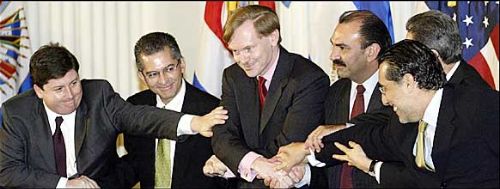
The signers of
the free trade agreement in Washington.
|
Agence France-Presse -
Getty Images |
Free Trade
Agreement Signed
Costa Rica, along with it's
Central American allies signed the free trade
agreement with the U.S. on Friday.
|
|
|
|
|
|
|
|
|
|
|
|
|
|
|
|
|
|
|
|
|
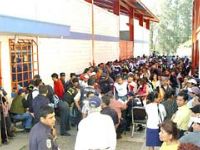
The Constitutional Court - Sala
Constitucional de la Corte
Suprema de Justicia - voted in
favour of the motion of Habeas
Corpus by Carlos Coronado Vargas
on behalf of 65 Nicaraguans who
were affected by the police
action in la Ciudadela La Carpio
en La Uruca and that the Costa
Rica government is responsible
to compensate them for damages
in a strong police action last
January 30.
More than 350 officers of the
Fuerza Publica, Unidad de
Intervención Policial (UIP),
Policía Especial de Apoyo (PEA),
agentes del Organismo de
Investigación Judicial (OIJ) de
la Sección de Capturas, Menores,
Fraudes y Delitos contra la
Propiedad, personal del
Patronato Nacional de la
Infancia (PANI), Immigration
officials and Municipal police
participated in the raid, where
620 persons, more than 90%
Nicaraguans, were investigated. |
|
|
The Central American Free Trade
Agreement still has to be ratified by the
legislators of the individual countries, facing
stiff here in Costa Rica and in the U.S. Congress.
Opposition to the agreement contends that it fails
to do enough to protect workers from unfair
competition.
CAFTA would immediately eliminate duties on more
than 80 percent of U.S. consumer and industrial
exports to Central America and over 50 percent of
U.S. farm goods.
Tariffs on other goods, except sugar on the U.S.
side and a few sensitive farm products on the other,
would be phased out over time.
The five Central American countries that
participated in Friday's signing were Costa Rica, El
Salvador, Guatemala, Honduras and Nicaragua. The
ceremony was held in an ornate hall at the
Organization of American States, while outside a
small band of demonstrators paraded with signs
saying, "Make trade fair.''
The Dominican Republic reached agreement in March to
join the Central American pact, but it could not
take part in Friday's signing ceremony because of
United States rules requiring a 90-day notice period
to Congress before the administration can sign trade
deals.
When the pact is presented to the U.S. Congress, it
will include all six countries. It was uncertain,
however, when the administration and Republican
leaders would bring the pact up given strong
opposition from Democrats and even some Republicans.
The U.S. administration is hoping that momentum
generated by the Central American deal will spur
stalled negotiations on a Free Trade Agreement of
the Americas, which would create a free trade zone
linking 34 nations in the Western hemisphere; Cuba
would be excluded. The agreement is scheduled to be
concluded by next January if wide differences over
such issues as agriculture can be bridged by then.
CAFTA should help ease poverty, foster development
and strengthen democracy in the region, US Trade
Representative Robert Zoellick said.
Four More
Months for Villalobos
Once again the court has
ruled to keep Osvaldo Villalobos, one half of "The
Brothers", in preventative detention with a
provisional extention of another four months
Yesterday, the 27th of May, 2004, the Tribunal
Superior de Casación Penal (Superior Tribunal of
Criminal Appeal) issued its decision on a petition
by Fiscal (prosecutor) Walter Espinosa requesting an
extension of Osvaldo Villalobos' preventive prison.
Also before the Court, was a petition by the Defense
to reject the Fiscal's request based on Article 378
of the Penal Code, which places a limit on the term
of the investigation.
A complete explanation of the court's decision is
expected by UCCR's lawyer, José Miguel Villallobos,
who today is set to announce the formation of his
new political party,
Alianza Democrática
Nacionalista (ADN).
The investor's group told their members that they
are at a crucial moment in the struggle and that
their can either accept the Appeal Tribunal's
decision and wait for the process or force the
issue.
The group has taken the decision to make a stand and
force the issue and will be taking decisive action
in the coming week, though no details were disclosed
at this time.
Father Calvo
Behind Bars
In our report yesterday we
erroneously reported that Father Minor Calvo
Aguilar, accused for being one of the authors of the
murder of journalist Parmenio Medina, had been
released on bail.
However, the priest was not set free and is behind
bars in the San Sebastian jail in San José on three
month's preventative detention.
A last minute decision by the court kept the Calvo
in detention mainly for disobeying an earlier ruling
by the court to give him bail on the condition he
not interfere with the ongoing investigation into
the murder case.
A key witness first declared that Calvo had not been
involved in the murder, then recanted when it was
clear that Calvo was one of the callers threatening
the witness.
Police in a security measure to protect the witness,
moved her to a new 'safe' house.
Six Convicted in Cocaine-Smuggling Case
SAN DIEGO, CA - Five
Colombians and a Mexican national were convicted of
federal drug trafficking charges stemming from the
seizure of a boat laden with nearly 5,000 pounds of
cocaine in the waters off Costa Rica last year.
Luis Ferne Olave-Valencia, Rene Al Chavarin-Carrillo,
Aquilino Bonilla- Torres, Jose Elvi Mosquera, Jose
Rebolledo-Estupinan and Sofonias Riascos- Riascos
were convicted by a jury yesterday following a
three-week trial.
All defendants were found guilty of one count each
of conspiracy to possess cocaine with intent to
distribute on board a vessel and possession of
cocaine with intent to distribute on board a vessel.
Sentencing was set for Sept. 14 before U.S. District
Judge Barry Ted Moskowitz.
According to trial testimony, a Customs C-130
aircraft came across a suspected "go-fast" boat
approximately 180 nautical miles from the U.S. Coast
Guard Cutter Hamilton off the coast of Costa Rica
last Sept. 13.
The Hamilton launched a helicopter and the crew
observed the "go-fast" boat and a second vessel tied
up together for about 20 minutes, authorities said.
The boats separated and the helicopter crew signaled
for the "go-fast" crew to stop, authorities said. A
chase ensued and the helicopter crew saw the
"go-fast" crew jettisoning bales over the sides of
the boat.
After a five-minute pursuit, the Coast Guard
helicopter disabled the engines of the "go-fast"
boat and boarded it. The Coast Guard crew picked up
99 bales of cocaine floating in the water in the
vicinity of the "go-fast" boat, authorities said.
|
Venezuela
attributes oil price hike to Iraqi war
Venezuelan President Hugo Chavez said here Friday that the
war in Iraq is "the fundamental reason" behind the increasing oil price,
and it was not the fault of the Organization of Petroleum Producing
Countries (OPEC).
"It is not our fault. The one who sees the problem in such a way is
completely wrong," Chavez told the press on his arrival for the third
summit of the European Union (EU), Latin America and the Caribbean
countries, held Friday in the west Mexican city of Guadalajara.
The Venezuelan leader underlined that "the ones who are requesting
Venezuela or Mexico to contribute to lowering the prices must adjust the
complete scenery," he said. "Why don't they ask US President George W.
Bush to abandon Iraq?"
The United States thought "they were going to take Iraq like a glass of
water" and in five or six months they would recover the oil production.
However, they have been unable to control the country, Chavez said.
He said that Bush had to be blamed for the situation in the oil market,
for he took an "arbitrary, imperialistic and unilateral" decision,
disregarding international laws.
It was necessary to maintain the oil price at a fair level because "one
of the risks of low prices was that once consumption soared, the
destruction of the environment and the ozone layer would be worsened,"
Chavez argued.
Leaders from the 58 countries attended the one-day summit during which
they agreed to criticize the United Sates for the abuse and torture of
Iraqi prisoners.
Court
strips Pinochet of immunity
The Santiago Appeals Court announced Friday that former Chilean
President Augusto Pinochet will no longer enjoy immunity from
prosecution. with a 14-9 vote.
The decision by a 14-1 vote was handed down Friday morning by the
Appeals Court President Juan Gonzalez, who also said that the document
will be written by Judge Jorge Dahm.
The news was hailed with joy and applause by more than 60 relatives of
the people who had disappeared during Pinochet's rule.
Pinochet's attorney said they would appeal to the Supreme Court.
Pinochet, 88, ruled Chile with an iron fist from 1973-1990. He was
charged for his role in Operation Condor, an international organization
aimed to neutralize leftist groups opposing the military regimes that
took power in Chile, Argentina, Brazil, Paraguay and Uruguay during the
1970s.
One of the arguments used to support the court's decision was an
interview by Pinochet broadcast in the US city of Miami, where he showed
that his mental deterioration was not real for he perfectly remembered
milestones in his regime.
To avoid being tried, Pinochet's defense argued he suffered from senile
dementia.
Pinochet has faced tens of trials, including his arrest and prosecution
in England after Spain requested his extradition on charges on human
rights violations.
He only lost his immunity from prosecution and was judged in the trial
on the so-called "Caravan of Death" in Chile. But later mental exams
showed he suffered from moderate, progressive and incurable dementia and
he was exempted from responsibility.
Brazil's 1st peacekeepers leave for Haiti
Brazil dispatched 161 soldiers Friday to join the UN multinational
peacekeeping mission in Haiti.
Four ships carrying the troops and equipment will arrive in Haiti's
capital Port-au-Prince in 18 days. They are part of a 1,200-strong
contingent sent by Brazil to the war-torn Caribbean country.
The situation in Haiti has become more complicated this week as floods
claimed at least 1,700 lives and affected thousands of people in the
country.
But Brazilian officials said the mission of the troops would still be
peacekeeping rather than providing humanitarian assistance until the
United Nations issues a new order. |