Free
Trade Agreement Signing Today
The U.S. is expected
to sign the Central America Free Trade Agreement
with the Central American countries of - Nicaragua,
Guatemala, Honduras, El Salvador and Costa Rica - at
a signing ceremony in Washington today.
|
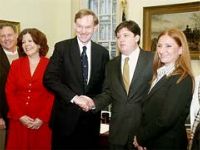
U.S trade representative,
Rober Zoellick, stands in
the middle with his
counterparts from Central
America, Regina Vargo,
Alberto Trejos and Anabel
González.
The Free Trade Agreement is
scheduled to signed today in
Washington D.C. |
|
|
|
|
|
|
|
|
|
|
|
|
|
|
|
|
|
|
|
|
|
|
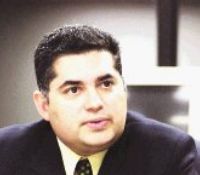
Former Justice Minister, Jose
Miguel Villalobos, is set to
announce his new political
party, Alianza Democrática
Nacionalista (ADN) in a press
conference Saturday.
Villalobos was fired by
President Pacheco in October
2002 following a disagreement
between the two men and is also
the lawyer representing a group
of "the brothers" investors in
their case against the
government. |
|
|
The Dominican Republic is expected
to join the accord shortly.
In the United States, the free-trade issue has
sparked debate about whether such policies promote
economic growth or cost jobs. In developing nations,
critics say that removing barriers to U.S. goods,
particularly agricultural products, undermines local
producers.
Democratic presidential candidate John Kerry has
opposed the treaty in its current form. Robert
Zoellick, U.S. trade representative told reporters
Thursday that the administration plans to delay a
ratification vote until after the election.
Already the treaty faces opposition that runs the
gamut from American sugar farmers, who object to the
entry of product from Central America, to AFL- CIO
President John Sweeney, who has called it "yet
another job-destroying free trade agreement that
will undermine workers' rights here and around the
world. ''
In Costa Rica, unions have called
for a general strike of all public employees,
calling on them to band together for a march through
the streets of downtown San José to the Legislative
Assembly building, where speeches and demonstrations
will take place.
According to the trade representative's office, the
United States shipped about $11 billion in goods to
the five CAFTA nations in 2003, making it a larger
export market than Russia, India and Indonesia
combined. About $12 billion in goods flowed the
other way.
Mills said CAFTA should benefit U.S. exporters
because more than three- quarters of Central
American exports covered under the agreement already
enter this county duty free and the accord returns
that favor to U.S. goods destined for the signatory
nations.
U.S. - Central America Free Trade Agreement
(CAFTA)
What it does: The treaty removes tariffs
on most goods traded between the United States and
five Central American nations, including farm
products and textiles.
What countries are involved: Signatories are
the United States, Costa Rica, El Salvador,
Guatemala, Honduras and Nicaragua. The Dominican
Republic is expected to join later.
What happens next: The Senate and House of
Representatives must both approve the treaty before
it can take effect. The measure won't be considered
until after the November elections.
Taiwan's Vice President to Visit Central America
Taiwan's Vice President Annette Lu will start a
14-day diplomatic visit today that will take her to
El Salvador, Costa Rica and Guatemala, the
Presidential Office announced yesterday.
This will be Lu's first overseas trip since she was
sworn in for a second four-year term May 20. She
will make transit stops in the United States on her
way to and back from Central America.
A major mission of Lu's upcoming diplomatic journey
is attending the inauguration of Salvadoran
President-elect Elias Antonio Saca on behalf of Chen
Shui-bian.
While unveiling her itinerary at a news conference,
Lu said this will mark the fourth time that she has
served as President Chen's special envoy to attend
the presidential inauguration of a Republic of china
diplomatic ally over the past four years. "I feel
honored to take up this assignment," she added.
During her visits to the three Central American
countries, Lu said she will address their
politicians and social elites, introducing them to
Taiwan's experiences in scientific, technological
and human rights development as well as its "soft
national power."
In addition to attending El Salvador's presidential
inauguration on June 1, Lu will deliver a speech on
science, technology and life at that country's most
prestigious university.
During her visits to Costa Rica and Guatemala, Lu
will receive decorations by her counterparts of the
two nations and deliver speeches at their top-notch
universities. She will also receive an honorary
doctoral degree from Guatemala's most famous
university.
In yesterday's press conference, Lu shrugged off
angry protests by mainland China over her planned
transit stops in the United States and thanked
Washington for agreeing to the layovers.
Beijing has denounced Lu's plans to stop over in Las
Vegas and San Francisco as a move designed to
promote Taiwan independence and hurt
Beijing-Washington relations.
Lu dismissed Beijing's strong reaction, saying that
mainland China always tries to mobilize its
resources to block her every overseas trip and to
insult her personally.
No comment was made on the recent news of Costa Rica
using Tawain's Foreign Affairs Ministry money to pay
the salaries of Costa Rican public employees,
including President Pacheco's daughter.
Father Calvo
Detained Again
Shortly after the lunch hour yesterday, father Minor
Calvo Aguilar and his lawyers arrived at the Heredia
courthouse to appeal a recent decision by a judge in
the Parmenio Medinca murder case.
The appeal was also to ask the Courts to exclude
Calvo from the case, as days earlier, a key witness
in the murder of the Colombian journalist, changed
his story, saying Calvo was not involved.
Wednesday, the same witness, changed his story
again, saying that he received threats from Calvo
and the reason why authorities arrested Calvo when
he presented himself at the courthouse.
Calvo's lawyers, Alvaro Jiménez y Perla Cheves, were
also arrested for taking part in the threats against
the witness. Calvo was freed on the condition
of presenting himself at the courthouse to sign in
every 15 days, while the lawyers were freed without
conditions.
The Court has declared the that the case is a
complicated one, using the legal term “tramitación
compleja”, which will give prosecutors more time to
investigate and bring the case to trial.
Shannon Martin School Graduates First Class
The Costa Rican school established in memory of a
slain Kansas University student will honor its first
graduates on today.
The Shannon Lucile Martin English Center will
recognize 48 students who have completed a basic
English instruction course.
The center, in Golfito, was established in honor of
Martin, a Kansa University biology student who was
killed in May 2001 in Costa Rica while completing a
research project she had started a year before.
Jeanette Stauffer, Martin's mother, said she planned
to attend the ceremony, which will be at the Hotel
Sierra in Golfito.
Satellite Internet Service Launched
The Instituto
Costarricense de Electricidad (ICE) - the state
monopoly on energy and telecommunications - has
announced it is offer internet service by satellite.
Internet users can now connect to the internet by
way of special equipment, to send and receive
information by satellite. The service is mainly for
those companies located in remote areas.
The cost of the service will be between $700 and
$1.400 dollars per month, depending on the
connection speed, which is offered at 128/512 Kb and
256/1042 Kb.
The cost of the equipment is et at $6.458 dollars
which does not include the cost of $1.000 for the
installation.
The service is being offered by the U.S. company
Andesat, which is represented in Costa Rica by the
Vector Telecom, which signed a deal with ICE to
provide satellite internet service in Costa Rica.
|
 |
|
Colombian Banana Workers Strike Over Pay
Most banana workers in Colombia, the world's third-largest
exporter of the fruit, began an indefinite strike on Thursday after
failing to clinch a new wages agreement with companies, their union
said.
"We were a long way apart and we couldn't reach an agreement," Oswaldo
Cuadrado, president of the banana workers' union, Sintrainagro, told
Reuters. Exports will stop immediately, he said.
About 16,000 workers in the northwestern region of Uraba, which produces
about 90 percent of Colombia's bananas, were striking, he said.
"The banana workers are at home and there isn't really any work going on
in the banana region at this moment," said Roberto Hoyos, president of
industry group the Colombian Banana Association, known as Augura, which
negotiated on behalf of companies.
The workers, who earn around $200 a month, want a 9-percent wage
increase, while management is offering the rate of inflation, which is
about 6 percent.
The last banana strike, over a similar dispute, took place two years ago
and lasted two days.
Colombia, which follows only Ecuador and Costa Rica as an exporter,
shipped 55 million 20-kilo boxes of bananas in 2003, earning about $310
million in export sales, about 2.5 percent of the country's total
exports. Between 80 and 90 percent of Colombia's bananas are exported,
particularly to the United States and Europe.
One of the largest exporters is U.S.-owned Chiquita Brands
International, which earlier in May said it was being investigated by
the U.S. government after voluntarily admitting its Colombian subsidiary
had paid protection money to illegal armed groups.
At least 2,000
killed in Haiti, Dominica floods
The floods caused by rainstorms in the Dominican Republic and Haiti have
killed at least 2,000 people, government institutions and humanitarian
organizations revealed Thursday.
Last week, a fierce tropical storm lashed the Caribbean island of
Hispaniola shared by the Dominican Republic and Haiti. The Soleil river
originating from Haiti overflowed after days of heavy rains.
Rescuers have recovered 233 bodies in the town of Jimani, 280 km
southeast of the Dominican capital of Santo Domingo. In addition, 122
people were taken to hospital, but about 375 people remained missing,
the Emergency Operations Center (COE) said.
Dominican President Hipolito Mejia visited the area Thursday and
declared it a disaster area and territory of public calamity. He ordered
an official mourning day for the victims.
The Catholic Church, Dominican aid institutions and non-governmental
organizations began to distribute clothes, food and medicines from the
United States, the European Union, Canada and several South American
nations.
The rainstorm also caused many deaths and damage in Haiti. Humanitarian
and aid groups said it claimed 1,666 lives, and the number of the
missing was still unknown.
The interim government and international agencies stepped up efforts to
provide aid for several towns hit by floods and large-scale mudslides.
International assistance has began to arrive in the country.
Haiti suffered much more serious damage. About 8 million people are in
poverty, and only a quarter of them have drinking water.
Chavez condemns US referendum call as "imperialism"
Venezuela President Hugo Chavez charged that the United States has
imposed "imperialism" on his country ahead of a signature verification
process that could oust him, according to comments released by the
president's office Thursday.
The comments were a response to a statement by US Assistant Secretary of
State Roger Noriega, who said Wednesday that Venezuela could face
suspension from the Organization of American States (OAS) if it blocks
the August referendum being sought by opponents of Chavez.
The Venezuela president, who has repeatedly accused the United States of
meddling in Venezuela's affairs and trying to topple him, condemned as
"ridiculous" the US official's calling for the referendum to go ahead.
Chavez now is in Mexico for a summit of the European Union, Latin
America and the Caribbean starting Friday in the Mexican city of
Guadalajara. He has said he would complain about US interference in
Venezuela to the European Union and Latin American leaders at the
summit.
In a three-day verification of signatures starting Friday, Venezuela's
opposition will attempt its last chance to complete the 2.4 million
pro-referendum signatures required to trigger an Aug. 8 recall
referendum.
The opposition submitted 3.4 million signatures to Venezuela's National
Electoral Council (CNE) last December following a signature drive. But
in early March, the CNE ruled that only 1.8 million of the signatures
were valid.
|
|
|
|
|
|
|
|


