Kanev
Not Alone
Arthur Kanev, 56, is the first person to
be extradited from the United States to face the law
in Costa Rica, on charges of corruption and abuse of
a minor.
|
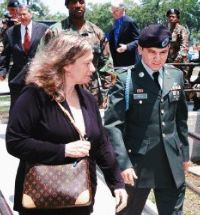
Tico-Nica Camilo Mejía
Castillo (right), outside
the military court in Fort
Stewart, Georgia, yesterday,
accompanied by his lawyer,
Gale Glazer, following his
guilty verdict of desertion. |
|
|
|
|
|
|
|
|
|
|
|
|
|
|
|
|
|
|

Jubilant Spaniards will
flock into the streets of
Madrid today to celebrate
Crown Prince Felipe's
marriage to former
television anchorwoman
Letizia Ortiz.
Wedding guests include the
first lady of Costa Rica,
Sra. Leila Rodríguez Stahl
de Pacheco. |
|
|
However, Kanev is not alone. Eight foreigners are
in prison doing time for abuse of children, five of
which are Americans. And another 15 foreigners like
Kanev, are in jail waiting their day in court.
A woman identified as Sharon Ann Castillo, like
Kanev, fled from Costa Rica after she was given bail
and required to sign in with police on a regular
basis. She and her husband, Ervin Castillo,
recruited young girls to work as prostitutes. The
man was senteced to eight years in prison, while the
woman is still at large.
Now that Kanev is in Costa Rica, his trial could
come as early as July. If convicted, Kanev faces a
maximum sentence of 30 years.
Leftist Sandinista Singer is Father of
Soldier-Deserter
A soldier convicted Friday of deserting
his U.S. Army unit in Iraq is the son of Nicaragua's
most prominent leftist singer, who wrote the line
"Let's fight the Yankee, enemy of humanity" into
Nicaragua's former Sandinista anthem.
The father, Carlos Mejia Godoy, condemned Friday's
verdict, saying his son, Staff Sgt. Camilo Mejia,
was convicted and sentenced to a year in jail and a
bad conduct discharge in retaliation for having
mentioned abuse of Iraqi prisoners by U.S. soldiers.
"We expected this verdict," Mejia Godoy said, noting
"my son's situation worsened after he bravely
revealed the torture he had witnessed against
Iraqis."
Mejia Godoy has said in recent interviews that he
opposed his son joining the U.S. army, but didn't
try to stop him.
Mejia Godoy wrote scores of leftist-oriented songs,
including the anthem for the Sandinista National
Liberation Front, which ruled Nicaragua from 1979 to
1989.
The line about "Yankee, enemy of humanity" had
always proved controversial, and the Sandinista
Party later dropped it from the anthem.
Mejia Godoy said his son "was prepared for this and
whatever came, because he took up this challenge
with all the firmness and dignity of his Nicaraguan
heart."
The younger Mejia, of Miami Beach, Fla., in fact
listed his citizenship as Costa Rican, and based
part of his defense against the desertion charge on
an obscure, old Costa Rica-U.S. treaty which exempts
citizens of that country from forced service in U.S.
militias.
Camilo Mejia said he joined the Florida National
Guard to help pay for college.
He was born in Nicaragua, but his mother, at that
point separated from Mejia Godoy, took Camilo Mejia
to live in Costa Rica at the age of one.
Mejia, 28, turned himself in in March and sought
status as a conscientious objector.
Lottery Vendors
May Strike
At every corner there is a lottery stand
or someone shouting out the sale of lottery tickets.
Ticos are accustomed to hearing the shouts and
chants of numbers as they stroll the streets of
downtown.
However, given the recent decision by the Junta de
Protección Social, the government agency that runs
the lotteries, to reduce to not more than 10% of
their unsold lottery tickets, lottery Vendors
are threatening to go on strike if the Junta does
not back down on it's policy.
Lottery Vendors who do not sell their tickets for
any given lottery can return them to the Junta. Luis
Polinaris, president of the Junta, explains that
most vendors sell their purchases, however, there is
a small group that continually returns a large
portion of their purchases and this could be sold by
other Vendors.
The Junta will meet this week with the Vendors for a
possible solution.
Foreign Drivers Immune to Traffic Fines
A loophole is being examined by Transit authorities
that exempts foreign drivers and vehicles from
having to pay traffic fines, since there is no
mechanism to obligate the offender to pay.
The exemption is in cases of drunk driving and
accidents causing fatalities, whereby the vehicle is
detained by Transit police.
At the moment, Transit authorities recognize fines
to drivers for the likes of speeding and failing to
use the seatbelt, are not collectable if the
foreigner chooses not to pay, since, unlike Costa
Ricans, they don't have to renew their driver's
licenses.
In Costa Rica, foreigners can drive without
obtaining a Costa Rican driver's license, using
their own country's license.
Most troubling to Transit authorities are 6.000 or
more foreign vehicles - mainly transport trucks with
trailers - with their foreigner drivers who enter
Costa Rica each month.
Transit officials are studying several different
options that could include, the vehicle cannot leave
Costa Rica without paying fines, the confiscation of
plates for certain types of offences, like being
overloaded.
|
 |
Colombia sets up first security posts in concentration zone
The Colombian government has set up the first security posts
in the northern "concentration zone" where they will resume peace
negotiations with the paramilitary United Self-Defense Forces of
Colombia (AUC), officials said Thursday.
Peace Commissioner Luis Carlos Restrepo has met with police officers and
governor of the Cordoba department, Libardo Lopez, to coordinate the
security posts on the borders of the "concentration zone".
The forces and police will be deployed in Severinera, Los Agujos,
Betanci, Los Volcanes, El Caramelo and Santafe de Ralito in the
department of Cordoba. Some of the roads to the area will also be
closed.
But Restrepo pledged that rights and investments of the residents in the
region will be respected.
Last Thursday, the Colombian government and the AUC agreed to create a
368-square-km concentration zone in northern Cordoba province for about
400 paramilitaries to demobilize, a process that will be supervised by a
mission of the Organization of American States.
The success of the peace process with the AUC will lead to the
demobilization of 13,000 paramilitaries, said official sources.
In the so-called "concentration zone", the rebels will be protected by
government troops and exempted from prosecution, but they will not be
able to leave without government authorization.
The AUC demobilization process will also help stop Colombia's
four-decade civil war, the longest in Latin America, which kills an
average 3,500 people every year, they said.
Also on Thursday, the AUC proposed to create another three concentration
zones like the one in Cordoba.
The right-wing paramilitary suggested on the Internet that the zones be
in the regions of Bajo Cauca, Magdalena Medio Antioqueno and the Eje
Cafetero. They also stressed their commitment to cease hostilities.
In a response to the proposal, Colombian Defense Minister JorgeAlberto
Uribe said it will be better for the two sides to reach an agreement on
the table rather than throwing out proposals before the country.
Argentine president inks draft law to send troops to Haiti
Argentine President Nestor Kirchner signed Friday the draft
law to contribute troops to the peacekeeping mission in Haiti, announced
Foreign Minister Rafael Bielsa at a press conference Friday.
The minister said they would be peace "stabilization" and not
"maintenance" troops, and would be deployed against the backdrop of
"unanimously voted" United Nations (UN) resolution.
He made it clear that this is a peace stabilization mission, and is not
responsible for the disarmament of violent groups, which differs from
the mission of the Brazilian contingent.
Bielsa considered that the dispatch of national troops would fit "the
Argentine trajectory in peacekeeping actions."
The Argentina government wishes to send 275 soldiers of the National
Army and 175 of the Marine Infantry, while another 50 will carry out
support tasks.
The terms of the Argentine contribution were discussed till the last
moments with Brazil, and an accord was reached 10 days ago during a
visit of Argentine Defense Minister Jose Pampuro.
The Brazilian mission will be centered on the "imposition of peace," and
will include tasks such as the disarmament of militant groups
Brazilian president
leaves for China visit
Brazilian President Luiz Inacio Lula da Silva left here
Friday for a state visit to China to strengthen bilateral relations.
The Brazilian head of state, who described his trip to China as the most
important of his administration, will arrive in Beijing Saturday. The
visit is due to end on May 27.
His entourage includes Foreign Minister Celso Amorin, Development
Minister Fernando Furlan, Planning Minister Guido Mantega, and Finance
Minister Antonio Palocci, the Foreign Ministry said.
The other ministers that comprise the delegation are Roberto Rodrigues
of agriculture, Eduardo Campos of science and technology, Walfrido Mares
of tourism and Dilma Dousseff of mining and energy.
A delegation of more than 400 businessmen will also travel with the
president to seek business opportunities in China.
Brazil is China's largest trade partner in Latin America, and China is
Brazil's fourth largest trade partner, according to the Ministry of
Commerce.
On Sunday, Lula will open the offices of the state-run oil company
Petroleos de Brazil in the Chinese capital.
After the visit, Lula will travel to Mexico to attend the 3rd summit of
Latin America and the European Union.
|
|
|
|
|
|
|
|


