Buckle Up.
Today is the day!
The new seatbelt law was passed by the legislature
at the beginning of the year and officially came
into effect on the 5th of May, following publication
in the official government newspaper La Gaceta.
However, Transit police gave drivers and passengers
a grace period until today, giving out warnings
instead of fine.
|
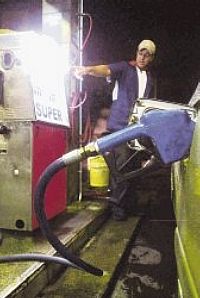
The rise in world oil prices
has the government worried.
The world price for crude
oil reached a high of $41.55
per barrel. In Costa Rica
gasoline prices have been
rising steadily. The last
increase on May 6, saw a
litre of super hitting
¢305.20 colones. The new
increase, if approved, will
see the cost go to ¢315.00
President Abel Pacheco
yesterday appealed to all
Costa Ricans to travel less
to reduce consumption. |
|
|
|
|
|
|
|
|
|
|
|
|
|
|
|
|
|
|
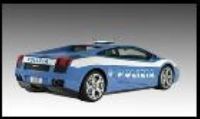
Italian Police Get a
Lamborghini
The newest car to be used by
Italian Police is seen in
this photo made available by
Italian police last
Thursday. This high
performance 2-seater
Lamborghini Gallardo car,
using a V10 cylinder DOHC
four valve V90 5 liter, 500
Hp engine, can reach the top
speed of 309 km/h (192 Mph).
Lamborghini, which is owned
by Volkswagen and based near
Bologna in northern Italy,
donated the car. The
six-speed, two-door luxury
vehicle promises the ability
to go from zero to 100 kph
(60 mph) in four seconds,
and has a list price of
US$165,000 (euro145,180 in
Europe). |
|
|
However, beginning today, the fine will be ¢8.350
colones for drivers and passengers (both front and
rear) of all types of vehicles, including taxis. The
driver is responsible for the passenger's use of the
seat restraint and will be fined for non use.
Taxi drivers will have the right to refuse a fare is
a passenger does not want to use the seatbelt or
risk being fined by the Transit police, who
beginning today will be mounting an all out
campaign, with 30 additional motorcycles - most of
them donated by the government of Spain - who will
give pursuit to vehicles where it is clearly seen
that the seatbelt is not being used.
In other Transit news, Transit authorities are
concerned at the high number of deaths this year due
to traffic accidents. To date, this year there have
been 130 deaths recorded, with this month being the
worst.
In the first 18 days of this month there have been
24 traffic fatalities. Driving at excessive speed is
the number one cause of accidents, according to the
statistics by Transit authorities, followed by
driving under the influence of alcohol. The rain was
factor in increasing the risk of accidents.
Imprudent pedestrian deaths came in third place.
Transit officials will be mounting an intensive
campaign directed at pedestrians and reducing the
number of deaths.
MOPT Loses
Riteve Contract
Is it corruption? Mismanagement? or
simply a mistake? That is the question in the minds
of legislators following the revelation made by
Minister de Obras Públicas y Transportes (MOPT),
Javier Chaves, that the contract between Riteve SyC,
S. A - the vehicle inspection firm - and the MOPT
has been lost.
This was confirmed yesterday by president Abel
Pacheco, who called the occurrence "a barbarity" and
adding that the loss occurred during the last
administration and not on his watch.
The situation came to light following the request by
Liberation party and former presidential candidate,
José Miguel Corrales, from Minister Chaves to
provide him the signed contract for a closer study.
Riteve was given an exclusive contract to operate
vehicle inspection centres in the country in July
2002. The contract was signed in 2001 under the
Rodriguez administration.
Chaves explained that this is a serious situation
and a full investigation will be done as to how and
why. He added that they know when, it was on the
28th June of 2001, when the contract was being
delivered to the Comptroller's office, more
specifically the Transport Division.
Chaves added that they were able to locate a copy of
the document held by the Comptroller's office (Contraloría
General de la República).
The controversy began when Corrales had been
questioning the practices of Riteve and the MOPT
regarding the vehicle inspections, following recent
reports of anomalies in the way Riteve has been
operating the vehicle inspections and the recent
announcement in the raising of prices for the
service..
When Corrales received no responses from either
Riteve nor the MOPT, he asked the Sala IV - the
Constitutional Court - to intervene and the court
ordered last week MOPT to deliver Corrales the
original document.
Workshop Addresses the Promise of Central America
Central American countries from Costa Rica to
Nicaragua are opening their arms to business from
the north, according to a local international trade
consultant who is organizing a workshop on the
issue.
Trade barriers that have stood for years have been
addressed by the Central American Free Trade
Agreement that was signed last year and mimics the
North American Free Trade Agreement NAFTA in many
ways, according to international trade consultant
Joyce Mikkelson of Chico, California.
"It's stronger than NAFTA," said Mikkelson,
addressing legal issues like helping American
companies getting paid and tariffs on items that
Americans want to sell.
"Issues like that discourage companies from pursuing
foreign trade," Mikkelson said.
Launched in 2003, the Central American Free Trade
Agreement initially involved El Salvador, Guatemala,
Honduras and Nicaragua, but now also includes Costa
Rica.
In addition to the benefit of new markets for
American companies and jobs for Americas, the
benefit for Central American consumers is locating
products that haven't been widely available in their
countries, Mikkelson said.
Other promising markets in Central America include
tourism, business and financial services, and
healthcare services and products, Mikkelson said.
Probably most unusual about this workshop is the
one-on-one time with trade experts for questions
about importing or exporting.
Mikkelson said this workshop is designed for anyone
thinking or already pursuing trade in Central
America. One of the speakers also has expertise in
trade with Asia as well.
US-Australia Accord on Free Trade Signed
The United States and Australia yesterday signed a
free-trade agreement, the first in a series the Bush
administration hopes to send Congress this year for
approval.
The administration is working to rapidly expand the
country's free-trade network even as economic
uncertainty has made trade a sensitive election-year
issue in Congress.
"In both the United States and Australia, we must
now turn our attention to winning approval of the
agreement from our respective legislatures," U.S.
Trade Representative Robert B. Zoellick said at the
signing ceremony.
Both nations would like their legislators to approve
the pact this summer so that it takes effect Jan. 1,
Mr. Zoellick added.
The administration also has concluded pacts with
Costa Rica, El Salvador, Guatemala, Honduras and
Nicaragua — the Central American Free Trade
Agreement — as well as the Dominican Republic and
Morocco. The CAFTA signing is scheduled for next
week; the agreement would later be packaged with the
Dominican Republic's for a single congressional
vote.
Under trade-promotion authority won by President
Bush in August 2002, the House and Senate vote yes
or no on trade deals. No amendments are allowed.
Yesterday Mr. Bush's trade team began negotiations
with Colombia, Ecuador and Peru, adding the three
South American nations to a list that includes
Panama, five southern African nations, Bahrain and
soon Thailand.
Collectively, the agreements would make up a
relatively small share of total U.S. trade but are
strongly backed by many U.S. businesses that see new
opportunities to sell their goods and services
overseas.
The Australia deal may have the best chance of quick
approval. Politically, the Pacific nation is an ally
in Iraq and on other foreign-policy initiatives.
Economically, the agreement is especially attractive
to manufacturers because more than 99 percent of
manufactured goods exported to Australia will become
duty-free as soon as the agreement becomes law.
Manufactured goods account for 93 percent of U.S.
exports to Australia.
|
US
requests extradition of Colombian paramilitaries
The United States has urged Colombian authorities to arrest
and extradite 23 Colombians, including six paramilitary chiefs, on
charges of drug dealing, Colombian government officials said Tuesday.
Salvatore Mancuso, military chief of the armed rebel group United Self
Defense Forces of Colombia (AUC), was among those wanted by the United
States.
The extradition request came at a time when the Colombian government and
the AUC are preparing for a formal resumption of their peace dialogue,
which seeks to demobilize 13,000 paramilitary combatants.
Twenty-five Colombians on charges of drug trafficking have been
extradited to the United States so far this year.
Venezuela: US has no right to comment on human rights
Venezuela dismissed a human rights report from the US State
Department as being unacceptable on Tuesday, saying that the United
States itself has no moral authority to comment on the issue.
Vice President Jose Vicente Rangel said in a statement that the US
administration has no moral right to make judgment on human rights in
the world, including Venezuela, because the author of the report is
infamous in dealing with moral matters.
"The United States knows no limit when it comes to human rights
violations, and therefore can hardly erect itself as the judge of
humanity," Rangel noted.
Rangel also rejected the US accusation against Venezuela as being
unfounded. He stressed that his country does not violate human rights
but has showed unprecedented respect for humanity.
Japan rejects Peru's request on Fujimori
Japan rejected Peru's request Tuesday that former Peruvian President
Alberto Fujimori should testify through teleconference as a witness in a
trial against Vladimiro Montesinos.
Such an interrogation was an interference in Japanese sovereignty, Nita
Gamio, a Japanese official was quoted by the Andina news agency as
saying.
Montesinos, jailed at El Callao, was Fujimori's former aide and chief of
the defunct National Intelligence Service (SIN).
He had requested Fujimori to declare as a witness in a trial on payments
to former owners of television channels, who backed Fujimori's
reelection in 2000.
The Peruvian Anti-Corruption Chamber accepted the request and asked the
Peruvian government to take steps to interrogate Fujimori, who has been
in exile in Japan since 2000 and was charged with corruption and illegal
association.
However, Japan rejected the extradition request filed by Peru on July
2003, as Fujimori holds the double Peruvian-Japanese citizenship. |