A Long Time Behind Bars
Yesterday, the Criminal Courts of Goicoechea handed
out 150 years of prison time to five men who robbed
a branch of the Banco de Costa Rica in Buenos Aires
de Puntarenas in 2002.
|
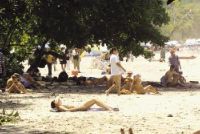
With the expansion of the
Daniel Oduber, airport in
Liberia, Guanacaste,
tourists can now be on the
beach within the hour of of
landing. More than 160.000
tourists are expected to use
the airport this year. |
|
|
The five men, Randall González,
Adrián Chávez Matarrita, Frander Fallas Siles, Luis
Aguirre and Jaime Barrios López were give 33 years
each, however, current legislation limits the
sentence to 30 years maximum for each man.
The original trial was to have been held in Pérez
Zeledón, however, for security reasons, the trial
was moved to the courthouse Goicoechea, east of San
José.
Some of the sentenced are also being investigated as
key suspects in the 2001 murder of radio journalist
Parmenio Medina Pérez.
The Goicoechea court in a separate action, sentenced
Hárold Hernández Quirós for the murder 2003 of
American Brian Kane, in La Granja, en San Pedro de
Montes de Oca, east of San José.
Hernández had claimed innocence since his arrest,
telling the court he did not shoot Kane. However, a
call made from his cellular telephone gave him away.
Hernández was given 32 years in prison for the
murder and robbery.
Judge Rosaura Chinchilla, who presided over the
trial, concluded that Hernández was responsible for
the death of Kane and absolved Jeilin Céspedes Ríos,
whom the Prosecutor had also attributed accused the
crime.
During the trial, the Prosecutor told the court of a
telephone call made by Hernández from Kane's
cellular telephone to Céspedes shortly after the
time of his death. The judge concluded in her
statement, why would Hernández call Céspedes if both
were to have been in the house and committed the
murder?
Tourism on the
Increase
The Cámara Nacional de Turismo (CANATUR)
predicts that tourism will increase 9% this year.
That figure is based on an increase of tourists
coming to Costa Rica over the year 2003.
According to government figures, there were
1.192.889 visitors to Costa Rican in the year 2003.
Based on those figures, Wílliam Rodríguez, president
of CANATUR, predicts an increase of 108.000 more
visitors for this year.
Rodríguez said that the stable economy in the U.S.
and the increase in direct flights to the Guanacaste
region are the principal cause of the increase.
Visitors can now fly from major centers in the U.S.
non-stop to the Daniel Oduber, in Liberia, and be on
the beach within an hour of landing. Figures from
the Dirección General de Aviación Civil (DGAC)
estimate that 160.000 passengers will be coming in
at the Liberia airport.
Rodríguez also added that European tourism is also
on the increase. Each year more and more Europeans
visit Costa Rica. The year 2003 saw an increase of
18% over 2002.
Coffee Importer Tries New Brew in Costa Rica
The president of Houston-based Duncan Coffee Co. has
three farms under contract in the Central American
republic. If the deals go through, the 83-year-old
business will import company-owned coffee for the
first time.
Duncan sees similarities between growing coffee and
raising cattle.
"I like the idea of being able to go out to the farm
and oversee the growth and quality control of the
coffee, just like I'm able to do at my cattle
ranch," says Duncan, who seven years ago revived the
business founded by his great-grandfather Herschel
Mills Duncan.
The cream of the company's coffee crop holdings will
be a 200-acre field in one of Costa Rica's top
producing regions.
Duncan estimates it will take three to five years to
produce top-quality coffee for import and sale in
the local market.
The decision is a "pretty big" capital investment
for the company, says Duncan, who projects an
expense of several hundred thousand dollars to set
up shop in Costa Rica.
The company currently relies solely on brokers to
supply more than 130 different types of coffee.
Ownership of the fields will allow Duncan to know
exactly where the beans originate, and how to price
the products.
"If this works out for us, we can produce 30,000 to
40,000 pounds of coffee a year, which will be
exclusive to the Duncan brand," he says. "And if we
can establish a foothold in Costa Rica, there's no
reason we won't continue to expand through
acquisitions."
Initial sales of the Costa Rica coffee beans, which
are available only during certain times of the year,
will be limited to a select few retailers in the
Houston area.
Duncan Coffee currently caters to a list of upscale
clients that includes the River Oaks Country Club,
Pesce and Cafe Annie.
SunTrips, Mexicana Airlines Reach Deal
SunTrips has reached an exclusive agreement to ferry
its travelers between Denver and Mexico and Costa
Rica on Mexicana Airlines.
The flights on Mexicana begin May 21 for Costa Rica
and May 25 for Mexico. San Jose-based SunTrips
previously chartered B-757-200 aircraft for its
flights from Denver.
The Mexicana Airlines flights will feature
additional amenities, including free movies, bar
service and meals.
From Denver, the SunTrips-Mexcicana flights will go
to Liberia, Puerto Vallarta, Los Cabos and Cancun.
A Euro for Latin America?
A monetary union might be more viable at a sub-regional level for Latin
America, according to a recent study.
Is a Latin American common currency on its way? A study by economists
Mauricio de la Cuba and Diego Winkelried suggests that it might be more
viable at a sub-regional level since some countries, particularly in the
Andean Community, have similar economic cycles and relative price stability.
The study also reports a growing correlation in variable interest rates
between countries in the region—a key condition for a successful monetary
union. Interest rate correlation means countries face similar economic
impacts and improves chances for a common currency.
The study, entitled Macroeconomic Coordination and Monetary Cooperation:
Costs, Benefits and Applicability in Regional Integration Agreements, was
awarded first prize in a research competition sponsored by the IDB’s
Institute for the Integration of Latin America and the Caribbean (INTAL).
De la Cuba and Winkelried find that the number of significant correlations
among countries increases from 29 to 36 percent if monetary policy is not
taken into account in the study. But the opposite occurs when fiscal policy
is excluded. This indicates current fiscal policies are better lined up than
monetary ones. The study covered 1980-2002 and included Bolivia, Brazil,
Chile, Colombia, Ecuador, Peru, Uruguay, Venezuela and Mexico.
Could the results justify an eventual monetary union in the region? If the
29 percent of significant correlations in the region is weighed against the
67 percent of cases found in Europe, the answer is no. But a monetary union
might still be considered for the future. The study indicates greater
possibilities within the Andean Community, where the economic cycles of
Ecuador, Colombia and Venezuela have greater correlations if their monetary
policies are left out.
The study’s findings could serve as a starting point for Latin America and
the Caribbean to follow the European Union, where adoption of the Euro has
allayed concerns over currency conversions that delay trade and financial
flows.
|
1.2 million
protest in Cuba against US sanctions
About 1.2 million Cubans, led by their leader Fidel Castro,
took to the streets in Havana on Friday to protest against tougher
sanctions imposed by the United States.
Waving national flags and chanting slogans, the demonstrators marched to
the US Interests Section in the capital. Castro walked in the first line
of the protesters that stretched several kilometers.
The rally, which the press said was the largest one
in Cuba's history, was an official response to the plan announced by
US President George W. Bush last week.
Under the new measures, 59 million US dollars will be allocated to
fund anti-Cuba activities for a period of two years; cash
remittances from Cuban Americans will be halved and a limit will
also be imposed on family visits between the United States and Cuba.
|

Castro walked in
the first line of the protesters
that stretched several kilometers. |
Before the demonstration, Castro delivered a 20-minute speech. He
said the march was not a hostile expression against the US people but an
indignant protest and denunciation against Washington's "brutal and
cruel measures."
The United States intends to intimidate Cuba and destroy its economic,
political and social systems, Castro said.
Official figures say that the economic, financial and trade embargo
imposed by Washington has cost Cuba more than 72 billion US dollars over
the years.
Plane
carrying 33 crashes in Brazil
A plane carrying 30 passengers and three crew crashed in Amazon area in
northern Brazil Friday night, local TV reported Saturday.
The Globo television network quoted air officials as saying that the
wreckage has been spotted by search helicopters about 20 km from the
city of Manaos.
The reports said the plane, taking off from Sao Paulo de Olivenca near
the border with Colombia, had prepared to land at an airport in the city
before the crash.
But the reports did not say what caused the tragedy and whether there
were casualties in the incident, and only said search for survivors was
already underway.
|


