Gasoline
Prices to Increase Again
La Refinadora
Costarricense de Petróleo (RECOPE) has requested a
new increase in gasoline prices of ¢11 for a litre
of super, ¢10 for regular and ¢8 for diesel. RECOPE
says that the increase is necessary due to the rise
in international prices.
|
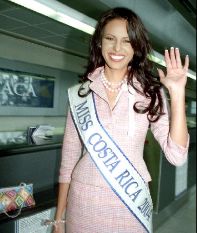
Nancy Soto, Miss Costa Rica
2004, says goodbye to her
admirers on her way to the
Miss Universe 2004 contest
on June 1st. being held in
Quito, Ecuador. |
|
|
|
|
|
|
|
|
|
|
|
|
|
|
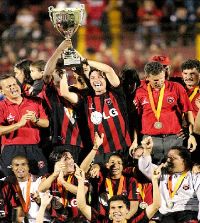
The Alajuelense crushed
archenemy Saprissa in the
CONCACAF championship. For the
first time in CONCACAF history,
two Costa Rican teams have
played against one another for
the championship title.
|
|
|
|
With this increase, the price of
gasoline will jump to ¢315 form ¢304 for super, to
¢301 from ¢290 for regular and to ¢223 from ¢215 for
a litre of diesel.
To fill a 45 litre tank with super gasoline it would
mean an increase of ¢450 colones, bringing the total
to ¢14.175. At the beginning of the year, it cost
¢11.988 to fill the same tank. That's an increase of
¢2.187 colones.
If approved, this will be the sixth price adjustment
this year and all have been for increases. The last
was approved and came into affect on the 29th of
April.
Street Vendors and Municipality Meet
For the street Vendors on 8th Street in downtown San
José, time is running out. The long battle between
the Municipality and the Vendors and the truce that
was negotiated is coming to an end. The Municipality
wants them out, the Vendors want to stay.
Yesterday a leader group for the Vendors met with
San José Mayor, Johny Araya, but no agreement was
reached, other than a reconfirmation that they must
abandon the streets.
At the meeting, the Vendors suggested that a new
market area like the one of Paso de la Vaca on 9th
Street, however, it was rejected by the
Municipality.
Last March the Municipality agreed to a 3 month
period for the 400 Vendors who occupy the sidewalks
of the streets and that time is coming up rapidly on
June 16.
In the meantime, both sides are continuing talks to
find a solution and alternatives that include
weekend fairs, using Municipal parking lots and
perhaps a more permanent solutions, setting up a
fixed market area on Municipal lands.
Notorious Killer Granted Parole
Man
MIAMI -- One of South Florida's most notorious
killers, a man who blamed TV violence for his crime,
has been granted parole.
Ronnie Zamora will be turned over to Immigration and
Customs Enforcement for deportation to Costa Rica
after his release June 1.
Zamora was 15 when convicted in 1977 of breaking
into his neighbor's home and then shooting her with
her own handgun when she threatened to call police.
His trial was the first criminal proceeding to be
televised and drew worldwide attention. His defense
claimed that Zamora was "intoxicated" by the
violence he watched on television.
In February 2003, a state parole board reduced
Zamora's sentence by seven years.
Zamora is now 43. He became eligible for release in
2002 after serving the mandatory 25-year portion of
his life sentence.
His original release date was scheduled to be June
7, 2012.
All Costa Rica: Alajuelense Beats Saprissa for
CONCACAF Champions Cup Title
Forward Alejandro Alpizar netted twin goals for
Alajuelense yesterday, leading his squad to a 4-0
romp over fellow Costa Rican squad and archenemy
Saprissa and to the CONCACAF Champions Cup title.
Froylan Ledezma opened the scoring for Alajuelense
just six minutes into the match, knocking in a pass
from Pablo Gabas at Morera Soto stadium.
At the 23rd minute, Alpizar headed in a pass from
Harold Wallace. Alpizar came back for a second goal
at 40 minutes, knocking in a short pass from Ledezma.
Wilmer Lopez headed in a shot at 76 minutes to close
the score at 4-0.
Saprissa's Jorge Pineda was expelled at 52 minutes
for a penalty against Ledezma.
The two teams tied 1-1 in the first leg of the
championship round.
CONCACAF is the Confederation of North, Central
American and Caribbean Association Football and
one of six continental confederations of FIFA
(Federation Internationale de Football Association)
and serves as governing body of football in this
part of the world. It is composed of 38 national
associations, from Canada in the north to Suriname
in the south
Costa Rica's soccer association has been affiliated
with FIFA since 1921. They first reached the World
Cup finals in 1990, advancing to the second round
before being eliminated by Czechoslovakia.
For the first time in CONCACAF history, two Costa
Rican teams played against each other for the
championship title. With yesterday's win, Costa Rica
has now won the CONCACAF championship 4 times: 2004,
1989, 1969 and 1963.
Costa Rica's soccer has been affiliated with FIFA
since 1921 and have taken part in every FIFA World
Cup™ qualifying competition since 1958, winning
through to the finals in 1990 and 2002. They proved
one of the surprises of Italy '90, racking up two
memorable wins against European sides when they
defeated Scotland 1-0 and Sweden 2-1.
Their campaign ended in the round of sixteen, where
they were crushed 4-1 by Czechoslovakia. Costa Rica
put in another strong performance in 2002, only
going out in the group round on goal difference to
eventual semi-finalists Turkey.
Their best result came in 1946, when they beat
Panama 12-0. Their most ignominious defeat was at
the hands of Mexico, who beat them 7-0 in 1975.
Cash
in on Cool Prices in Costa Rica
We've found some cool prices that will refresh your
travel budget. Flights to Central America's "rich
coast" start at just $146 round-trip, and there is a
pair of vacation packages as low as $369. Those
planning a family getaway shouldn't miss an
adventure cruise with discounted children's rates.
If you're ready to book soon,
United's Costa Rica sale
can get you to this Central American paradise for
less this spring or summer. Fares with this sale
start at $278 round-trip. You must book by May 14,
though you can depart through June 24, on Mondays
through Thursdays. This is a good option for stays
as short as three days, to those as long as 30 days.
And though United is the only major U.S. airline
with a current sale to Costa Rica, it makes sense to
shop around before booking, since other airlines had
lower prices on a few of the routes we checked.
Spain's Iberia Airlines is offering the lowest
Costa Rica airfare
we've seen lately: $146 for travel from Miami to San
José. If you don't live in South Florida, you can
still take advantage of this fare, and Iberia's
other Central American air deals, by flying to the
Sunshine State and connecting with this flight.
Departures are valid through June 30.
For one of the best starting rates that we've ever
seen, look no further than
Jet-A-Way Holidays' Costa
Rican Sampler package, which
starts at just $369. This price includes roundtrip
airfare and four nights at the Best Western Irazu.
In addition, this deal features airport transfers, a
one-day car rental and daily breakfast, adding value
to an already attractive offer. Book by June 15, for
departures through October 31.
While
Gate 1 Travel's Costa Rica
package may not seem as appealing as
Jet-A-Way's offer at first glance, its value depends
on where you live. It also includes airfare and four
nights at the Best Western Irazu, arrival airport
transfers and daily breakfast. And though the lowest
rate is considerably higher at $529, we found better
prices with Gate 1 for several departure cities,
including Boston, Chicago, Dallas and New York.
Departures are valid on select dates through June
10, and from August 19 through October 14. There is
no booking deadline listed.
Families seeking a different sort of vacation
this year will want to consider
Cruise West's discounted
children's fares on six-night Costa
Rica sailings. With this offer, children ages 12 and
under receive a 50% discount on the regular adult
price ($1,699), while older kids (from 13 to 21) are
eligible for 25% cuts. While the overall prices may
seem high at first, they represent a good value for
small-ship adventure sailings, which are typically
more expensive than large-ship trips.
|
 |
Chavez
claims paramilitary infiltration planned in US
Venezuelan President Hugo Chavez said Wednesday that the
Colombian paramilitaries arrested near Caracas since Sunday was an
"invasion" of Venezuela organized in the United States and Colombia.
Chavez, who faces a possible recall referendum, has charged the
right-wing paramilitary United Self Defense Forces of Colombia (AUC) for
collaborating with Venezuelan opposition forces in a coup to oust him,
after about 100 suspected members of the Colombian group have been
arrested mostly at a ranch on the southern outskirts of the capital
Caracas.
Roberto Alonso, owner of the ranch, is a Cuban exile and an important
member of Venezuela's opposition against Chavez. He is reportedly linked
to Cuban exile groups headquartered in Miami opposed to Cuba's Communist
President Fidel Castro.
Miami and Colombia are the two points in an axis and two epicenters
where they were planning, preparing the invasion, Chavez said in a
national broadcast.
With no proof yet, Chavez said investigations would prove his charges
that foreign-backed opponents were conspiring to topple him. He cited
criticism of his rule by US and Colombian authorities, but stopped short
of accusing the US and Colombian governments.
The opposition has dismissed the case as a government ploy to justify a
crackdown on them and to distract attention from efforts to stage a
referendum to recall the president.
On Monday, a police search on a US Embassy warehouse was carried out as
part of the plot investigation. The search found nothing.
US Ambassador Charles Shapiro has denied any involvement in the plan to
use paramilitaries against Venezuela. The Colombian government has also
rejected the coup accusation by Chavez and supported the Venezuelan
authorities in probing the case.
Three active-duty Venezuelan military officials have been detained by
the authorities for allegedly cooperating with the suspected
paramilitaries.
Preliminary investigation indicated more than 130 Colombians, dressed in
Venezuelan military uniforms, had been undergoing military training at
the ranch after they secretly came to Venezuela in March.
Security officials said the police are still hunting other Colombians
who have fled the ranch.
Nicaragua works out
law on weapons control
Nicaragua has worked out a draft law to control weapons and related
materials in an effort to contribute to the western hemisphere's
security, President Enrique Nicolas Bolanos Geyer said Wednesday.
He made the statement at the opening of a seminar on control and
destruction of light weapons, saying the draft law was submitted on Jan.
10 to the parliament.
He said the draft was designed to regulate the trade, import and export,
production and possession of fire arms, munitions, explosives and other
related materials.
Bolanos said about 6 million US dollars have been spent to find illegal
weapons and buy weapons from illegal groups.
The seminar has been attended by some senior officials of the
Organization of American States (OAS)
Statistics provided by the country's National Police and the army showed
that about 78,000 weapons were seized in the capital Managua, while the
Defense Ministry has so far destroyed 22,000 war fusils and thousands of
anti-personal mines, local media reported.
Colombian gov't softens position on FARC for freedom of kidnapped
The Colombian government offered not to describe the guerrilla
Revolutionary Armed Forces of Colombia (FARC) as terrorist if the sick
kidnapped people are freed.
Governmental official Eduardo Herrera Verbel told the press that the
FARC could become a "middle negotiator" to reach a humanitarian accord
with the Colombian government.
Verbel said the government had given up very important political spaces
to achieve the freedom of the kidnapped people, as long as the FARC also
fulfilled their commitments.
The government's proposal was unveiled at a forum of the Good Government
Foundation.
The FARC holds several foreigners, as well as soldiers, policemen and
politicians. Former presidential candidate Ingrid Betancourt is among
them.
The guerrillas have insisted that the only way to release the abducted
people be through a humanitarian accord to stipulate their swap for the
500 guerrilla combatants jailed in Colombia.
Meanwhile, the Colombian army has arrested the FARC's chief of security
in Florencia, the capital of the southern Caqueta department, military
officials said Wednesday.
The FARC is the oldest and largest leftist guerrilla in Colombia, with
some 17,000 to 20,000 combatants distributed throughout the nation.
Colombia has been locked in a four-decade civil war, the longest in
Latin America, in which government forces, leftist guerrillas and
far-right paramilitaries fight against one another. The conflicts kill
an average of 3,000 people every year.
Brazilian opposition, press criticize US reporter visa cancellation
Brazil's press and opposition on Wednesday criticized the government's
decision to cancel the visa for a US journalist of The New York Times,
who reported Brazilian President Luiz Inacio Lula da Sila as an
"alcoholic."
The sanction against Larry Rohter broke freedom of the press, said the
opposition and mass media.
Brazilian dailies noted Wednesday that reporters had only been expelled
from the country in the darkest period of the military regime that
dominated the nation from 1964 to 1985.
The opposition expressed indignation over the sanction against the US
correspondent, who released on the newspaper a story about the alleged
alcohol addiction of da Silva on Sunday.
Under the Brazilian law, a foreigner whose visa has been canceled has
eight days to leave the country. If he does not, he will be expelled by
force.
Jose Agripino of the Liberal Front Party said the decision "turns an act
of the state into a personal reprisal."
Although Lula's ruling Workers' Party voiced complete solidarity with
the president, some of its parliamentarians also questioned the validity
of the government's decision.
Brazilian Attorneys' Order President Roberto Busa to regretted the
incident, saying it was not Brazil's tradition to expel reporters.
Brazilian Foreign Press Correspondents Association President Michael
Astor said the cancellation of Rohter's visa violated freedom of the
press in the country.
Sources from the government said the order to call off Rohter's visa was
given by da Silva.
But da Silva argued that Rohter "does not know me and I do not know him,
but today he must be more concerned than I am. I don't comment on the
case, and it is the Justice Ministry that comments. This is a case that
doesn't deserve an answer, it deserves an action."
According to the Justice Ministry, the decision was made "in the face of
a light, lying and offensive article to the honor of the president of
the Federal Republic of Brazil, with serious damage to the image of the
country abroad." |
 |
|
|
|
|
|


