Pacheco Visits Areas Affected by Rain
President Abel Pacheco, accompanied by the Minister
for the Presidency, Ricardo Toledo and Minister
Public Works and Transport (MOPT), Javier Cháves,
visited the Limón area that has been affected by
have rains the last several days.
|
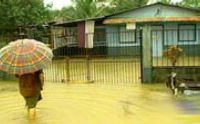
Many houses like the one
above are flooded, the
effects of the heavy rains
of the last 72 hours in the
Atlantic and Northern Zones.
The most affected areas are
Matina, Batán and Siquirres
in Limón and Puerto Viejo de
Sarapiquí in Heredia and la
Fortuna de San Carlos. |
|
|
|
|
|
|
|
|
|
|
|
|
|
|
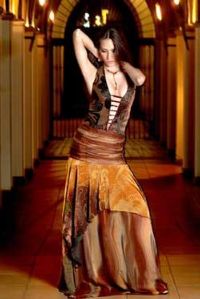
Sonia Chang, who will present
her couture evening and
ready-to-wear collections at the
Miami Beach's Fashion Week of
the Americas.
''She some socialites and
fashion-forward first ladies of
Costa Rica,'' according to Cece
Feinberg, Chang's publicist.
Chang currently is carried
solely in her native Costa Rica.
The event showcases Latin and
Caribbean clothing, accessory
and jewelry designers, as well
as those from a handful of other
countries, including Canada,
Italy, Spain, Panama, Trinidad
and India.
|
|
|
|
The President toured the areas of Sarapiquí,
Matina and Batán - Batán is Pacheco's birthplace.
The President told the residents that he came to the
area to see first hand the damage and give hope to
the residents of the area that the government will
be there to help those affected.
The Comisión Nacional de Emergencias (C.N.E.)
released a preliminary count of 2.076 persons
affected by the rains of the last 72 hours and who
are now lodged in temporary shelters and three
deaths, who were swept away by torrential rivers.
The hardest affected are the communities of Matina,
Batán and Siquirres in Limón, as well as Puerto
Viejo de Sarapiquí in Heredia and la Fortuna de San
Carlos.
The CNE has called a "red" alert of the Atlantic
zone and a "yellow" alert for the Nortern Zone.
US, Central America to Sign Trade Deal May 28
US and Central American ministers will
sign up to a free-trade pact in Washington later
this month, El Salvador's economy minister said.
"All agreed the signing will be May 28," Miguel
Lacayo said.
Nicaragua, Guatemala, Honduras and El Salvador
reached agreement with the United States on the
accord in December. Costa Rica did so in January.
The signing ceremony will take place at the
Organization of American States, in Washington, he
said.
Trade ministers of Guatemala, Honduras, Nicaragua,
El Salvador and Costa Rica will sign the document,
along with Robert Zoellick for the United States,
Lacayo said.
The Dominican Republic will accede to the agreement
in a separate ceremony to be held in July at the
latest, he said.
Lacayo said the document's final text should be
prepared by next week.
The legislature of each country will then need to
ratify the signed agreement.
The United States plans to submit the Central
American agreement for ratification after US general
elections on November 2, according to US lawmakers
who visited San Salvador on the weekend.
Wanted Italian Arrested in Costa Rica
The count for this year so far is 12. That is, 12
foreign nationals who have been arrested in Costa
Rica on international warrants, wanted in their
countries and having fled to Costa Rica.
The latest case is of Italian national Ilvo Usai who
is wanted in his country for fraud in excess of $2
Million Dollars.
Fusai had been in Costa Rica for some time and owned
a several businesses - two North American clothing
outlets in San José and a ceramic tile business in
Alajuela.
 |
According to
Eduardo Guzmán, chief of the "capturas" section
of the police, the capture had been planned for
the week earlier, however, they had lost traces
of the man for a while.
Usai was not aware that he was wanted by the
Italian justice. He had come and gone to and
from Costa Rica on a number of occasion, the
last recorded entry into Costa Rica was last
December at the Juan Santamaria airport. |
The man lived in a luxurious
residence in La Aurora de Heredia. He was arrested
by police and Interpol agents in the area of Sabana
Norte yesterday morning. Police say the man was
relaxed, though surprised, when shown the
extradition request against him.
Usai was sentenced in October of 2000 by a court in
Turin, Italy.
Three Beers is
the Limit
Following the passing and
coming into law of the new transit laws, most are
not aware that in addition of the use of the seat
belt requirement by all passengers, the law also
regulates drinking and driving.
Transit police
have given until May 19 for drivers and
passengers to get into the habit of using their
seatbelts, by only giving out warnings, the same
is not with drinking while under the influence
of alcohol.
According to Ignacio Sánchez, director of the
Transit police, the law allows transit officials
to confiscate the driver's license of anyone who
is found to be driving intoxicated. The norm and
depending on the body metabolism of each person,
is three beers per hour and there is no grace
period or warnings as in the case of not using a
seatbelt.
Transit police have been out and about in full
force stopping drivers as well as spot checks in
various locations. Transit police have the
right, under the new law, to stop a driver
and/or passenger who is not using their seatbelt
restraint or are driving in a dangerous way.
|
 |
As of yesterday, Sanchez said,
that 30 motorcycle units donated by the government
of Spain, in addition to another 10 purchased by the
Transit authority, are patrolling the roadways. This
is in addition to the normal Transit police patrols.
The new BMW and Honda motorcycle cops will be
handing out ¢10.000 colones fines.
Earth
Council Flees Costa Rica
Global maestro of sustainable development
Maurice Strong is in a pickle in Costa Rica. The
government in San Jose is chasing one of his most
important global policy instruments, the Earth
Council, for US$1.65-million, charging the council
with the "wrongful sale" of land which the
government had granted it for a headquarters. As a
result, the council has left the country.
In the wake of the Rio Earth Summit in 1992, Mr.
Strong -- perennial United Nations player-referee
and now a key advisor to Canada's Prime Minister
Paul Martin - set up the Earth Council as a
"watchdog" on the process he had started himself. It
was to keep up the pressure for Agenda 21, Rio's
doorstop socialist wish list, as well as for global
restrictions on carbon emissions.
The council was also to seed myriad new
non-governmental organizations to spread the gospel
of sustainable development, and push the notion of
an "Earth Charter," which had been rejected at Rio.
As the location for this beacon of radical
environmentalism, Mr. Strong chose Costa Rica, well
known for its status as eco-tourist paradise and tax
haven. In 1996, the Earth Council was granted land
on which to build a new headquarters, with the
provision that the land would have to be returned if
the council shut down or moved on.
Intriguingly, the funds to build the new
headquarters were to come from part of the proceeds
of issuing Costa Rican Carbon Bonds, a Swiftian
emissions trading instrument which entitled the
bearer to emit CO2 if he paid the government of
Costa Rica not to torch its own rain forest. Hence
"value" would be created literally from thin air,
with the proceeds to flow to part of Mr. Strong's
master plan to save the world from capitalism. At
least capitalism as practiced by others.
Mr. Strong had long held land in Costa Rica, and had
become embroiled in a tourist development for which
he was harshly criticized by local native groups.
Also, in 1994, when he was head of Ontario Hydro,
Mr. Strong had become steeped in controversy when he
was discovered to be considering the purchase of a
swathe of Cost Rican rain forest.
In anticipation of the carbon bond proceeds, the
council started spending its own money on
development plans, eventually sinking $1.1-million
into the centre. But then a new Costa Rican
government abandoned the carbon bond plan, and
suggested that the Earth Council share the
facilities of the United Nations' University of
Peace, which also happens to be in San Jose.
However, trouble arose in paradise when the Earth
Council decided to reimburse itself for its
expenditures by selling the land that Costa Rica had
given it. The government cried foul, and the Earth
Council upped and departed the country, citing the
drain of the legal fight.
That Mr. Strong's council is miffed is obvious from
a thinly veiled warning on the Earth Council's
web site that if Costa Rica doesn't
get its act together, then other UN-type boondoggles
might not find their way to its shores. "This
unfortunate experience of the Earth Council," says
the council, "will also affect the attitudes of
other international organizations in deciding
whether to locate in Costa Rica."
The council, meanwhile, has moved its operations
back to Toronto, which is also threatened with the
first offshore campus of the University of Peace.
|
|
Colombian paramilitaries reject coup accusations by Venezuela
The right-wing paramilitary United Self Defense Forces of
Colombia (AUC) on Monday rejected the accusations by the Venezuelan
government, who charged the AUC for collaborating with Venezuelan
dissidents in a coup to overthrow left-wing President Hugo Chavez.
"We reject the accusations made from Venezuela by its leaders, "AUC top
leader Salvatore Mancuso told Colombia's RCN television via telephone.
"Only sick people with messianic delusions of staying in power by the
force of dictatorship can put forth stories so far from reality."
Venezuelan authorities on Sunday arrested at least 88 paramilitaries.
Mancuso also accused Chavez's government of maintaining an
"anti-democratic collaboration" with the Revolutionary Armed Forces of
Colombia (FARC) and the National Liberation Army (ELN).
According to the Colombia police and military sources, Colombian
paramilitaries and left-wing guerrillas operated in Venezuela, just
across the border from Colombia.
The AUC is an illegal armed group with 13,000 members. It was created by
the far-right elements about 22 years ago.
Colombia has been locked in a four-decade civil war, the longest in
Latin America, in which government forces, leftist guerrillas and
far-right paramilitaries fight one another. The conflicts kill an
average of 3,000 people every year.
Cuba
closes hard-currency shops
The Cuban government has closed most shops
selling goods in dollars.
It says it is an emergency measures in reaction to United States'
proposals to tighten its embargo on the country. US President George W.
Bush last week gave his backing to various measures designed to hasten
the end of Fidel Castro's rule in Cuba.
The moves include a reduction in the
amount of money Cuban Americans are allowed to take to their
families on the island. Thousands of shops across the country were
shut on Tuesday.
Department stores that sell furniture, electrical equipment or
hardware all had their doors firmly closed. In the morning crowds
milled outside. A heavier than normal police presence was
noticeable. |
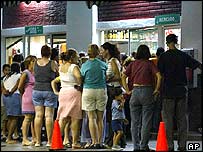
Queues formed outside dollar-
stores in Cuban cities |
Some Cubans were staring at the signs reading "closed
until further notice" with an air of disbelief.
Since the dollar was legalized in the early 1990s, dollar stores have
become the only places for them to buy not just luxuries but some
essentials too, particularly clothes.
Cuba has given no detailed explanation for shutting the shops - beyond
that faced with US aggression, it is necessary to conserve resources.
Long queues have formed outside dollar stores that sell food. They have
been allowed to stay open but some wonder for how long.
There is an air, encouraged by the Cuban government, that this country
is getting on a war footing. Dissidents have expressed dismay at the
whole turn of events.
They say that President Bush's declared aim to speed up political change
here has given President Castro the perfect opportunity to create a
sense of crisis in the country and they warn that a wider clampdown may
yet come.
Honduras
withdrawing troops from Iraq: president
Honduran President Ricardo Maduro said on Tuesday that his
country had begun withdrawing its troops from Iraq, as the first of its
369 soldiers arrived in Kuwait, reports reaching here said.
Maduro, who is now on a tour of Japan, Spain and Italy, made the
announcement in an interview broadcast early Tuesday from Tokyo.
"I'm pleased to officially announce to the Honduran people that we have
begun withdrawing our soldiers from Iraq and that some of them are
already in Kuwait," he said.
However, he did not specify how many troops had left Iraq, but said that
preparations for a full withdrawal were under way and that all the
troops would soon return home.
Honduras and the Dominican Republic decided last month to pull their
troops out of Iraq following Spain's decision to bring home its soldiers
in Iraq.
Honduras, a close ally of the United States, sent troops to Iraq around
the middle of last year as peacekeepers, who had planned to stay there
until July. |


