Canadian Offers to Develop Paquera
A report by the Spanish daily La Nacion tells us
that, Francesco Pécora, a 39 year old Canadian
arrived in the small community of Paquera, in the
Nicoya Peninsula, offering a multimillion dollar
loan to the Asociación de Desarrollo Integral de
Paquera (ADIP), backed by gold bullion.
ADIP is the government agency responsible for the
development and growth of this small community of
6.000 people.
|
 |
|
Magnate or scam artist?
Pécora, the 39 year old
Canadian who is promising to
finance a paradise in
Paquera, says he doesn't
have to prove if has the
money or not. Foto:
David Vargas/LA NACIÓN |
|
|
|
|
|
|
|
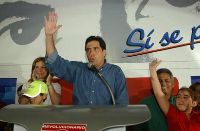
Panama's President-elect Martin
Torrijos waves after winning the
elections in Panama City,
Panama, Sunday. |
|
|
Pécora is promising to finance a paradise: a new port, an airport, a
university, a hospital, hotels and casinos.
To date, Pécora offered ADIP $134.2 Million Dolloars (¢57.840 Million
Colones) with showing if he really has the money or where it's origin.
Members of the ADIP board of directors of ADIP believe Pécora and gave him
the keys to the treasury, while the community is divided.
Pécora has been manager of ADIP since December and is spending the
organization's money. To date he has passed cheques for about $12.000
dollars and has billed ADIP for room and board.
However, the ferries that were promised as part of Pécora's financial plan
have yet to arrive and nor has the documentation backing Pécora financial
promises or has be handed over any money to the community.
Pécora and his partner, Costa Rican Ileana Romero Bermúdez, say they
represent the Euro Capital Group, which is supposedly a multi million dollar
international investment group housed in the United States.
However, a check on the internet reveals no such group and neither are they
listed with the U.S. Security and Exchange Commission.
"Bill Gates has nothing compared to Euro Capital. For us, two billion
dollars is nothing", Pécora told the daily Spanish newspaper La Nacion this
past week, when asked by that paper to explain the roots of the company.
"I don't have to prove anything. I will do so when I am ready", Pécora
emphasized during the interview.
One thing is for sure, Grupo Euro Capital F.I. S. A. is a registered company
in Costa Rica, with Romero as it's treasurer and Pécora as president, with
it's office located in Hatillo Centre, with ¢100.000 Colones or $230. in
capital.
Is this a total scam?
ADIP has more than 300 affiliates with more than 30 years, serving as the
main thrust for progress in the area. In the last five years alone it
brought more than ¢350 Million colones to the area.
ADIP's principal activity is the ferry transport between Puntarenas and
Paquera, carrying daily vehicles and passengers, generating more than ¢600
Million Colones per year.
In March, the general directorate of ADIP asked Pécora and the board of
directors to produce certificates and other documents and titles to back his
claim. However, Alvin Jiménez, president of the association only produced a
key which is supposed to open a safety deposit box where the documents and
titles are being kept.
To complicate matters, the Ministerio de Obras Públicas y Transportes (MOPT)
just last week awarded the ferry Tambor - competitor to the ferry operated
by ADIP - a 10 year concession and exclusive rights to run two ferries
between Puntaranas and Paquera.
To date, the route was divided between the two ferries, one owned by Tambor
and the other by ADIP.
The Dirección Nacional de Desarrollo Comunal (Dinadeco) is investigating the
business between Pécora and ADIP.
Canada
Strict on Costa Rican Visitors
The increase in Costa Rican going to Canada has
prompted Canadian immigration officials to take a closer look at all Costa
Ricans entering Canada.
Costa Rican consul general in Canada, Lina Ajoy, says that each week about
14 Costa Rican are detained by immigration officials.
Costa Ricans are using the fact that Canada does not require a visa to enter
as tourists and then stay, working illegally and in some cases, crossing
illegally over any one of the border crossing points into the U.S.
Most of the detained are returned back to Costa Rica within hours of being
denied entry. Others, who do not voluntarily accept deportation are being
held in immigration detention centres awaiting a hearing.
This is the reason why immigration officials are being stricter on Costa
Ricans as they try to enter the country. Their documents are closely
reviewed and each is interviewed as to their intention of their visit.
Marco Badilla, director of immigration in Costa Rica, tells that Canada has
an internal alert, however, there has been no immigration policy change with
regard to Costa Ricans.
Costa Ricans who want to visit Canada must meet the following criteria:
provide immigration officials with proof of where they are going to stay - a
confirmed hotel reservation or the name or a friend or family member where
they will be staying and demonstrate sufficient financial resources for the
duration of their intended stay.
International
Police Academy Nixed
A series of modifications to the original accord,
made by the International Relations Commission of the Legislative Assembly,
led the United States to decide against installing the International Law
Enforcement Academy (ILEA) in Costa Rica.
The United States Embassy in Costa Rica rejected the modifications in a
press release. It set an April 30 deadline to withdraw the amendments,
or it would consider the project unviable.
One of the amendments prohibits the participation of military officers as
instructors, administrative personnel or students, as established by Costa
Rican law, said deputy Rodrigo Alberto Carazo of the Citizen Action Party.
"Arguing reasons of sovereignty on the issue of nations’ internal security,
the US maintains its interest in incorporating military officers in the
academy’s work," Carazo said.
Another amendment is related to respect for international human rights
treaties. The US maintains that all training should be carried out in
agreement with the international treaties of which it forms a part.
Nevertheless, Carazo said this affirmation is particularly serious, because
the United States has not ratified the majority of international treaties on
human rights.
Taiwan on Alert
After Threats
Taiwanese authorities have stepped up security for foreign embassies after
threats were made against diplomatic staff planning to attend President Chen
Shui-bian's inauguration, officials said today.
The National Police Agency (NPA) confirmed that the embassies of Panama,
Costa Rica, the Dominican Republic, Nicaragua, Honduras and El Salvador
had received threatening phone calls.
Taiwan's foreign ministry said presidents from 11 countries had planned to
attend Chen's inauguration on May 20.
Twenty-six countries recognise Taiwan, which China regards as part of its
territory waiting to be reunified, by force if necessary.
The NPA said it had ordered beefed-up security around the embassies after
the threats.
Chen's Democratic Progressive Party plans to invite at least 200,000 people
to witness his inauguration, despite threats of a mass opposition protest.
Two grand evening galas will also be staged, with one scheduled for May 19
in the southern city of Kaohsiung and another for May 20 outside the capital
Taipei.
Late Dictator's
Son Wins Panama Presidential Race
Martin Torrijos, the son of a former dictator, won
Panama’s first presidential elections since the handover of the Panama Canal
and withdrawal of US troops in December 1999, electoral authorities said.
Ex-president Guillermo Endara, his main rival, conceded defeat to Torrijos,
whose father was the late dictator General Omar Torrijos who ruled Panama
from 1968 until his death in 1981.
During the campaign, both candidates had vowed not to revive the nation’s
authoritarian past, but in his victory speech Mr Torrijos said: “If my
father were here, he would be proud of what we accomplished today.
“I invite everyone to join in a new social pact against poverty, corruption
and despair,” he continued. “It will be a social pact of solidarity, social
justice, opportunity and prosperity.”
Campaign officials said the US-educated Mr. Torrijos would focus on tax and
spending reform, negotiating a free trade agreement with Washington, and
improving the canal.
Mr Torrijos won around 47% of the vote, to around 29% for Mr Endara, with
about one-quarter of votes counted. In his concession speech, Mr Endara
said: “I am happy, because our democracy emerged from this untouched.”
Third-place candidate Jose Miguel Aleman, of President Mireya Moscoso’s
ruling Arnulfista Party, conceded defeat after winning around 19%, saying,
“the people have spoken loudly and clearly, and Martin Torrijos is the
president of all Panamanians”.
Voter turnout in the nation of 2.8 million reached nearly 80%, despite the
fact that both leading candidates were heavily associated with the country’s
troubled past. “Our people have liked democracy so much, they don’t want to
lose it,” quipped Mr Endara, whose 1989 election was overturned by the
military. He was sworn into office later that year, when US troops invaded
Panama and overthrew dictator General Manuel Noriega, and served until 1994.
After rejecting his father’s authoritarian style, Mr Torrijos paid a visit
to his father’s crypt before voting yesterday. Later in the day, he said: “I
hope that people vote thinking of the future, about their families and the
needs of the country.”
Despite his authoritarian rule, some have fond memories of Mr Torrijos’
father. He was liked for his folksy style, land reform and public works, and
for signing the treaty that resulted in the handover of the formerly US-run
canal to Panama.
But the younger Torrijos has reformed the party, easing out most of the old
guard, and Panama abolished its armed forces in 1992.
|
|
Peru
recalls ambassador to Cuba
Peru has recalled its ambassador to Cuba to
protest "offensive" remarks by Cuban leader Fidel Castro, the government
said late Sunday in a communique.
The communique said Cuban leader Fidel Castro slammed Peru and other
Latin American countries in a May Day Speech for their vote at a UN
human rights body in Geneva to demand Cuba's cooperation with
international organizations in the protection of human rights.
The Peruvian government rejects the "offensive" remarks made bythe Cuban
leader, the communique said.
Chile
may send more troops to Haiti
Chilean President Ricardo Lagos said Saturday that his country may
increase the number of Chilean troops deployed in Haiti on a
peacekeeping mission.
The decision would be made after he discussed the issue with Brazilian
president Luiz Inacio Lula da Silva and received a nod from Chile's
Senate, Lagos told local press.
Lagos, who is now in Singapore for an official visit, confirmed Friday
that the United Nations Security Council had decided to replace the
current 3,600-member contingent of US-led troops with UN peacekeepers
from June 1 for an initial period of six months.
The troops from the United States, Canada, Chile and France have been on
patrol since the ouster in February of Jean-Bertrand Aristide, Haiti's
first democratically elected president.
Lagos said the United Nations' decision "is important because it
proposes the withdrawal of certain troops and the council wishes Chilean
troops to stay."
"We must carry out an evaluation and we also want to establish contact
on this issue with President Lula and the Chilean ambassador to the UN,"
he said.
Lagos said the cost of the presence of Chilean soldiers in the
peacekeeping force was one of the issues to be considered, but he
branded as "demagogic" domestic criticism on the issue.
LATIN AMERICA: Gender parity in
education improves
A recent report of the United Nations
Organization for Education, Science and Culture (UNESCO) said that the
region had achieved an adequate level of gender parity in education in
the last decade, although girls still suffer some level of
discrimination in gaining access to schooling.
The Follow-up Report on Education for Everyone 2003-2004 focuses on
educational parity between boys and girls, the first of six goals set by
164 governments that met in the World Education Forum held in Dakar,
Senegal in 2000.
In some countries like Mexico and Colombia, the parity favors girls
because there are a considerable number of boys who do not finish
secondary school.
Koichiro Matsuura, director general of UNESCO, said the good results
obtained by most of the Latin American countries does not mean that they
do not have other serious educational problems to resolve, such as
improving the quality of teaching.
|


