For Former President, the Culmination of a Lifetime of
Diverse Experiences
By Nora Boustany
The Washington Post
Miguel Angel Rodriguez Echeverria, the former president of Costa Rica,
sat up straight at his spotless desk, ready for prime time. His choice
of clothing, a navy blue blazer, a blue-and-white striped starched shirt
and gold cuff links, suggested a penchant for perfection, discipline and
diligence.
Unanimously elected secretary general of the 34-member Organization of
American States on June 7, Rodriguez, 64, takes over this key leadership
post in September. Until then, he and a handful of aides are ensconced
in his transitional offices on F Street.
|
|
|
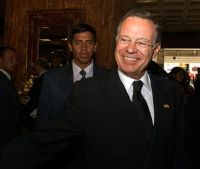
Miguel Angel Rodriguez |
He said he had no illusions about the bumpy road ahead and the vast
task of reducing poverty, and promoting the rule of law and human rights
in a region where natural disasters, disenchantment with government and
disappointment with democracy and free trade are endemic.
"Every country is faced with the same kind of problem, how to organize
power, how to lead its institutions and allow society to grow, to feel
included and to have equity so all can share in fair human rights
standards and growth," he said. "Of course each nation has its
peculiarities and specificities, but inter-American goals are the same."
In 1968, at the age of 28, Rodriguez became one of Costa Rica's youngest
government ministers. He was elected to the legislative assembly as a
representative of the Social Christian Unity Party in 1990 and as house
speaker the following year. In 1998, he won the presidency. He went on
to become a visiting professor at the George Washington University
Elliott School of International Affairs.
Rodriguez, who received his master's and doctorate degrees in economics
at the University of California at Berkeley, emphasized that he hopes to
draw on his experience as a statesman, his training as a lawyer and an
economist and his extensive reading of political philosophy to carry out
his new job.
John F. Maisto, U.S. ambassador to the OAS, said: "When I was ambassador
to Nicaragua, he was very active in Central American conflict resolution
processes as president of his party. He used to work quietly, helping
Nicaraguans resolve crises."
"He is not only a statesman, he comes from a stellar democracy which is
Costa Rica and which has a solid reputation in human rights and
education. He is an excellent choice because he combines experience as a
former president, legislator, party head and in both the private and
public sector."
Rodriguez also has spiritual side, steeped in Catholicism and an abiding
love for his pious grandmother, who doted on him and made him believe at
the age of 3 that he could become president and that he had the
obligation to improve conditions around him, he recalled.
Her name was Lupita Velasques de Echeverria, and she was the
granddaughter of Jose Maria Castro Madriz, who became Costa Rica's first
president in 1848 when it declared itself a republic. Although her
family later fell on hard times, she never lost her bearings. A proverb
she often repeated was "Pray to God and hit the hammer," Rodriguez said,
to emphasize the value of faith as well as hard work. She wore hats, a
veil and gloves when she went out on her long walks and badgered her
grandchildren about table manners and social graces.
"She had such a great influence on me. When I was barely 5, I mistakenly
thought I could become the president of America as well," he chuckled.
When he was young, he sat at her feet and she taught him English and the
importance of developing a sense of equality and of caring.
"My only idol is Jesus," Rodriguez said. "He was a carpenter until he
was 30, he worked with ordinary people. He prayed and worked and
performed miracles. . . . working hard, making marginal progress, the
activity of creating and improving things slowly . . . all that is a
miracle."
Rodriguez said the happiest day of his life was the birth of his son
Miguel Alberto, and the saddest day was in 1979 when his son died in an
accident while on a mountain climbing expedition.
At home, where his success has been widely celebrated, opposition party
members had raised questions about his slow response to an inquiry into
campaign finances involving his party.
Last week he appeared before a commission probing a loan his wife's
company made to the party in 1994 that was repaid by a group of
individuals after he left office, he said.
In vying for the OAS post, Rodriguez left no stone unturned. He lobbied
feverishly for support, and in the past two years jetted to 31 countries
to discuss his vision with their presidents, prime ministers and foreign
ministers and to listen to their views and concerns about their place in
the inter-American system.
"I suppose I carried out a good campaign," he said.
© 2004 |


