|
CCSS
Has New Chief
The new head of the
scarred Caja Costarricense del Seguro Social (CCSS)
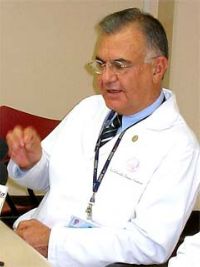
is Dr. Alberto Sáenz Pacheco, a cousin of President
Abel Pacheco.
The current
sub-director of the Hospital de Niños (Children's
Hospital) in San José was recently named as chief
executive of the CCSS and affirms that his election
was a surprise and was a grateful for the vote of
confidence while accepting the post.
Dr. Sáenz has more than 29 years working at the
Hospital de Niños and said that his new patient (the
CCSS) will be much harder to treat, citing that the
cure for the CCSS is to combat corruption.
The CCSS has had it's president being accused of
being influenced by the CCSS's largest supplier of
medical equipment, the Fischel Corporation and has
had it's board of directors suspended and a new
board installed.
Sáenz will taking control of the CCSS in the near
future and said he only knows two of the eight new
board members, hoping he can forge a good alliance
with all the new members to correct the direction
the CCSS. His post is only for six months, however,
he indicated that if he is asked to stay at the post
longer, he will accept.
Sáenz father, Dr. Carlos Sáenz Herrera, founded the
Hospital de Niños.
On Tuesday the CCSS had a new board of directors was
appointed, even though the new board is provisional
while the problems at the CCSS are being
investigated deeply by the authorities.
The old board of directors was removed last week
when the
Ministerio Público
launched an investigation into the possibility that
the board detoured public funds.
Michigan Boys:
Warren Officials Deny Prostitute Allegations
By
Mary Owen
Detroit's WXYZ-TV (Channel
7) and city-run TV Warren are challenging each
other's news report about 200 Michigan men,
including some public officials, who went to Costa
Rica for an annual fishing trip in May.
Warren officials said Friday that they have no
intention of retracting statements alleging that
WXYZ-TV investigative reporter Steve Wilson hired
prostitutes to hang around the Michigan men to
manufacture a story.
During reports that aired May 17-19, Wilson alleged
that there were "dozens of prostitutes who paid the
organizers $300 to get into the hotel taken over by
the Michigan Boys."
Local members of the group in Costa Rica included
Warren Police Chief Dan Clark, Police Sgt. Lou
Galasso and Macomb County Circuit Judge Ed Servitto.
All three officials, part of a group that calls
itself the Michigan Boys, denied wrongdoing. But
Wilson said Friday that the thrust of his report was
to question why public officials would engage in
activities where prostitutes would be involved.
Wilson, who spent 10 days in Costa Rica with a
camera crew, denied hiring prostitutes for the
story.
Warren officials called the report unfounded and
snapped back with their own media blitz when Wilson
did not provide video of anyone with prostitutes.
Wilson admits that none exists.
In a May 20 Warren press release, Deputy Mayor Mike
Greiner cited a May 13 article in an
English-language newspaper in Costa Rica. The
newspaper wrote a story in response to a La Nacion
newspaper article about Wilson's endeavors. La
Nacion, a Spanish-language newspaper in Costa Rica,
worked with Wilson on his story.
The article said Wilson and a reporter from La
Nacion, went to a beach in Flamingo, Costa Rica, "to
line up underage prostitutes." Wilson and the
reporter from La Nacion secretly photographed one
30-year-old woman bragging that she could supply
underage prostitutes, but she never did.
James Stewart, attorney for Wilson and WXYZ-TV, sent
a letter May 27 to Warren officials demanding that
they retract and stop making statements alleging
that Wilson hired prostitutes.
The letter said further comment by city officials
"compounds the liability that already exists for
past publication of these knowingly false
statements."
"Our story was fair, balanced and accurate," said
Wilson.
After the first Channel 7 report aired, Wilson
revisited City Hall. That's when staff from the
city's TV Warren followed Wilson around police
headquarters and ran their own version of the story,
asserting that Wilson's story was baseless. The TV
Warren report, which called Wilson's interview with
the police commissioner Jim Vohs "heated and
confrontational," aired six times daily from May 24
to June 1 in Warren.
News Summary:
- The cleaning crew at the Hotel Tryp Corobici got a
surprise of a lifetime, when on Monday in the early
afternoon, workers found a body in the basement of
the hotel.
The body was found in one of the the ventilation
ducts and was rotting. The Organismo de
Investigación Judicial (OIJ) removed the body from
the location and have begun their investigation if
it was an accident or murder.
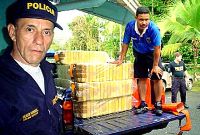
- In Golfito, at kilometer 37 on the Interamericana
South highway, police confiscated about 600 kilos of
cocaine. The drug was hidden in a truck driven by a
Costa Rican identified as Ugalde Jiménez, who is in
police custody.
The bust is the largest for the area this area,
bringing the total amount of drugs confiscated in
the area to more than 1.200 kilos for the year 2004.
|
|
OAS to
Stay in Venezuela for Recall
Miguel Ángel Rodríguez, who was elected
Monday as new secretary general of the Organization
of American States (OAS), said he deemed necessary
to keep the observation mission in Venezuela in a
moment when the country has completed the stages of
collection and verification of signatures for the
presidential recall vote and awaits a date to hold
it.
Rodríguez, a former president of Costa Rica, pointed
out that the Venezuelan referendum has no precedent
in Latin America, and congratulated both the
government and the opposition for seeking solutions
to their conflicts through electoral mechanisms.
The secretary general-elect, who is expected to
officially take over on September 15, expressed his
confidence that the upcoming process will be carried
out with transparency and respecting democracy.
Rodríguez met with U.S. Secretary of State Colin
Powell early in the morning to talk about the
Venezuelan situation, and both said to be happy
about the enormous democratic progress made by the
parties involved in Venezuela's political crisis and
their turning to the Constitution to solve it.
A few hours before, during the opening of this
year's plenary session of the organization, Powell
had mentioned Venezuela in his speech. He
"commended" the Venezuelans for having completed the
ratification process on the signatures backing the
presidential referendum and for having committed
themselves to respect the results of the vote.
The U.S. official also underscored the crucial role
played by the OAS and the Carter Center in helping
solve the political impasse through an election, as
established in the Resolution 833 of the OAS and the
agreement of May 2003 between the parties.
"We, the governments of the Americas, must give the
peoples of our hemisphere good reason to think that
elections will result in accountable leaders who are
committed to far-reaching democratic development,"
he said. "We must give ordinary people good reason
to think, to believe, that their elected
representatives, once in power, will operate within
the law, that they will combat corruption and that
will practice transparency in government."
Meanwhile, Venezuela accepted Rodríguez'
announcement that OAS' observers will remain in the
country during the recall election.
"If there is that idea, we welcome it," said
Venezuelan Foreign Minister Jesús Arnaldo Pérez. "We
Venezuelans are united, we will go to a referendum
that both the opposition and the government
followers support, and that is a victory for
democracy and for Latin America."
Argentina urges UK to resume negotiations on
Malvinas
Argentine Foreign Minister Rafael Bielsa
on Tuesday urged Britain to resume talks on the
controversial sovereignty of the Malvinas Islands
(the Falklands).
He made the call at the plenary session of the 34th
General Assembly of the Organization of American
States (OAS).
Bielsa also urged the OAS to stick to its commitment
of backing Argentina's demand to resume negotiations
for a peaceful solution.
The Malvinas (the Falklands), located off the coast
of Argentina in the southern Altantic, were occupied
by the British forces in 1883.
Argentina and Britain fought a 45-day war in 1982
over the islands. Argentine forces occupied the
archipelago on April 2, 1982, but were driven away
by the British troops.
The two countries had been holding talks since 1965
over the sovereignty of the islands but talks were
suspended by the 1982 war.
The Argentine foreign minister also voiced annoyance
over the British refusal to resume negotiations and
deplored London's intention to extend its operative
capacity "beyond the disputed area."
The OAS general assembly has been supporting
Argentina with its demand since 1983 and several
foreign ministers attending the general assembly
urged the OAS to take more active measures to back
up Buenos Aires.
G-8 summit opens in US
The 2004 summit of the Group of the Eight
(G-8) opened here in an informal setting in Sea
Island, the southeastern US state of Georgia, on
Tuesday evening with a social dinner hosted by US
President George W. Bush for his seven counterparts
from major western industrialized nations and the
European Union.
The three-day annual summit, the 30th of its kind,
brings leaders from Canada, France, Germany, Italy,
Japan, Russia, Britain and the United States to
discuss a wide range of issues such as Iraq, the war
on terror and proliferation, with focus on Bush's
broader Middle East plan.
The European Union also attends the G-8 summit,
represented by Romano Prodi, president of the
European Commission, and the prime minister of
Ireland, which is holding the rotating presidency of
the European Union.
Bush will hold bilateral meetings with leaders of
Japan, Germany, Russia and Canada respectively on
Wednesday.
G-8 leaders would agree to launch many new
initiatives "to advance freedom" by strengthening
international cooperation, Condoleezza Rice, Bush's
national security adviser, said Monday.
They are expected to take new actions to promote
freedom, democracy and prosperity in the broader
Middle East, to counter the proliferation of weapons
of mass destruction and to counter the proliferation
of weapons of mass destruction, and discuss the war
on terror, global peacekeeping efforts, global
economy and trade, poverty, health, famine and
environment, she said.
Leaders from Afghanistan, Algeria, Bahrain, Jordan,
Yemen and Turkey are invited to attend the G-8
Summit on Wednesday, with the Iraq issue expected to
be core issue.
On Thursday, G-8 leaders will have lunch with
African leaders from Algeria, Ghana, Nigeria,
Senegal, South Africa, and Uganda to discuss topics
like famine/food, security, peacekeeping,
development and HIV/AIDS.
This year's summit features a keen interest of
American officials in inviting journalists to
interview US administration officials, on topics
ranging from AIDS/HIV to debt relief for African
countries, and from the war on terror to
international security.
As Bush has designated all summit venues National
Security Special Event sites, security for the
summit has been particularly tight this year.
Some 20,000 police and security agents were
reportedly mobilized to secure the Sea Island, the
meeting place for summit, and some of them received
anti-terror and anti-riot training one year ago.
The US Federal Aviation Administration has closed
the air space within a 65 km radius of Sea Island,
and the restriction will remain effective until
Friday, June 11, with permission given only to US
military planes and helicopters and those flown by
law-enforcement agencies.
One of the biggest concerns of the organizers is how
to protect the participants from terrorist attacks.
US authorities announced last month that terrorists
were planning a major attack on the United States
this summer with the summit as a possible target.
|