|
Rodriguez Elected as OAS Secretary
General
The Organization of American States elected former
Costa Rican President Miguel Angel Rodriguez as the
group's next secretary general, replacing Colombian
Cesar Gaviria, whose second five-year term expires
in September.
|
|
|
|
|
|
|
|
|
|
|
|
|
|
|
|
|
|
|
|
|
|
|
|
|
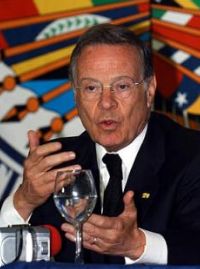
Former president, Miguel Angel
Rodriguez, n Quito,
Ecuador, named
Secretary General of the
Organization of American States
(OAS).
MIGUEL ANGEL RODRIGUEZ
- President of Costa Rica,
1998-2002
- Headed Costa Rica's
right-of-center United Social
Christian Party and was
president of the country's
legislature. Also served as
president of the Christian
Democrats of America.
- Doctorate in economics from
the University of California at
Berkeley.
- Currently J.B. and Maurice C.
Shapiro Visiting Professor of
International Affairs at George
Washington University
- Before entering politics, he
was highly successful in the
dairy and meatpacking
businesses.
- Married to Lorena Clare, they
have two grown children.
|
|
``We want to pursue freedom, justice and
development so that every citizen of the Americas
can enjoy a decent life and realize his or her full
human potential,'' Rodriguez said at the OAS general
assembly meeting in Quito, Ecuador.
Newly elected Rodríguez says he hopes to raise
the OAS' influence by boosting its support for
democracy and programs that stimulate economic
growth, improve political stability and diminish
poverty in the Western Hemisphere.
Haiti's return to a democratically elected
government, Venezuela's political crisis and
Colombia's peace talks with right-wing paramilitary
fighters will also take up much of his time.
In an uncontested election Monday, Rodríguez was
picked to succeed OAS Secretary General César
Gaviria, a former president of Colombia who will
step down in September after leading the
organization for the past decade.
Although remembered by his Costa Rican opponents as
something of a weak president, serving from 1998 to
2002, Rodríguez said that he's committed to help the
OAS achieve ``additional strengthening and
definition.''
He credited Gaviria for raising the profile of an
organization that had long been viewed as powerless
and said he plans to raise its status even further.
Rodríguez, 64 and an economist and businessman with
graduate degrees from the University of California
at Berkeley, takes over the helm of the OAS at a
critical juncture, amid crises in Haiti and
Venezuela, a lengthy insurgency in Colombia and
serious political problems in nearly half the
organization's 34 active member states. Cuba's
membership has been suspended since 1962.
''I come from experience as a private entrepreneur.
I ran government. I have a vocation for
management,'' Rodríguez said, adding that he is
''completely committed, fully committed, deeply
committed'' to the values of liberty, justice,
solidarity, sovereignty and development.
''This commitment, on my part, will help me to work
for the [OAS member nations] and achieve fruitful
results,'' he promised.
Although regarded as a brilliant economist, experts
said Rodríguez's presidential tenure was marked more
by what he didn't accomplish than what he did,
according to José Miguel Villalobos, a former
minister of justice.
''He's an intelligent man with a vision of the
future -- it's just that his vision was not shared
by the majority of Costa Ricans,'' said Villalobos.
``He was a great thinker, but not a great leader.''
Showing his pragmatism, Rodríguez withdrew his
proposal to break up the Costa Rican government's
monopoly of the telecommunications industry after it
brought tens of thousands of protesters to the
streets.
Supporters noted Rodríguez managed to maintain
modest 4 percent economic growth for Costa Rica
during his tenure, and helped push forward a new
labor law and an innovative paternity law to go
after dead-beat dads.
His selection to head the OAS was largely due to the
sense that after three failed candidacies by Costa
Ricans seeking the post, it was the small Central
American nation's ''turn'' to run the OAS, experts
said.
But more than a personal challenge, running the OAS
will be more of an institutional challenge, said
Manuel Orozco, a senior researcher at Georgetown
University.
''Rodríguez has the ability to run the OAS,'' Orozco
said. ``The challenges before him as secretary
general have to do more with the institutional
weakness of the organization.''
Among his top challenges will be Venezuela, where
the OAS has been monitoring a pitched battle by
opponents of leftist President Hugo Chávez to hold a
recall vote now expected in August.
Chávez government officials have often accused the
OAS observers of siding with the opposition, and at
times threatened to expel them.
The OAS has also agreed to supervise the Colombian
peace talks with the rightist United Self-Defense
Forces of Colombia, which recently agreed to
concentrate its top leaders in a northern region
while the talks continue.
Haiti also remains a challenge for the OAS, one that
Rodríguez characterized as ''the most important
moral issue'' facing the organization.
''We have to take all the measures that are required
for a very strong, humanitarian program'' to help
the hemisphere's poorest nation, Rodríguez told
reporter. Long-term solutions also must address the
health, education, security and economic development
there, he added.
Rodríguez also said that the Caribbean Community,
whose 15 members also belong to the OAS, must take a
leading role ``in the . . . solution of Haitian
issues.''
The OAS and CARICOM must agree on how to manage the
political transition unfolding in Haiti following
the Feb. 29 departure of President Jean-Bertrand
Aristide and his replacement by a non-elected
interim government.
''Everyone is in agreement of the need for a fast
election to take place in Haiti, so that the new
authorities could emerge,'' Rodríguez said.
|


