|
Former Costa Rican President to Lead OAS
Former Costa Rica president, Miguel Angel Rodriguez,
is the sole candidate in an election to select a new
secretary general of the Organization of American
States taking place today (Monday) as part of the
annual general assembly.
|

Former president, Miguel Angel
Rodriguez, n Quito,
Ecuador, will be named today
Secretary General of the
Organization of American States
(OAS). |
|
|
|
|
|
|
|
|
|
|
|
|
|
|
|
|
|
|
|
|
|
|
|
|
|
|
|
|
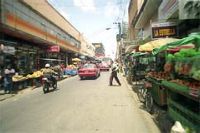
Street Vendors have until June
18 to clear the street of their
fruit and vegetable stands or be
removed by force. |
|
Rodriguez will replace Cesar Gaviria, former
president of Colombia, who has led the 34-nation
organization for 10 years. Rodriguez assumes the
post in September as the organization's eighth
president.
This year's gathering of foreign ministers, which
runs through tomorrow (Tuesday), will tackle a
number of issues in the hemisphere.
U.S. Secretary of State Colin Powell arrives today.
The general assembly opened Sunday amid tight
security as participants discussed proposals for
denying safe haven for officials embroiled in
corruption.
"We are going to propose denial of refuge to all
corrupt individuals in all hemispheric countries,"
Ecuadorian Foreign Minister Patricio Zuquilanda told
Agence-France Press.
Among the topics of discussion are the continuing
turmoil in Bolivia, Haiti and Venezuela, where
voters recently ratified enough signatures to force
a recall referendum in August against President Hugo
Chavez.
Also on the table is a proposal by Central American
and Caribbean countries to invoke the OAS's
Democratic Charter against Haiti, now under the
leadership of an interim government backed by the
United States. A peacekeeping force, recently taken
over by the United Nations, remains in that country
following the Feb. 29 departure of Jean-Bertrand
Aristide who fled amid an armed revolt.
The proposal, if approved, would be a slap to
Washington, which helped negotiate Aristide's
departure and has played a key role in the
transitional process.
Street
Vendors Have Until June 18
The battle for the streets is nearing as
June 18 fast approaches, the date the Municipality
of San José has set for the street Vendors to remove
their stalls or be removed.
A small group of street Vendors, in anticipation of
the Municipalities dateline and to prevent a violent
confrontation with police, have agreed to the
Municipality's offer to accept to hold "ferias" on
weekend at a location in the periphery of the city
and clear the streets of downtown San José.
Another group however has decided to stay firm and
is relying that the Constitutional Court will decide
their case before the 18th of June, that will allow
them to stay. In any event, they have decided to
stay even if the court doesn't rule in their favour.
According to Rafael Arias, assistant to the Mayor,
the group known as Federación Nacional de Vendedores
Estacionarios y Ambulantes (FENVEA), with 150
members, has accepted the Municipality's offer to
relocate.
However, the number affected by the Municipality's
decision numbers 500 and the majority say that they
deal in perishables and their unsold products won't
hold for an entire week until the next 'feria'.
The area affected is Calle 8 and 3rd Street.
Several years back the Municipality of San José
cleared Calle 8 of the street vendors following a
long legal struggle, offering them space in
the Municipal building known as Paso de La Vaca on
9th Avenue. Soon after, a new group of street
vendors appeared and once again blocked the streets
with their fruit and vegetable stands. And the new
battle between the Municipality and Vendors started
all over again.
Insurance Fraud Costs INS Millions
The Instituto Nacional de Seguros (INS) - the
national insurance company - reports a loss of
between ¢50 million and ¢100 million colones due to
fraud during the last 20 years. This according to
Enrique Mora, a manager in the Investigations
department of INS.
False invoices for part purchases, false accident
reports and altered vehicle identification are the
largest frauds perpetrated against the institution.
Mora added that the majority of the fraud is by
organized gangs who, in conjunction with auto repair
shops, specialize in handling the insurance claims
that defraud the insurance company.
The INS has it's hands tied. In the two cases it has
before the courts against two of the organized
gangs, the auto shops involved can still continue to
file insurance claims and the INS cannot stop them
from doing so.
There are currently 722.664 vehicles registered, of
which 234.795 or 33.75 have additional insurance for
their vehicles that are covered by the INS.
In Costa Rica, basic insurance coverage is part of
the yearly payment of the "marchamo". However,
vehicle owners can purchase additional coverage for
their vehicles that is not covered in the basic
policy.
Each year the INS receives and average of 50.000
claims.
The INS is the sole provider of insurance coverage
in the country has been the subject of great debate
in the negotiations of the Free Trade Agreement with
the United States.
BBC film Features Casa Alianza Thursday, June 10th
Commercial sexual
exploitation of children (CSEC) is not only a threat
for children in Central America, but also a menace
that tends to diversify, as it has become a very
lucrative activity for criminal rings that
simultaneously operate in many countries at the same
time.
After a one-month investigation in Costa Rica and
Honduras earlier this year, a BBC2-TV crew from
London, has gathered abundant evidence to show the
world the disturbing damage that the CSEC inflicts
on some of Latin Americas poorest children and the
fight that the Casa Alianza charity is leading to
stop it.
The programme will air this Thursday, June 10th,
2004 on “This World”, on BBC 2, at 9:00 p.m. and at
a later date on BBC World. The one-hour long report
will reveal that the fight against the commercial
sexual exploitation of children needs further
support from countries.
“The Commercial Sexual Exploitation of Children is a
global menace. A girl victim of human trafficking
and rape in Central America will be abused every
time a pedophile, in any country, opens a web page
with the pornographic pictures of her. The visit of
the BBC crew was, in fact, a window to prove this”,
said the Englishman Bruce Harris, Regional Director
of Casa Alianza for Latin America, whose hometown is
Wareham in Dorset.
Casa Alianza is an independent, non-profit
organization dedicated to the rehabilitation and
defense of street children in Guatemala, Honduras,
Mexico, Nicaragua and Costa Rica. Casa Alianza is
the Latin American branch of the New York-based
Covenant House. Casa Alianza has a UK office based
in Kettering.
The BBC was an eyewitness to Casa Alianza’s work as
they entered into the shadows of the commercial
sexual exploitation of children in brothels in
tourist destinations in both Costa Rica and
Honduras. They also followed the steps of adult
fugitives who are trying to escape from justice,
accused of sexual exploitation and the abuse of
children.
The TV audience will personally get to know some of
the stories of the victims, and will be in contact
with the poverty and hopelessness of many children
feel, who anxiously ask themselves what their future
holds.
The BBC program will not only be an informative
report, but a documentary on the work of Casa
Alianza in the fight against the commercial sexual
exploitation of children, showing the faces and the
stories of many abusers. One of them, a Costa Rican
priest, has managed to hide from authorities for six
years.
“We hope that people around the world will
understand the rights of the child victims to
justice, protection and to have hope in the
future…just like our own children who play in the
safety of our homes, sleeping under warm blankets
with loving parents”, added Harris.
ICE
Modernizes Access Network
Teledata Networks, a leading provider of wireline
access products and network solutions for telecom
operators and service providers worldwide, has
completed the delivery of the first US$5M shipment,
as part of a US$25M contract with ICE, Costa Rica's
National Electricity and Telecommunications company.
The contract includes the supply of 300 BroadAccess
Integrated Multiservice Access Platforms (IMAPs)
over a maximum period of three years.
Under the terms of the agreement, Teledata Networks
will help ICE expand, modernize and digitalize the
country's access network.
Using the BroadAccess IMAP, Teledata Networks will
provide ICE's customers throughout Costa Rica with
high-quality voice and advanced data services using
a single integrated platform.
"We are proud to be ICE's sole supplier for this
contract. There were 11 participants in this tender,
and Teledata Networks is the sole winner" said Amnon
Unger, CEO, Teledata Networks.
"Teledata Networks has maintained a fruitful
relationship with ICE over several years, having
supplied equipment for support of voice services. We
feel privileged to be working with this operator on
such an important project, which is part of a
strategic plan for the modernization of Costa Rica's
entire telecommunications network.
Our flexible technology is sure to be a stepping
stone for ICE in its transition to Next Generation
Networks."
|
OAS opens assembly with poverty, corruption on top
agenda
The Organization of American States (OAS)
opened Sunday its 34th general assembly with focus
on eliminating poverty and fighting corruption.
Addressing the opening session, Cesar Gaviria,
secretary general of OAS, said poverty and economic
inequality are the greatest challenges to democratic
stability in the Latin America, and urged greater
efforts to tackle the problems to achieve progress
in the region.
Gaviria said the Latin America has advanced in
security and human rights issues but not in economic
fairness.
"We need a system of greater solidarity and with a
larger humanitarian component. We have advanced in
political and security issues but not in social
ones," Gaviria said.
"There is no political system that is immune to
greater inequality or regress in the fight against
poverty," he said.
In the two-day meeting, foreign ministers and
delegates from 34countries will discuss ways to
strengthen the fight against corruption across the
region, such as a proposal for nations to deny
asylum to politicians accused of corruption at home.
A draft declaration on fight against corruption is
expected to be adopted at the end of the meeting.
Representatives are also expected to choose former
Costa Rican president Miguel Angel Rodriguez to
succeed Gaviria, who will leave on September 15
after 10 years in the job.
According to statistics from UN Economic Commission,
43 percent of the region's population lived below
the poverty line in 2002.
Founded in 1948, the Washington-based OAS brings
together 34 countries in the Americas. It is the
primary vehicle for resolving political differences
in the Americas. Cuba was suspended from the
organization in 1962.
OAS may supervise Venezuela's referendum
The Organization of American States (OAS) will not
rule out the possibility of acting as an observer in
a recall referendum against Venezuelan President
Hugo Chavez in August, OAS Assistant Secretary
General Luigi Enaudi said here Sunday.
Although the rules for supervising the referendum
have not been worked out, the 0AS will closely
follow the situation in Venezuela, said Enaudi, who
is attending the 34th OAS session here.
In order to guarantee full transparency of the
upcoming referendum, it is very important that the
OAS will monitor the revocation process, he
stressed.
Venezuela's National Election Council (CNE)
announced Thursday that the validated anti-Chavez
signatures the opposition gathered had surpassed the
margin set by law, and therefore a referendum on
Chavez's rule will be launched on Aug. 8.
Chavez, a former paratrooper who won a 1998
election, carried out a series of reforms in his
country, hurting groups of special interest. The US
government has been dissatisfied with him because of
his bold criticism about US President George W.
Bush.
Venezuela has been in a political turbulence since
2001 when opponents staged a series of
demonstrations and strikes. Chavez survived a coup
in April 2002 that was followed by a two-month
general strike.
In May 2003, under the mediation of the OAS and the
Carter Center, the Venezuelan government and the
opposition agreed to back the recall referendum,
opening a road to resolve domestic crisis with
political means.
Chavez will step down in the August referendum if
the votes collected by the opposition exceed those
of Chavez supporters and also surpass the 3.75
million in the 2000 elections.
Figures issued by the opposition predicted that 8
million people, out of a total of 12 million
registered voters, would participate in the
referendum. The opposition says it could garner at
least 4 million votes against Chavez.
Russian
president to visit Mexico
Russian President Vladimir Putin will pay
a visit to Mexico, with discussion of cooperation on
military, law enforcement and financial matters with
Mexican officials toping his agenda, the sources
from the government said on Sunday.
Agustin Gutierrez, spokesman for Mexican President
Vicente Fox, has said the visit by Putin, who will
arrive in Mexico early on Monday, is designed to
increase communication between the two countries.
"We are now looking for new areas where we can
expand that collaboration," Gutierrez said.
Fox said last week that his country hopes to expand
military cooperation with Russia, including the
assembly of some Russian helicopters here and
importing a mixed civilian-military factory.
Putin and Fox are expected to sign agreements on
foreign investment and cultural exchanges.
|


