|
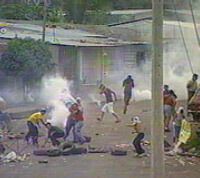
Violence in La
Carpio
What started as a peaceful demonstration
in the early morning, turned out to be a bloody and
violent evening, as residents of La Carpio took the
day to protest their displeasure with the
government's lack of action to their concerns.
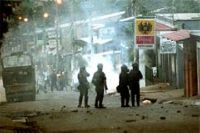
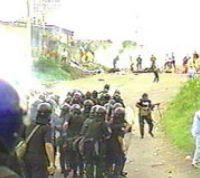
Members of the Unidad de Intervención Policial (UIP)
- riot police - and the Fuerza Publica had to be
called into action to quell the ensuing rioting,
that saw 7 people injured. Police used tear gas to
control the crowd, however, as it became night,
several gun shots were heard and police several
hours later had to retreat in fear of more violence.
The Minister of Security, Rogelio Ramos, was on hand
to personally direct the police action and vowed
that order will be restored.
It all started when a group of community organizers
blocked the only entrance to and from the area known
as La Cuidadela de La Carpio, west of San José. They
wanted to let the government know that they will not
tolerate the conditions of neglect of the residents
of the "barrio" and the broken promises made to
them.
Organizers affirmed to have signed documents that
promised to resolve their problems, like the repair
of the streets, including paving them and
construction of sewers and drains to control storm
waters.
All day organizers met with various government
agents, but could not come to any agreement or
solution to their problem.
The confrontation with police came about 5:00pm,
when residents refused to remove the barricade as
ordered by police. The main focus points of the
confrontation came in two distinct points known as
"la cueva del sapo" and "la cuarta parada.
Ricardo Toledo, Minister of the Presidency, who was
on the scene meeting with other government officials
to plan a strategy to restore order, said President
Abel Pacheco would visit the area when he returned
to Costa Rica tomorrow. Pacheco is in El Salvador
attending the inauguration of a new president.
The area is primarily inhabited by Nicaraguans, most
of who work as domestics and low salaried labourers.
The residents don't own their properties, nor is
there an official record for the community.
The area was the scene of a massive police raid
where more than 600 residents were checked for their
documents of legal status in Costa Rica, where more
than 200 were detained for criminal pasts, wanted by
the authorities, others for being illegal in the
country and deported.
Last week the Sala IV - the Constitutional Court -
declared the police action invalid and awarded
compensation for some of those detained or suffered
damages as a result. The ruling ties the hands of
police, being extremely careful in how they react to
the rioting, which is being attributed to a small
youth gang.
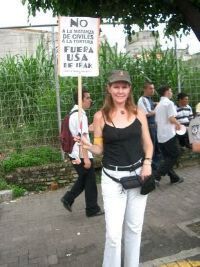
No Al TLC! No Al
TLC!
That was the chant that ran through the
crowd of thousands that took to the streets of the
San José yesterday.
The protest march started at 10:30am in front of the
offices of the Instituto Costarricense de
Electricidad (ICE) in La Sabana, moved along Paseo
Colón, meeting up with more protestors along the
way, especially in front of the Banco Negro (Banco
de Costa Rica) and ending in front of the
Legislative Assembly building.
The protest was organized and announced several
weeks back by the unions to demonstrate their
disapproval to the government's signing of the Free
Trade Agreement - Tratado Libre de Comercio (TLC) in
Spanish.
Last Friday May 28, Costa Rica and the four other
Central American nations of Nicaragua, El Salvador,
Honduras and Guatemala signed the trade deal with
the United States in Washington.
Opponents to the agreement contend
that it fails to do enough to protect workers from
unfair competition, having devastating effect on
workers, farmers and the environment.
Several Deputies were on hand to lend support to the
protest, making speeches and pleasing the crowd
gather in front of the Legislative building.
The majority of the protestors were employees of the
ICE and La Caja Costarricense del Seguro
Social (CCSS). Though hospitals and
many government offices were open, ICE was not.
The protest was peaceful and organized squashed any
attempts by some young protestors to start any
violence, burning of flags and effigy as it occurred
in the past.
By 2:00pm all the speeches were made, the chants
became quiet and it was time go home.
The agreement is now in the hands of the
Legislators, both in the U.S. as in Costa Rica and
one other Central American country, who need to
ratify it before it can come into effect.
Click here for all the fotos of the protest!
Hurricane Season is Officially On
Today the Hurricane season official begins. The
weatherman -
Instituto Meteorológico Nacional (IMN) - is
predicting heavy rain and storms for the next couple
of days.
It is expected that between 12 and 15 Tropical
Storms and 6 to 8 Hurricanes will form this season.
The
Comisión Nacional de Emergencias (CNE) warns
residents of low lying areas, especially the
Caribbean coastal areas, to prepare and be
ready in the event of an emergency.
This year's names (in Spanish) for the Hurricanes
are: Alex, Bonnie, Charley, Danielle, Earl,
Frances, Gastón, Hermine, Iván, Jeanne, Karl, Lisa,
Matthew, Nicole, Otto, Paula, Richard, Shary, Tomás,
Virginie and Walter .
|
Italy offers
support to Colombian peace process
The Italian government "supports all" the peace processes in
Colombia as long as "they are accompanied by the cease of hostilities,"
Italian Foreign Minister Franco Frattini said Monday.
With a cease-fire and the cease of hostilities, "Italy offers itself as
a guarantee of the reconciliation processes in Colombia," Frattini told
the Colombian National Radio Cadena in the Italian capital city of Rome.
Frattini said, "Italy backs the fight of the Colombian authorities and
society against terrorism."
The Italian official invited the National Liberation Army (ELN), the
second most important guerrilla group in Colombia, to cease hostilities
and immediately launch peace talks with the government of President
Alvaro Uribe, with the support of international observers.
Frattini added that those who want to make their rights understood
cannot do it with violence and assassinating children and innocent
people.
Frattini's announcement was made after Uribe proposed in Mexicoto begin
a peace process with the rebel group.
The ELN has about 4,500 men that operate in different parts of Colombia,
a country ravaged by a four-decade-old civil war.
The war pits government forces, leftist guerrillas and far-right
paramilitaries fighting one another, killing an average of 3,500 people,
mostly civilians, each year.
Chile calls for Latin America's joint efforts to face globalization
Chilean President Ricardo Lagos Escobar call on Latin American countries
Sunday to make joint efforts to face the challenges brought by
globalization, said the reports reaching here from the Guatemalan
capital of Guatemala City.
Lagos, who is paying a state visit to Guatemala, made the call when
addressing the Guatemalan parliament. He said that as globalization
strides ahead, Latin American countries should make joint efforts to
establish a fair international order and just trade rules.
He also said Latin American countries should unite to oppose the
agricultural subsidy policy of the developed countries that infringes
upon the interests of the former.
Lagos said at a previous welcoming ceremony that Chile and Guatemala
would work together to promote bilateral ties and world peace and
development.
His Guatemalan counterpart Oscar Rafael Berger Perdomo echoed his call,
saying Lagos's visit will strengthen bilateral ties, promote business
cooperation and contribute to the free trade agreement negotiations
between Chile and Central American countries.
Uruguayan military investigates alleged sex abuse in Congo
Uruguayan military authorities are investigating allegations
that their troops were involved in sexual abuse of minors while serving
as United Nations (UN) peacekeepers in the Democratic Republic of the
Congo (DRC), said officials Monday.
Chief of the Uruguayan mission Col. Luis Lavista was quoted Monday by
the press as saying that the accusations have not been proved.
The Uruguayan Armed Forces told each of the 1,500 soldiers deployed in
the DRC that having sexual relations with a minor was a very serious
crime, even though she agreed to it.
The punishment includes the repatriation and discharge from the army,
Lavista said.
To prevent such incidents, the military chief decided this week that the
personnel deployed outside the town of Bunia would not be given leave,
thereby preventing the soldiers from leaving the military base except on
an official mission.
About half of the 10,800-strong UN peacekeeping force in Congo and some
60 civilian staff are based in and around Bunia, the capital of the
troubled Ituri region.
A UN team has been investigating since May 21 the charges that members
of its blue helmets were involved in 30 cases of alleged sexual abuse
against minors in Congo's Ituri region.
The accusations were presented mostly against the Moroccan contingent
and some Uruguayan soldiers.
Uruguayan Defense Minister Yamandu Fau was quoted Sunday by El
Observador as saying that the government did not officially receive any
accusation on this case.
In 2003, Uruguay repatriated five soldiers charged with stealing at a
church in Bunia.
|