Cellular Telephony
A cell phone is a portable telephone which receives or makes
calls through a Cell site, or transmitting tower. Radio waves are used
to transfer signals to and from the cell phone.
Large geographic areas (representing the coverage range of a service
provider) are split up into smaller cells to deal with line-of-sight
signal loss and the large number of active phones in an area. Each cell
site has a range of 3-15 miles and overlaps other cell sites. All of the
cell sites are connected to one or more cellular switching exchanges
which can detect the strength of the signal received from the telephone.
As the telephone user moves or from one cell area to another, the
exchange automatically commands the handset and a cell site with a
stronger signal (from the handset) to go to a new radio channels.
When the handset responds through the new cell-site, the exchange
switches the connection to the new cell-site.
Almost all mobile phones use cellular technology, including GSM,
TDMA & CDMA and the old analog mobile phone systems. Hence, many
people use the term "cell phone" to mean any mobile telephone
system. The exception to mobile phones using cellular technology are
satellite phones.
Old systems predating the cellular principle may still be in use in
places. The most notable real hold-out is that many amateur radio
operators maintain phone patches in their clubs' VHF repeaters.
There are a number of different digital cellular technologies; these
include: GSM & TDMA.
TDMA/GSM
TDMA is the access method used by the Electronics
Industry Alliance and the Telecommunications Industry Association
for Interim Standard 54 (IS-54) and Interim Standard 136 (IS-136).
Using TDMA, a narrow band that is 30 kHz wide and 6.7 milliseconds
long is split time-wise into three time slots.
Narrow band means "channels" in the traditional sense.
Each conversation gets the radio for one-third of the time. This is
possible because voice data that has been converted to digital
information is compressed so that it takes up significantly less
transmission space. Therefore, TDMA has three times the capacity of
an analog system using the same number of channels. TDMA systems
operate in either the 800-MHz (IS-54) or 1900-MHz (IS-136) frequency
bands.
GSM is the international standard in Europe, Australia and
much of Asia and Africa. In covered areas, cell-phone users can buy
one phone that will work anywhere where the standard is supported.
To connect to the specific service providers in these different
countries, GSM users simply switch subscriber identification module
(SIM) cards. SIM cards are small removable disks that slip in and
out of GSM cell phones. They store all the connection data and
identification numbers you need to access a particular wireless
service provider.
Unfortunately, the 1900-MHz GSM phones used in the United States are
not compatible with the international system. If you live in the
United States and need to have cell-phone access when you're
overseas, the easiest thing to do is to buy a GSM 900MHz/1800MHz
cell phone for traveling.
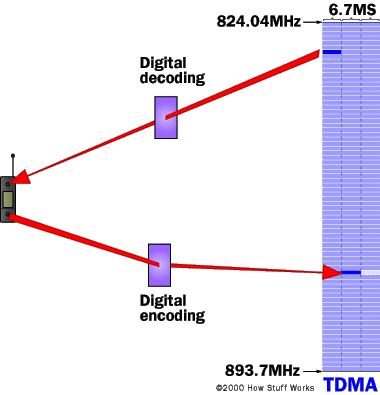
TDMA
splits a frequency into time slots.
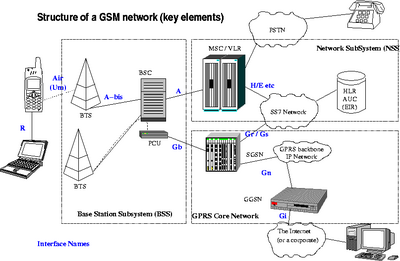
The structure of a GSM network
|


