Banco ELCA's Sin: Lack of consolidation
Last week, the Superintendencia General de Entidades Financieras (SUGEF)
intervened in the operation of the private Banco ELCA, basing it's
decision that it found irregularities in lending and credit
practices that placed the bank's solvency in jeopardy.
According to government regulators, ELCA's reserves were below 1%,
way below the 10% reserve that private banks are required to
maintain.
|
Private Banks. Why do we use them and how should we be
protected?
Virtually all of us who live in Costa Rica
need to have a bank account. Our choice is to open an account at one of
the state banks, Banco Nacional, Banco de Costa Rica and Banco Popular
or one of the many private banks.


ELCA's main offices in La
Sabana.
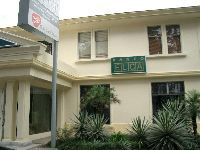
Banco ELCA San Pedro. ELCA
opened this medical centre as
part of CIMA Hospital's services
in the east end.
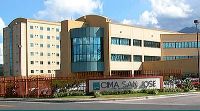
ELCA president Carlos Alvarado
Moya was also president of the
CIMA Hospital in Escazú. |
The Venezuelan Investment
-
August 20, 2003: a group heade
by Venezuelan businessman,
Carlos Gil, agrees to buy 50% of
ELCA stock with a $5.4 Million
dollars cash injection
- April 26, 2004: the new
partners take control of the
board of directors and name
fellow Venezuelan Antonio
Saturno as general manager-
June 2004: ELCA sells off three
operations to concentrate in
banking operations; the
Venezuelans announce that they
will not capitalize the bank as
agreed |
Reasons for the interevention
- Deterioration of portfolio
forces ELCA to maintain an
estimation of ¢4.377 million,
which leaves with a negative
patrimony of ¢589,2 million.-
Credit operations related to
Carlos Alvarado, president of
the bank, were found to be tied
to persons and/or companies with
high levels of losses.
- Among the anomalies found
in ELCA's lending practices were
guarantees without naming or
identifying the guarantor.
- The SUGEF found "back to back"
operations for $23.8 Million
dollars with show the bank's
real financial position as at 31
May 2004. |
In May of 2004, ELCA's assets totaled ¢34.76 Billion colones,
while it's liabilities exceeded ¢31.89 Billion colones.
ELCA's assets have been frozen by SUGEF for a period of 90 days
while the entity reviews the bank's operation and makes it report to
the Consejo Nacional de Supervisión del Sistema Financiero (CONASSIF),
whether the bank is a viable financial entity and a plan to
normalize the operations of the bank of what action is to be taken.
If that option is viable, SUGEF can recommend that the bank or it's
parts be sold to one or more buyers or liquidating the bank
entirely.
Government regulators are quick to point out ELCA is an isolated
case and the banking system in Costa Rica is not failing and that
other private banks are not in the same condition.
Banco ELCA counted with 8 branches including it's main offices in La
Sabana and 155 employees.
In August of 2003, officials at ELCA announced a the sale of 50% of
it's shares to a Venezuela group - Banco Canarias - which would
inject some $3 Million dollars of fresh capital. However, that
transaction took it's time and never came to fruition.
Creditors and depositors alike are nervous as to the final outcome.
The main office and it's branches are all open, accepting credit and
mortgage payments. As well, depositors can obtain their account
balance and statement up to and including the 29th of June. Any
information about the future of the bank and the deposits have to be
done personally at the main office.
A visit last Wednesday at the main offices, a week after the
intervention, we were told that SUGEF is expecting depositors at the
bank can claim their deposits in the first week of August, a month
after the intervention. However, there is no "official" position by
anyone at SUGEF or any other government agency.
Many depositors of the bank are foreigners who had deposited at
least $60.000 with the bank to comply with their residency
requirements, preferring the small size of ELCA bank to the larger
private banks and national institutions. ELCA had been very
aggressive over the last couple of years attracting foreigner
deposits.
One government agency - Banco Hipotecario de la Vivienda (BHV) -
is also very nervous and anxious for a positive outcome as it is a
major creditor of the bank. BHV is owed some ¢4.165 million colones
(more than $9.500.000 at today's exchange rate) by the bank on
mortgages, trust funds and bonds that were placed through the bank.
BHV and othe major creditors is being invited by SUGEF to have a
close look at the situation.
The History
Banco ELCA began as a financial group back in 1981 by the Alvarado
and Moya families with the objective of offering small and medium
sized businesses lines of credit and financial help. Eliécer
Alvarado Arias is recognized to be the founder and father of the
ELCA financial group, who began with in the importing and
distribution of household goods and appliances.
In 1995, the ELCA financial group bought out the Banco de la
Industria, founded in 1983 by Albán Brenes, which was later renamed
Banco ELCA.
The objective of Banco ELCA, now part of the ELCA Financial Group,
was to consolidate and expand ELCA group's aim at offering services
to Costa Rican and Central American entrepreneurs. In 1998, the bank
offered banking services that included checking and savings
accounts, mortgage services, trust and security loans, credit cards,
international and local factoring and certificate deposits,
integrating into the National Banking System.
The bank operates 8 branch offices, that included the main offices
in La Sabana, Barrio Amón, Intenacional Mall Alajuela, Downtown
Heredia, CIMA Hospital, San Carlos, San Ramón and San Pedro.
Last year, as part of an organizational restructuring, ELCA sold
it's stock exchange and insurance operations.
ELCA was also involved in providing credit card processing services,
providing local businesses with a merchant account through it's
Comercard operations. Insurance services, stock brokerage and
arbitrage were part of the group's aim to provide total financial
services.
Arbitrage is the trading of one currency for another with the
hopes of taking advantage of small differences in conversion rates
among several currencies in order to achieve a profit. It was
reported in financial circles that ELCA was heavily trading in the
difference in Colombian interest rates and exchange rates.
In it's history, the ELCA financial group was constantly looking for
partners to develop and extend it's financial services. Headed by
it's principal partner, Carlos Alberto Alvarado Moya, (son of
Eliécer) history shows that three different groups have been
interested in partnering with ELCA, however, none of them actually
completed their deals.
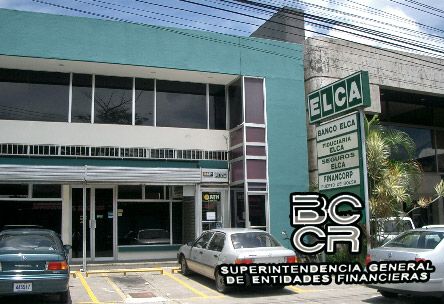
SUGEF and BHV cars are
constantly parked outside the main offices of Banco ELCA in La
Sabana, while the bank is under intervention by government
regulators.
The Fall Begins
The younger Alvarado took the reigns of Banco ELCA and as it's
president showed a lot of promise as an up and coming banker, who
was involved in various other sectors, principally the health
industry, investing in the CIMA Hospital and a plan to provide
pre-paid health care.
ELCA's objectives were to treat some of it's "faithful" clients as
shareholders. But the project never solidified and from there, the
fall began.
In October 2002, the SUGEF, qualified the bank as a risk and asked
for a clean up action in it's activities. The risk classification
saw the deterioration of some credit operations.
ELCA, in it's attempt to respond to the SUGEF request sold some of
it's losing operations, like ELCA Consultores, ELCA Servicios, and
Arrendadora ELCA which never did get operational. It kept the stock
exchange and insurance operations, until last year when it was
forced to sell those off also.
During this period, ELCA became a victim of rumours and extortion
when a group started an action against the ELCA to discredit it, by
handing out flyers to customers as they would leave the bank.
ELCA and it's president Carlos Alberto Alvarado Moya, never stopped
looking for partners. In May 2003, ELCA reached an agreement with
Consorcio Bantec, however, three months after Banco Bantec was
intervened by the SUGEF.
Banco Bantec depositors and creditors are still awaiting the outcome
of the intervention.
While ELCA was still under the watchful eye of SUGEF, in August 2003
it announced for a sale of 50% of the ELCA stock to a Venezuelan
group, Banco Canarias, headed by Venezuelan businessman Carlos Gil.
The announcement said that an injection of US$5.4 Million dollars,
though it appears now that the capitalization never took place.
At the same time, Kuwaiti investor Al Fahed, who had had purchased
26% of the stock of ELCA some years before, in a transaction with
the elder Alvarado, wanted out and sold his stock back to Alvarado
family.
In May, the Venezuelan group took administrative control of ELCA and
forced the bank to sell of the stock brokerage and insurance
operations.
The Present
The intervention by SUGEF is to last 90 days from the 28th of
June, at which time a decision will be made on the future of the
bank.
In the meantime, Alvarado and his partners will need to continue to
look for a way to capitalize the bank if it is to remain in their
hands.
Rumours have been circulating that a Spanish/Mexican consortium is
seriously looking and deal with the Alvarado family in the making.
If the purchase does materialize, it will inject the necessary
capital to satisfy government regulators and take the bank out of
it's financial crunch and operational again. |
|
|
|
|
|
|
|


