Costa Rica
in Crisis
The general strike
that began Monday morning
continued into Tuesday, where
truckers blocked major arteries
around the country, with the
intent of cutting off vitality
to major centres, pressuring the
government into conceding to
their demands.
Movements in and and around
the the Central Vallery, to
points to and from San José and
to the Pacific and Atlantic
regions were completed closed.
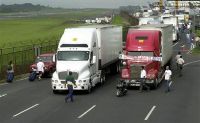
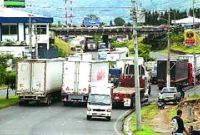
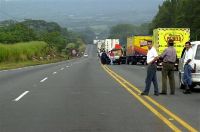
Truckers parked their rigs on
the highways, blocking any kind
of vehicular traffic in all
directions, allowing passage
only to ambulances and other
emergency vehicles.
Hardest hit were the areas
surrounding Grecia and Naranjo,
a major gateway to the Port of
Caldera, Ochomogo and
other points to Limon, stopping
the flow of gasoline.
In San José last night by 7pm,
as reported in other parts of
the country, gasoline station
tanks were being emptied
quickly. Where gasoline was
still available, hundreds of
drivers sat patiently, forming
long lines awaiting their turn
at the pumps, with the hope that
there would enough left to fill
their tank. Police were on hand
at several gasoline stations
visited in the west end,
controlling traffic and ensuring
peace. Several stations were all
out as early at 7:30pm.
President Abel Pacheco went on
national television minutes
before 8:00pm to reassure Costa
Ricans that the government was
open to dialogue the organizers
of the strike. However, he
assured that his government
cannot break laws or the
constitution to give in to
demands of a minority group.
He strongly warned the activists
that the government was ready
and willing to use force if
necessary to clear the roadways.
He told Costa Ricans that the
activists have a right to
protest, however, Costa Ricans
have also the right to use the
highways and not have their
daily lives affected in such a
negative way.
Many, living in outlying areas
and working in San José could
not get to work or doctor's
appointments or medical
attention at the major
hospitals. Those who did make it
to San José were making
temporary arrangements for the
night with friends and
co-workers. Long lines formed at
bus stations, however, no buses
going or coming.
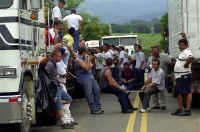
Organizers vowed to stay put
until such a time they have an
agreement. Television news
interviews with organizers
warned that the government
should not use any kind of
force, as there are very brave
people among those protesting
and a confrontation with police
could result in violence.
Police take action
True to his words, President
Pacheco gave the green light to
the Fuerza Publica to use force,
if necessary, to clear the
roads.
At 3:00am, a team of about 100
officers of the Fuerza Publica
and Transit descended on the
roadblock at Ochomogo, dressed
in riot gear, asking truckers to
move or be moved.
Police began with the first
trucks, megaphone in hand,
waking sleepy drivers to move
their trucks. Several broken
windows and a few arrests got
the message to the rest of the
truckers that the police were
serious in removing them.
Some truckers complained that
police used violence and
unnecessary force against them,
that they were ready to move
their trucks.
Transit officials began removing
license plates of those truckers
that refused.
No violence or any injuries were
reported as 6:00am, and traffic
returned to normal. Television
news footage showed many of the
major roads building with normal
morning traffic, with truckers
to the side of the road.

President Pacheco Addressed the
nation last night, saying that
police would use force is
necessary to remove the
blockades
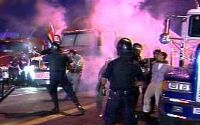
Police use tear gas to remove
the blockades, taking a swift
and decisive action at 3am. The
blockades were cleared within
1/2 hour.
|
At the Root of the Strike
The general strike began
Monday morning by taxi drivers
and truckers protesting the
government's police of
maintaining the vehicle
inspection monopoly given to the
Spanish firm Riteve SyA, the
recent increase in public
employee salaries and the Free
Trade Agreement (Trato Libre de
Comercio - TLC).
Groups gathered in front of the
Legislative Assembly on Monday
what was supposed to have been
an opportunity to deliver the
legislators a document
denouncing their actions and a
statement of demands by the
organizers of the strike.
Strike Continues
The strike is
expected to continue today,
though it is expected that the
roads will not be totally
blocked. Truckers are expected
to maintain a slow down on the
roads, but will permit passage
of vehicles at major points.
Several other unions -
workers of the Instituto
Costarricense de Electricidad
(ICE), and the Caja
Costarricense del Seguro Social,
as well as school teachers, may
join the movement today.
More than 10.000 ICE workers are
expected to take part in the
manifestations that have been
common around the country since
Monday. It is expected that ICE
offices will be closed today,
reported this morning the
Spanish daily Diario Extra.
According to the Diario Extra,
Asociación de Profesores de
Segunda Enseñanza (APSE), the
largest of the teacher's union
has called on all parents not to
send their children to school
this morning, as teachers are
expected to participate in a
march.
Although police were effective
in removing the blockades of
yesterday, there are still areas
where traffic is slow to a stand
still. Though no blockades are
being anticipated "el tortugismo"
is expected to continue.
|