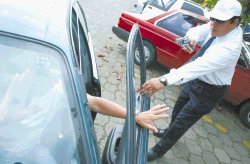
Alert for
the "Bajonazos"
Costa Ricans have become easy prey for car thieves "robacarros" and "bajonazos"
- a quick give me your money at the point of a gun and run - the preferred
method for a perfect crime.
|
|
|
|
|
|

By 2010 the Ministry of Labour
forecasts that no children will
be working. At present, 1 out of
10 in the work force is under
the age of 18. |
|
|
Police estimate that at least 8 "bajonazos"
occur in Costa Rica each day.
The assailants, according to police, are no longer distinguishing make and
model of the vehicle or social class of the driver and occupants, but are
quick to point out that most convert themselves to easy victims.
Former president Luis Alberto Monge was a
victim of the "bajonazo" last Saturday, when a group of heavily armed men
intercepted Monge in the streets of Heredia, who made away with his Toyota
Prado.
During the period of January to March of this year, the OIJ responed to 210
"bajonazos" just in the San José - 150 automobiles and 60 motorcycles. More
than 1.000.000 vehicles are registered in the Costa Rica.
Most of the crimes are committed after 6pm, in the cover of darkness and
usually between Wednesday and Saturday, according to judicial statistics.
Police recommend not to give resistance to these quick draw artists. All
they want is the cash or valuables on hand and a quick get-a-away.
Police and other judicial authorities assure that they are making headway in
the situation. Their efforts are slowly paying off in reducing car thefts
and locating ring leaders.
And while police look for a solution, car thieves are busy thinking up new
ways to make a quick buck while leaving no tracks.
Drivers should be alert at all times. Look for situations where you could
fall victim, with an eye to an escape route.
Pornography to be
Regulated at Internet Cafés
A series of new regulations, which
will come into effect in a few days, after being published in the official
newspaper La Gaceta, will attempt to control pornography in internet cafés.
The new regulations when they come into effect will require all internet
cafés to limit the access of pornography by minors.
All internet cafés will be required to have an "adult" section if they
permit pornography to be viewed by adults and cannot be more than 20% of all
computers and must restrict access by minors.
Those internet cafés that will not allow the viewing of pornography will be
permitted to post signs to that effect.
Defenders of children and minors are applauding the government's
initiatives, however, doubt that they will have any real effect. The
Ministry of Health will be responsible to inspect all internet cafés to
ensure compliance with the regulations, and that alone is a difficult task,
given the Ministry's resources, activists say.
The regulation will also affect video games and video game centres.
Vaccination for All
Children and Women 15-40
Children and women between the ages
of 15 and 40, need to lose their fear of needles and take advantage of the
opportunity the Ministry of Health if offering.
Costa Rica will, along with 36 other countries in the Americas and Europe,
vaccinate all children and women in the age group.
During the coming weeks, the Organización Panamericana de la Salud (OPS) and
the Caja Costarricense del Seguro Social (CCSS), will be throught the
country with their needles, including remote areas.
In Costa Rica the vaccination is against: Polio, measles, tetanus,
diphtheria, Meningitis, Tuberculosis and Hepatitis B.
Honeymooners
Choose Costa Rica & Central America
If you are one of the 2.3 million
people in the United States who is getting married this year, we have bad
news. Your honeymoon is going to be a lot more expensive than it would have
been last year.
With the rising value of the euro against the dollar, the increase in
gasoline prices and creeping but real inflation, the cost for everything
from airfare to French champagne is on the rise.
Moreover, as the economy recovers the hotel industry is on track toward
enjoying its best year since 2000. As business and luxury travelers return,
many hotels are dropping the discounts and promotions that had been used to
boost occupancy rates over the past few years.
Last year Americans spent more than $7 billion on honeymoons, with the cost
of an average one-week vacation around $3,400 (although the price can be
considerably higher), according to Condé Nast Bridal Infobank, the market
research division of Condé Nast Bridal Group, publisher of Bride's and
Modern Bride, the two largest bridal magazines.
This year, the cost for one week of post-nuptial bliss will be even more
expensive.
The news is not all bad, though. Even if the cost of a first-class European
honeymoon is now prohibitive for all but the richest Americans, there are
still plenty of lower-priced, though still luxurious alternatives.
One of our the destinations is Costa Rica. You have the beaches, but
you also have the jungle, rainforest tours, and monkeys hanging out your
window.
According to Howard Green, chief executive of Moonrings, an upscale
Chicago-based travel agency specializing in honeymoons, many of his clients
want to combine a beach vacation with other activities — such as sightseeing
and soft adventure sports, like rock climbing or going off-roading in a 4x4.
Each year Modern Bride magazine polls U.S. travel agents to determine the
top honeymoon spots, and warm weather destinations always dominate the list.
"Hawaii was number one in 2003, and has been for the past seven
years," says Modern Bride editor-in-chief Antonia van der Meer. "Hawaii,
Mexico, Jamaica, Tahiti and Bermuda are always on the list."
However, for the year 2004, vacationers are venturing to Central America,
Hawaii being their second most requested active/adventure destination.
|
|
Another Argentine judge issues international arrest warrant for Menem
A second Argentine judge issued an
international arrest warrant Monday for former president Carlos Menem in a
corruption probe, the judicial sources said.
Judge Norberto Oyarbide issued the warrant after Menem failed to appear in
court for several times for questioning, charged Menem with failure to
report to tax officials about a Swiss account reportedly containing 600,000
US dollars.
Last Tuesday, Judge Jorge Urso issued an international warrant for Menem,
accusing him of embezzling up to 60 million dollars in public funds in the
construction of two prisons and requesting the International Police
(Interpol) to arrest the former president.
Oyarbide, who is investigating the charge of tax evasion against Menem,
froze Menem's assets on Feb. 24, accusing the former president of "malicious
omission of assets" in the corruption probe.
Menem, after years of denials, admitted to holding the account in a media
interview several years ago, but noting it was legal. He said the account
was opened in 1986 and the initial 200,000 dollars were the money for
settlement after he was freed from the jail as a political prisoner by the
former military dictatorship. The money has grown to about 600,000 dollars
including the interest. The account has been blocked by Switzerland since
then at the request of Argentina.
Menem, 73, who served as the South American country's president from 1989 to
1999, is living in neighboring Chile with his Chilean wife and a newly born
son. He refused to return to Argentina and stand trial, saying he would get
an unfair trial.
Menem is also facing a charge of taking bribes in illegal arms sales to
Croatia and Ecuador. In 2001 he was arrested for this but was released five
months later due to lack of evidence. The investigation is still under way.
Argentine gov't denies political persecution against Menem
Argentine Interior Minister Anibal Fernandez denied Monday that former
President Carlos Menem is politically persecuted by the Argentine
government.
"The executive power does not participate in this type of decisions,"
Fernandez said.
The interior minister was referring to the international arrest warrant and
extradition request issued last week by federal Judge Jorge Urso against
Menem, after the former president had for four times failed to appear in
court in an ongoing probe into charges against him for embezzling up to 60
million US dollars of public funds during his 1989-1999 rule.
Since late last year, Menem has lived in Chile's capital Santiago with his
Chilean wife Cecilia Bolocco, and their newly born son Maximo Saul Menem.
Menem told the press in Santiago that he is politically persecuted by the
Argentine government and that he will not return to his country until
"conditions for a fair trial" are set.
Minister Fernandez told local television that "in this government there is
nobody that is acting, pressing or influencing the thought of the judicial
power, and that is why we have the right to say that there is no act of
persecution, at least of the political power" against Menem.
The former president's political prospect became darker as Judge Norberto
Oyarbide confirmed Monday that he is to rule on a possible new citation for
Menem or otherwise declare him as "rebellious", and thus order his
international arrest.
"The crime for which he is summoned has a minimal penalty of 15days and a
maximum of 20 years," Oyarbide explained.
Chile, Dominica sign
cooperation accords
Chilean and Dominican foreign ministers signed two cooperation accords in
the Chilean capital of Santiago on Monday and vowed to further strengthen
the "excellent" bilateral ties.
Chilean Foreign Minister Soledad Alvear and her Dominican counterpart,
Francisco Guerrero, who landed in Santiago on Sunday, signed the agreements
and a joint statement after a working meeting.
At a ceremony in the Diplomatic Academy, Alvear conferred her Dominican
counterpart the Merit Order medal in Great Cross grade for his contribution
to strengthening the historical ties between both nations.
Alvear added that promoting the integration in the Latin America region " is
a high and permanent priority for the Chilean government."
She said that one of the accords is designed to promote export.
In a brief press statement, the ministers said the two countries would
continue to cooperate in both economic and political fields. |