| NEWS |
|
updated by 7:00 a.m. CST each day
|
ICE Strike: Day 10
•
Central Bank authorizes issue of bonds for $40
million
• Teacher's may go on strike tomorrow as well
Though the Central Bank authorized $40 Million
of the $100 Million bond that ICE had requested, the
strike continues, as union leaders and management
are not satisfied with the decision.
Meanwhile, Pablo Cob, president of ICE is hard at
work making his explanations to the government on
the irregularity found in it's accounting, when the
Central Bank alerted the government that it found
40.000 million colones difference in the
documentation submitted by ICE to that institution.
There is talk of telephone and electrical rates
increase, a way for ICE to make up the shortfall it
claims will be necessary if the bonds issue is
complete.
Meanwhile, teachers and their unions are discussing
plans for a strike action to begin as early as
tomorrow (Monday). The three unions that represent
the different teachers' groups are in total
agreement when to stage a work action and to what
extent.
The problems the teachers face is the government's
or more specifically the Education Ministry's
failure to resolve it's problem with the payment of
teachers salaries. Some teachers have reported to
get none to little salary payments, while others are
in the millions.
The problem has been ongoing for months. Teachers
have made their case known and have staged
demonstrations and work actions, but, now they feel
it is time to coat tail ICE's action against the
government.
When
it rains, it pours
The last few weeks, mother nature has been playing
with us. It gave us a taste of the rains to come,
with regular afternoon rains/showers and then a few
days of no rain, or at least in some parts while
downpouring in others.
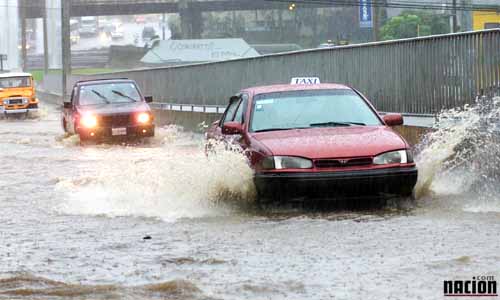
But, yesterday, did it rain!
While
many communities have a high risk of flood in
the rainy station, in the Central Valley at
least 30 location had problems yesterday
afternoon/evening when the first great heavy
rains of the season fell.
One of the hardest hit areas in
San José was in front of San Pedro Mall,
where the road became a river as the storm
sewer system could not handle the tremendous
downpour. |
Foto: Carlos
Borbón/ La Nación.
Click
here to see large foto.
|
|
|
|
Founder's Passion Is Helping
Youths
Ken Kay was doing
his best to look unruffled.
At the headquarters of World Wide
Association of Specialty Programs and Schools, in an
office complex the same rusty red as the southern
Utah hills, the phone rang incessantly Friday.
On the line were parents and
reporters from across the country, clamoring for
news about the confusing events taking place at the
Academy at Dundee Ranch in Costa Rica. Calls also
flooded in from the ranch, as staff sent garbled
messages about the fate of director Narvin Lichfield
and the status of the school.
[full
story]
Drop
in fertility
In Costa
Rica, women ages 15 to 45 gave birth to an average
2.1 children last year.
Just 10 years ago, the average was above 3 babies
and, further back, in 1980, for example, the figure
was 4, according to the Central American Population
Center.
The downward trend accelerated, unexpectedly in
2002, when the 2.1 average came as a surprise,
because demographic forecasts set that figure for
three years later.
On the other hand, of the 71,144 births recorded
last year, 12,670 (over 20 percent) were to
foreigners.
Also, according to the data available at the time of
birth, more children were born to single mothers,
37,728, as compared to 31,567 children of married
women.
Tropical
studies
It all
started with one idea, studying, researching, and
rationally using the bio-diversity of the
tropics.
The University of Costa Rica and six other
higher-learning institutions from the United States
joined to establish the Organization for Tropical
Studies (OTS), that is now 40 years old.
Scientists from 65 universities around the world met
in San Jose to commemorate the anniversary. "We
are the world's largest organization dedicated to
studying the bio-diversity of the tropics,"
claimed OTS Costa Rica director Jorge Jimenez.
The claim is validated by more than 5,000 graduates
from the OTS programs and over 1,000 research
projects that are developed under the organization
every year. Along these four decades, the OTS has
developed three biological stations, where 1,000
researchers work throughout the year.
The stations are La Selva, in Sarapiqui; Palo Verde,
in Guanacaste; and Las Cruces in San Vito de Coto
Brus.
Organic
products
European
consumers pay up to 30 percent more for Costa Rican
organic products, while several nations are drafting
legislation to promote the consumption of such
goods.
This is to the advantage of Costa Rican growers,
particularly now that the European Union has
acknowledged the local organic certificates, which
cost $4,000 a year, as compared to the $20,000 that
cost those issued in Europe and which were the only
valid ones until now.
Costa Rica thus joined a very exclusive club of
nations, that includes only Argentina in Latin
America, and the Czech Republic, Hungary, Israel,
and New Zealand at world level.
The acknowledgement implies that bananas,
blackberries, pineapples, mangoes, and other Tico
produce can be certified in Costa Rica and access
the 15 nations of the European Union under that
label.
|

|
Brazil's
Lula to Seek Seat for Cuba at Next
Rio Group Summit
Brazilian
President Luiz Inacio Lula da
Silva said he will ask members of
the Rio Group of 19 Latin American
nations to allow Cuba's presence
at the organization's annual
summit next year in Brazil.
The
Rio Group, which serves as a forum
for cooperation among members, has
excluded Cuba since its creation
in 1986.
``Since
the next meeting is in Brazil, I
plan to consult all members of the
Rio Group so that Cuba could take
part, at least as a special guest,
in our meeting,'' Lula, a former
union leader, said in a press
conference at the end of this
year's Rio Group summit in Cuzco,
Peru, 1,165 kilometers (725 miles)
southeast of Lima.
In
the two-day Cuzco summit, Rio
Group presidents agreed in to
support an accord between
Venezuelan leader Hugo Chavez's
government and the opposition for
a referendum. Presidents also
called for the United Nations to
push rebels to join peace talks in
Colombia.
The
Rio Group includes Argentina,
Bolivia, Brazil, Chile, Colombia,
Costa Rica, Dominican Republic,
Ecuador, El Salvador, Guatemala,
Guyana, Honduras, Mexico,
Nicaragua, Panama, Paraguay, Peru,
Uruguay and Venezuela.
The
group doesn't have a permanent
headquarters office and only works
around annual presidential
meetings
Disease
threatens people and palms
Lethal
Yellowing Disease (LYD) has ripped through the
Caribbean coast of Central America, destroying
the major species of coconut palm in its path.
It is also wiping out the livelihood of the
Garifuna people who populate the Caribbean
coastal regions of Belize, Guatemala, Honduras
and Nicaragua. LYD is a phytoplasma whose
organism is thought to behave like a primitive
virus.
"The
disease is uncontrollable," said
Guillermo Cruz, director of the International
Body of Regional Plant and Livestock Health (OIRSA)
in Honduras. Where it has arrived, the disease
has killed all of the Atlantic Tall palms in
its path. The tree is the most abundant palm
in Honduras and the one that yields the
highest quality coconut. There is no effective
cure for the disease and the palms die three
to six months after the appearance of the
first symptoms. The Garifuna export the
Atlantic Tall’s coconut and use it
themselves to make bread, sweets, and oil.
They also use the tree’s leaves as roofs for
their houses.
On the
Guatemalan Caribbean Coast, Myndus crudus, the
insect that carries LYD, has visited with a
vengeance. The leafhopper bug feeds on an
infected palm and ingests the LYD phytoplasm,
after which it infects other palms that it
feeds on. The infectious agent can only be
spread by the insect, which metabolizes the
organism and makes it transferable. Scientists
who tried injecting active LYD phytoplasm into
healthy palms found that the disease never
appeared.
Statistics from
Guatemala’s Ministry of Agriculture,
Livestock and Nutrition (MAGA) indicate that
losses from LYD amount to one-third of the
country’s total annual production — 15,800
metric tons of coconut grown on 4,188
hectares.
Growers have
tried cross breeding different coconut palms
to try to develop a species that does not
contract LYD. They thought they had found the
solution with the Maypan, a cross between a
Malayan and a Panama tall palm. While the
Maypan was originally considered to be
somewhat resistant to LYD, they soon found out
otherwise and, today, there is still no palm
that offers any reliable resistance to the
disease.
MAGA is working
to find or develop a resistant native variety
of Guatemalan palms. "We believe that it
is easier to create a resistant variety
locally than to try other hybrids," said
the ministry’s coordinator, Mario Aldana.
The government plans to spend the equivalent
of about US$500,000 over the next five years
to find a substitute and begin the replanting
process.
|
|
|