| NEWS |
|
updated by 7:00 a.m. CST each day
|
More Troubles for
Pacheco:
Minister of the Presidency Affirmed No Sell Out to
Political Favors
Minister of the Presidency, Ricardo Toledo,
affirms that "Nobody purchases anybody in this administration
for a political favors and if they have given money,
they are persecuted with no concern the consequences...".
His comments are with respect to the raid of the
homes of two Orientals and one Salvadoran, who
according to reports, evaded the state treasury of
paying 5.100 Million Colones in taxes, and who are
reported to have given 27 Million Colones in
donations to the President Pacheco's campaign.
The minister of Public Security, Rogelio
Ramos, informed that these 3 people left the country in commercial flights 2 days ago. The
Oriental left for Canada, while the Salvadoran
for his home country of El Salvador.
There exists the possibility that someone
informed the three that they were going to be
detained by the authorities? "The were
well informed of the raid", said Ramos.
Minister Toledo suspects that there was leak
of information, rather than favors being
repaid. He wants to form an commission to
investigate the situation.
Toledo added that President Pacheco will not
talk about the subject, when asked about the
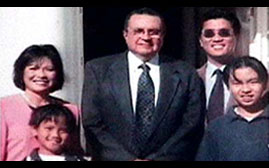
existence of photographs of Pacheco with the
Oriental family. He said that, "it is
possible that there photos with Pacheco,
anyone can have photos with the
president".
|
|
He also offered that
there exist photos of the Oriental family with
ex-presidents Rafael Angel Calderón, Jose Maria Figueres and Miguel Angel Rodriguez.
The case is into the hands of the INTERPOL, but, the process is slow.
|
|

Click
here a FREE quote on the lowest Air Tickets Prices
to and from Costa Rica!
|
|
US authorities arrest teenage computer virus suspect
US authorities arrested an 18-year-old teenager Friday, who was suspected of creating a version of "Blaster", the Internet worm that infected hundreds of thousands of computers worldwide.
The teenager was identified by a court official as Jeffrey Lee Parson, of Hopkins, Minnesota, The Associated Press said in a report.
In an interview with the Federal Bureau of Investigation (FBI) agents, Parson admitted modifying the original "Blaster" worm and changing it into a more vicious variant known as the
"Blaster.B".
According to court papers, Parson told the FBI that he built into his version a method for reconnecting to victim computers later, and infected computers automatically registered themselves with Parson's Web site so he could keep track of them.
Since their emergence on Aug. 11, different versions of the "Blaster" worm have infected more than 500,000 computers around
the world, said Symantec Corp., a security software company.
The computer virus targeted a flaw in recent versions of Microsoft's Windows operating systems. Infected computers were programmed to automatically launch an attack against a Web site run by Microsoft to deliver repairing software patches.
Carter Center to keep policy for Venezuela
US institution Carter Center agreed on Friday to continue "facilitating" the contacts and accords between the Venezuelan government and opposition to solve their political and social differences.
Jennifer McCoy, the representative of the center founded by former US President Jimmy Carter, announced here the acceptance
of the group at the request of the government of President Hugo Chavez and the opposition.
She made the remarks following talks with Vice President Jose Rangel on the new electoral authorities, which the Supreme Court temporarily appointed on Monday.
The new electoral authorities will leave the post when the congress appoints the directors of the National Electoral Council (CEN), according to the Supreme Court which made the provisional appointment to make up for the lack of legislative agreement in the selection of the officials.
The Carter Center, a private institution, participated with other international organizations as "mediator" in the talks at the beginning of the year between the government and the opposition, which ended in May with an agreement to carry out a referendum to determine the continuity in office of several officials.
The so-called "binding referendum" was pushed by the
opposition through the presentation, before the new electoral authorities,
of thousands of signatures of individuals who want the ousting of President Hugo Chavez.
The referendum is the third attempt by Chavez's opponents to oust him after a failed coup in 2002 and a general strike earlier this year, which crippled the oil industry of the world's fifth oil exporter.
|
|
|