|
Chile
agreement expands free-trade in Americas
The US Senate
easily approved a new free trade agreement with
Chile Thursday, a major step forward in the United
States' goal of eliminating trade barriers
throughout the Americas.
Senators also signed
off on a free-trade pact with Singapore, a coup for
the Wm. Wrigley Jr. Co., which has been salivating
for the chance to resume selling chewing gum in that
city state.
Demonstrating its
traditional friendliness toward trade deals, the
Republican-led Senate voted 66-31 to make Chile the
first South American nation to enjoy a free-trade
agreement with the United States. The Senate
approved the Singapore pact 66-32.
The GOP-controlled
House passed identical legislation last week.
President Bush now is expected to sign the two bills
into law within the next few weeks.
The two free-trade
agreements, argued Sen. John Cornyn, R-Texas, will
be "good for American markets, American
businesses and American workers."
Democrats voiced
concerns about provisions that would allow 1,400
workers from Chile and 5,400 from Singapore to come
into the United States annually, arguing the bills
mixed trade with immigration policy.
When signed by the
president, these bills will bring to six the number
of countries enjoying free-trade agreements with the
United States.
Canada and Mexico
already have that status under the North American
Free Trade Agreement, while the United States also
has agreements with Israel and Jordan.
The administration is
currently holding talks with Costa Rica, El
Salvador, Guatemala and Nicaragua with the hope of
agreeing to terms for a new U.S.-Central American
Free Trade Agreement by the end of the year.
Trade negotiators are
slated to provide an update Friday.
Peru still looking forward to Fujimori's extradition: FM
Peruvian Foreign Minister Allan Wagner said Friday that his government is still looking forward to the extradition of former president Alberto Fujimori, dismissing reports that Japan has rejected Peru's request for the extradition.
Reports said that a Japanese official reiterated on Thursday that Japan would not extradite Fujimori, who holds dual citizenship of Japan and Peru.
"The remarks of the Japanese official mean, in general, Japanese law does not allow the extradition of the citizens of Japan," said Wagner, adding that such comments had been distorted by the press.
"The Peruvian government hopes Japan ... to proceed with the extradition of Mr. Fujimori," Wagner said.
A 700-page extradition request was submitted to the Japanese Foreign Ministry by Peruvian Ambassador to Japan Luis J. Macchiavello on Thursday.
After 10 years in office, Fujimori fled to Japan, his parents' country in November 2000.
Although the Peruvian government has charged Fujimori with abandonment of office, embezzlement of public funds, homicide and violation of citizens' communications privacy, Thursday's extradition request applies only to the murder charges.
On Thursday, Fujimori, 65, denied all charges, saying that "there is not a single line of proof" in the extradition request presented by Peru.
US releases pictures showing Saddam's possible new looks
The US Central Command released five digitally enhanced pictures of Saddam Hussein showing his new appearances if he is in disguise.
The pictures, made by the Pentagon, show Saddam's different looks, with a beard, white hair, gray hair, a trimmed mustache and one with a traditional Arab
headress.
Central Command spokesman Ryan Fitzgerald said that the military began from Thursday to distribute the pictures to US troops in Iraq searching for Saddam.
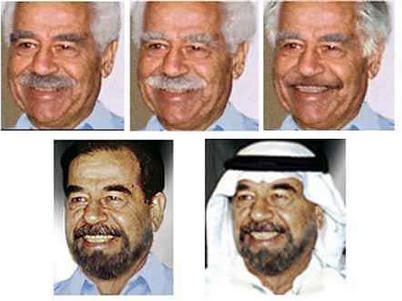
He said the pictures would help the troops recognize Saddam if he tries to change his appearance to elude capture.
Fitzgerald said the bodies of Saddam's sons Uday and Qusay showed that they had been trying to alter their appearances through growing different beards and other means, so Saddam may also follow suit.
The US Central Command posted the digitally altered photographson its website.
Since Uday and Qusay were killed in a raid on July 22, US troops in Iraq have intensified their hunt for Saddam Hussein.
A US official, speaking on condition of anonymity, said the Central Intelligence Agency also has made separate images depicting what Saddam might look like after three months on the run.
|


