Nearly 4.5 tons of cocaine seized in Colombia
Colombian police seized nearly 4.5 tons
of cocaine in the northwestern shores of the country
on Friday and the drug belonged to a paramilitary
commander of the region, authorities said.
|
Today's Stories:
 Nearly
4.5 tons of cocaine seized in
Colombia Nearly
4.5 tons of cocaine seized in
Colombia
Spanish
FM visits Colombia to "update"
ties
Venezuela
would never be a US colony:
Chavez
18
countries join in anti-doping
campaign
|
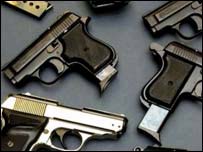
Brazil gun amnesty nets huge
haul - A Brazilian woman
in Sao Paulo has handed almost
1,300 firearms to the
authorities, claiming $65,000
under a government disarmament
scheme.
The woman, whose cache ranged
from muskets to mortar shells,
told police her late father was
a gun collector.
The haul was collected from her
home in a heavily-armed police
truck.
More than 7,000 weapons have
been surrendered across Brazil
since the campaign launch last
week, in which the government
pays citizens for weapons.
According to the United Nations,
Brazil has the world's
fourth-highest murder rate, with
40,000 gun-related murders last
year.
Under the scheme, payments range
from $33 for a pistol to $100
for an assault rifle.
Anyone can hand in a weapon
before the end of the year
without fear of being questioned
or charged with illegal
possession.
|
|
|
"It is a very large cargo that was seized there," National Police
Commander, general Jorge D. Castro, told the local television
network RCN.
He added that the seizure carried out at the rural area of the
municipality of Necocli, some 500 kilometers northwest of Bogota,
could be one of the largest "in the history of Colombia."
According to the police chief, the drug belonged to a paramilitary
commander identified as "El Aleman" (The German), an alias used by
Jose Alfredo Berrio, chief of Block Elmer Cardenas, a division of
the armed group of United Self-Defense Forces of Colombia (AUC).
The paramilitaries had presumably tried to ambush the policemen in
the Cordoba state on their way to seize the drug. Some 4,420 kgof
cocaine kept in a hideout were seized and one suspect was captured
during the operation.
Block Elmer Cardenas is outside the peace negotiations between the
AUC and the government of President Alvaro Uribe.
United States, the principal provider of funds in the war on drug in
the Andean region, has expressed concern over the Colombian
government's negotiations with the AUC, citing the close links of
the illegal armed group with international drug trafficking.
In addition to this haul, anti-narcotics police agents also seized a
ton of cocaine on Thursday hidden in an power plant in the region of
Yumbo, southwest of Bogota. The cargo, valued at 20 million US
dollars, was to be shipped to the United States.
According to authorities, the drug might belong to one of the top
leaders of the paramilitary group of Norte del Valle Cartel, which
operates side by side with the paramilitaries of the AUC.
Spanish FM
visits Colombia to "update" ties
Spanish Foreign Minister Miguel Angel Moratinos arrived here Friday
for a brief visit to "update" the bilateral relations.
Moratinos, on an America tour that included stops in New York and
Brasilia, was accompanied by a parliamentary delegation composed of
representatives from almost every party. senior government officials
said.
In addition to meeting with Colombian President Alvaro Uribe and,
the Spanish diplomat will also meet with his Colombian counterpart,
Maria Carolina Barco Isackson, and Vice President Francisco Santos,
senior government officials said.
Madrid considers it necessary to "re-evaluate" its military
cooperation with Colombia "in the regional context," in such a
waythat other needs of the Andean country, like the defense of human
rights and the combat against drug traffic, could be attended.
The previous government of Spain headed by Jose Maria Aznar had
agreed to sell Colombia under favorable conditions eight CX-212
planes and nearly 40 AMX-30 tanks, but the deal was suspended
withthe taking office of the new government led by the Spanish
Socialist Workers Party.
Uribe announced last week that he wished the Spanish government
would change the sale of tanks for something "more useful."
Moratinos will present a message to the Colombian authorities from
Spanish Prime Minister Jose Luis Rodriguez Zapatero, in support of
the policies driven by Uribe "to consolidate the rule of law all
over the territory of the country, with a full respect of human
rights and fundamental liberties."
In addition, he will convey the needs of the Spanish investors in
the Colombian market and highlight the importance of an environment
favorable to increasing the presence of Spanish capital in the
Andean country.
Venezuela
would never be a US colony: Chavez
Venezuelan President Hugo Chavez told visiting Argentine President
Nestor Kirchner Friday that his country will never be a colony of
the United States.
"We are determined to remain free and we won't ever be a US colony,"
Chavez said at the welcoming ceremony in Puerto La Cruz, Venezuela's
oil-producing state of Anzoategui.
According to reports, Kirchner arrived in Venezuela after visiting
Bolivia, Latin America's largest reserve of natural gas, to discuss
energy cooperation.
Chavez, whose term will be subject to a recall referendum promoted
by the opposition, said Venezuelans are debating about the country's
future and that "the situation is simple, we debate whether
Venezuela will continue being a truly free homeland or it will
become a US colony."
"Our freedom and potential will help us to unite and make the
continent united, free and sovereign forever," he said.
During his meeting with Kirchner, Chavez also highlighted the recent
entry of Venezuela into the Common Market of the South (Mercosur) as
an associate member.
"We belong to Mercosur, a strategic alliance that will make us
free," he said.
Reports said that Kirchner also has plans to reach an agreement on
hydrocarbon resources with Venezuela, the world's fifth largest
exporter of crude, and will discuss another one with Venezuela on
tourism.
Kirchner and Chavez are expected to attend the closing ceremony of a
meeting of 600 businessmen of the two countries at the Venezuelan
island of Margarita.
18 countries
join in anti-doping campaign
Representatives from 18 countries accorded to join efforts in their
combat against doping within the framework of the meeting of Latin
America, Spain and Portugal Sports Council (CID).
The delegations issued a document called Declaration of Cartagena de
Indias Against Doping.
Spain's Jaime Lissavetzky, CID Chairman, underscored that this was
the first time a declaration of such importance is issued in the
community formed by Latin America, Spain and Portugal. The document
will be presented to Jacques Rogge, President of the International
Olympic Committee.
The countries accorded to commit in waging an effective war against
doping. They will establish and enforce measures of prevention,
control and sanction against the traffic of doping-related products
and against the use of substances and methods banned from sports.
"CID attempts to unify the efforts of cooperation in order to make
this goal to have the greatest possible efficiency," reads the
declaration.
Prior to departing for Madrid, Lissavetzky said that in CID would
meet again in 2005 to present its plan of decision to harmonize the
combat against doping, conclusions that will then be presented
before IOC and the World Anti-Doping Agency.
Other issues addressed during the CID meeting was the presentation
of the new guidelines of compromise to extend and reinforce sports
programs with Latin America, Spain and Portugal, in addition to
inform the sports chiefs in Latin America.
|


